

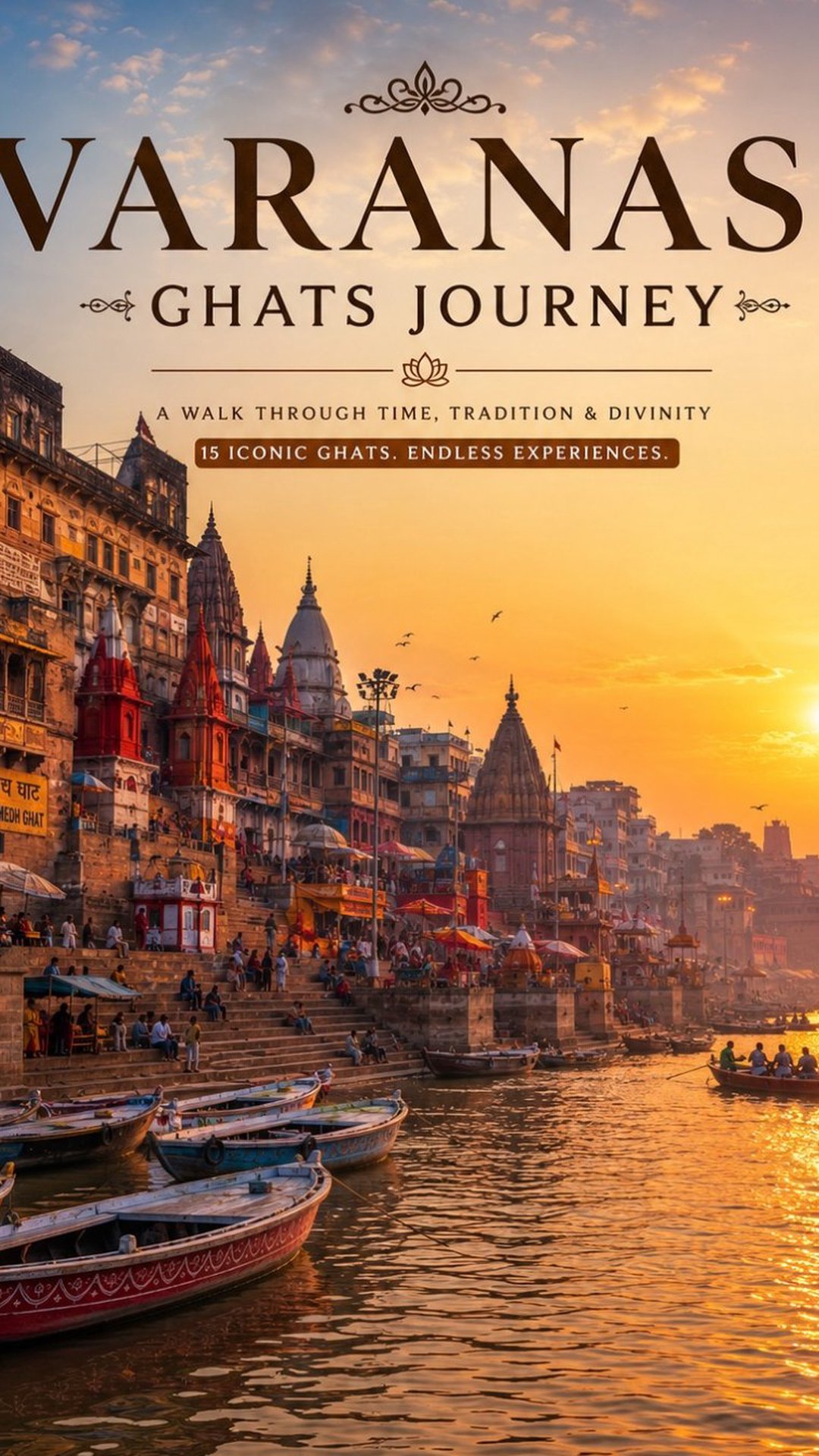
Which ghats are famous in Varanasi: The Complete Riverfront Guide
All 15 essential Varanasi ghats — Assi Ghat sunrise to Dashashwamedh Aarti to Manikarnika. Insider timing, mistakes to avoid.
There are cities you visit, and then there is Varanasi—a city you experience with every step, every sunrise, and every prayer that echoes across the sacred Ganga. This journey isn't simply about visiting famous landmarks; it's about walking through over three thousand years of living history, where every ghat has its own story, every temple carries centuries of devotion, and every moment along the river reveals a new side of India's spiritual heart.
Your experience begins at the peaceful Assi Ghat, where you'll witness the city awaken with the beautiful Subah-e-Banaras ceremony. As the first rays of sunlight illuminate the Ganga, you'll enjoy a tranquil boat ride while watching priests perform ancient rituals, locals practice yoga, and pilgrims begin their day with prayers. From here, you'll continue north along the riverfront, discovering the literary heritage of Tulsi Ghat, the quiet charm of Jain Ghat, the historic grandeur of Chet Singh Fort, and the elegant riverside architecture of Shivala Ghat, each offering its own unique glimpse into the timeless character of Kashi.
As your journey unfolds, you'll enter the spiritual heart of Varanasi, where devotion comes alive at every turn. Visit the sacred Kedar Ghat, experience the profound traditions of Harishchandra Ghat, and stand among thousands of devotees at the iconic Dashashwamedh Ghat, where the spectacular Ganga Aarti transforms the riverfront into a breathtaking display of light, music, and faith. Continue through the beautifully restored Kashi Vishwanath Corridor, connecting the holy temple to the Ganga, before exploring Man Mandir Ghat, home to one of India's oldest astronomical observatories overlooking the river.
The final chapter of your journey reveals the oldest and most sacred corners of Kashi. At Manikarnika Ghat, you'll respectfully learn about the spiritual beliefs that have shaped this city for centuries. Discover the remarkable Leaning Shiva Temple at Scindia Ghat, admire the peaceful atmosphere of Panchganga Ghat, and explore the exquisite wooden craftsmanship of the Nepali Temple at Lalita Ghat. Your experience concludes at the tranquil Raj Ghat, where the Varuna River meets the Ganga and the ancient Adi Keshava Temple marks one of the earliest sacred settlements of Varanasi.
Throughout your journey, you'll enjoy scenic boat rides, heritage walks through centuries-old ghats, visits to ancient temples, vibrant local markets, authentic Banarasi cuisine, traditional silk weaving, and unforgettable opportunities for photography. Every stop has been thoughtfully planned to reveal the city's history, architecture, spirituality, and living traditions while allowing you to experience Varanasi at a comfortable pace.
366
Route
Home
MomentAssi Ghat, Varanasi

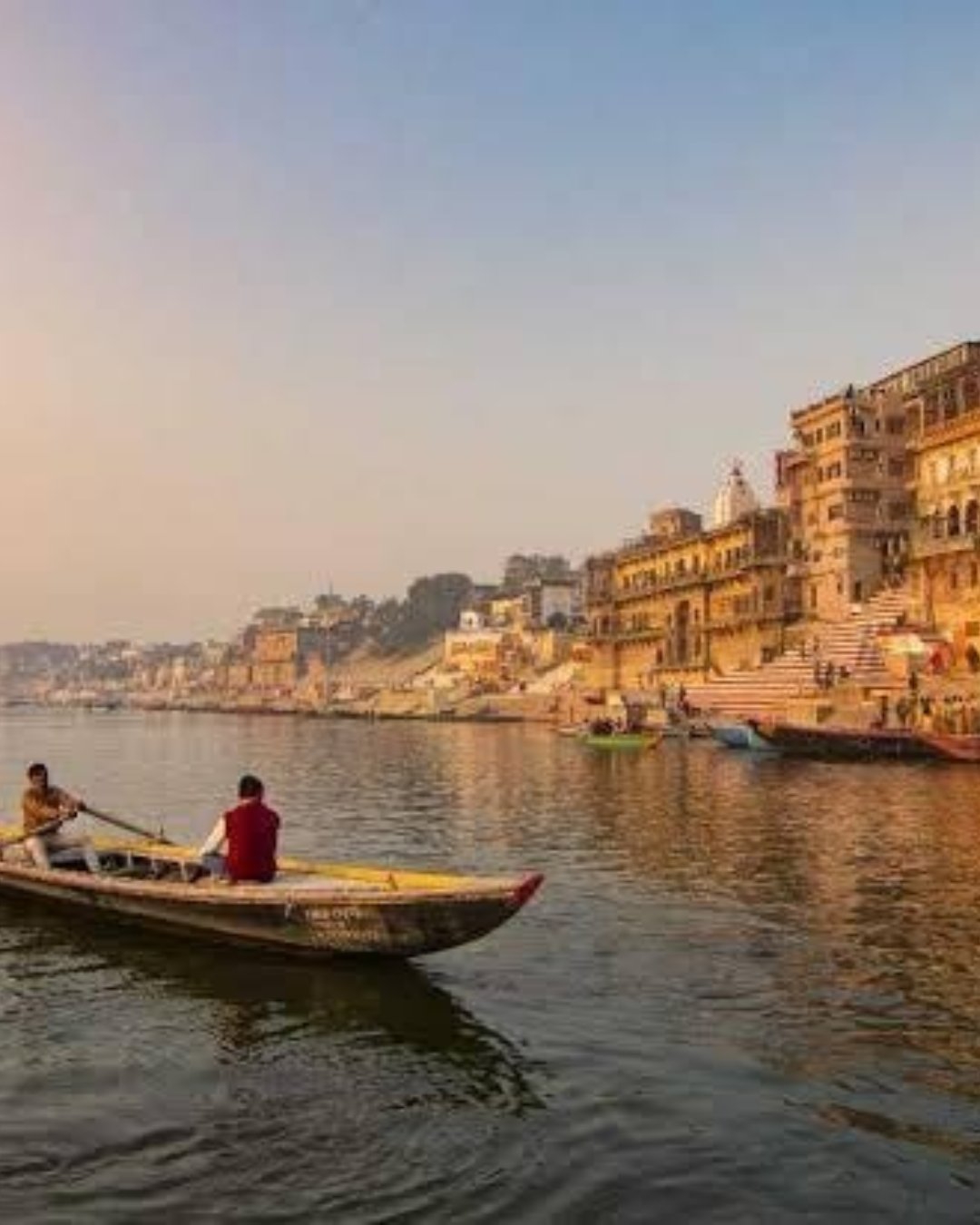
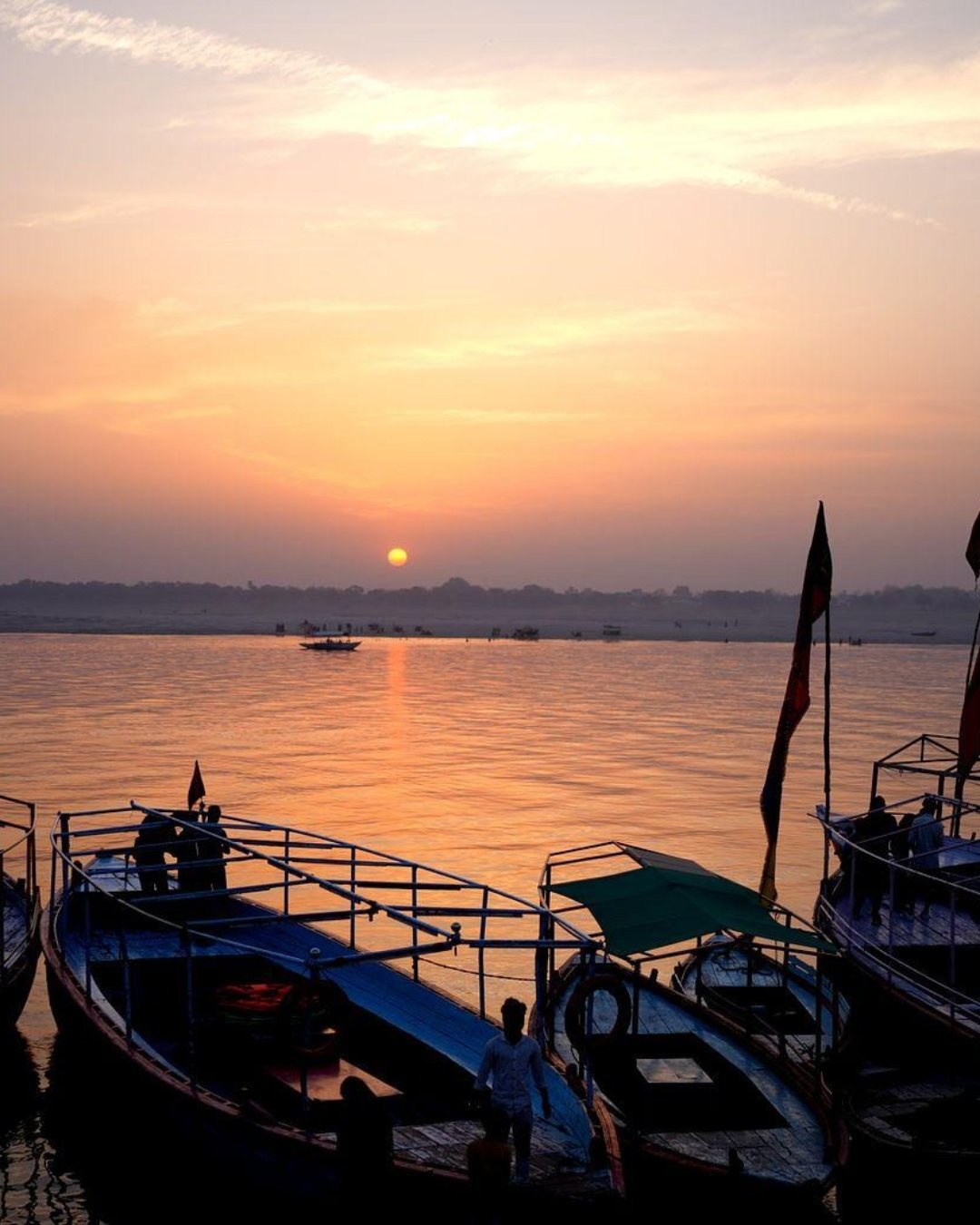
Sunrise at Assi Ghat
You've probably got Assi down as a boat launch. It's where your driver drops you at 5 a.m., where the oarsman is waiting, and where you step off an hour later on your way to breakfast. But here's the thing nobody tells you: Assi at dawn is the one ghat in Varanasi you can simply sit on—no touts working you, no crush, no ceremony to get a seat for—and almost everybody who comes here is looking at their watch, waiting to be somewhere else. You can spend two hours on these steps and never take a photo, and it'll be the part of the trip you describe when you get home.
Let's fix that. Here's how sunrise at Assi Ghat actually works, and how to get it right the first time.
Why Assi, and not any other ghat
Dashashwamedh at dawn is a scrum. Manikarnika is not somewhere to linger. Assi sits at the southern end of the ghat stretch, where the Assi stream meets the Ganga, next to the university quarter—and that changes its whole character. It's calmer, greener, wider, and it belongs to the neighbourhood rather than to the tourists.
Which means it's the one place where dawn happens around you instead of at you. Get there by about 5:15 a.m. in summer, closer to 6:00 a.m. in winter, and you'll have the steps before the day starts. The sun comes up over the far bank directly in front of you—Assi faces east across open sand, so you get the whole thing uninterrupted.
What you'll actually see
Sit halfway down the steps and let it come to you:
* The bathers — locals and pilgrims taking their morning dip, unhurried, entirely unbothered by you.
* Subah-e-Banaras — the dawn programme of aarti, yoga, and live classical music on the platform. Free, and most people don't know it runs.
* The pipal tree and the lingam — the old shrine at the top of the ghat, where Assi's own history sits.
* The everyday — chai in clay cups, students from the university, dhobis, kite strings, dogs asleep on warm stone.
Bring a light layer even in warm months—the wind comes off the water and it's cool until the sun clears the far bank.
And leave the phone in your pocket for the first twenty minutes, not the first ten. Travellers who've sat here will tell you the same thing: Assi doesn't give you one dramatic frame the way the aarti does—it gives you an hour of small things happening at once, and none of them photograph. Just watch. The light changing on the water, the chanting starting up behind you, a city of a million people waking without any noise at all—that's the part the photos never quite catch.
Pro tip: Come here after your boat ride, not instead of it. The ride ends around 6:30 a.m.; most people go straight back to the hotel and sleep. Don't—get out at Assi, buy a clay cup of chai at the top of the steps, and sit for an hour while Subah-e-Banaras plays out. It costs nothing, needs no booking, and it's the calmest hour you'll get in Varanasi. Sit on the steps rather than the platform if you want to watch the river rather than the ceremony.
The mistakes that ruin it
Most first-timers trip over the same few things. They use Assi purely as a boat jetty and never set foot on the steps. They arrive at seven, after the light and the programme have both gone. Or they stay ten minutes, decide "it's just a ghat," and miss what it actually offers.
The easy fix is to build an unhurried hour into the morning here rather than rushing back for breakfast—or let the dawn be planned as one continuous stretch, boat and ghat together.
Want the sunrise, the boat, and the ghat in one morning?
Hit Do this trip — we'll build the dawn around Assi.
111
MomentTulsi ghat B2, Varanasi

Tulsi Ghat & Tulsi Manas Legacy
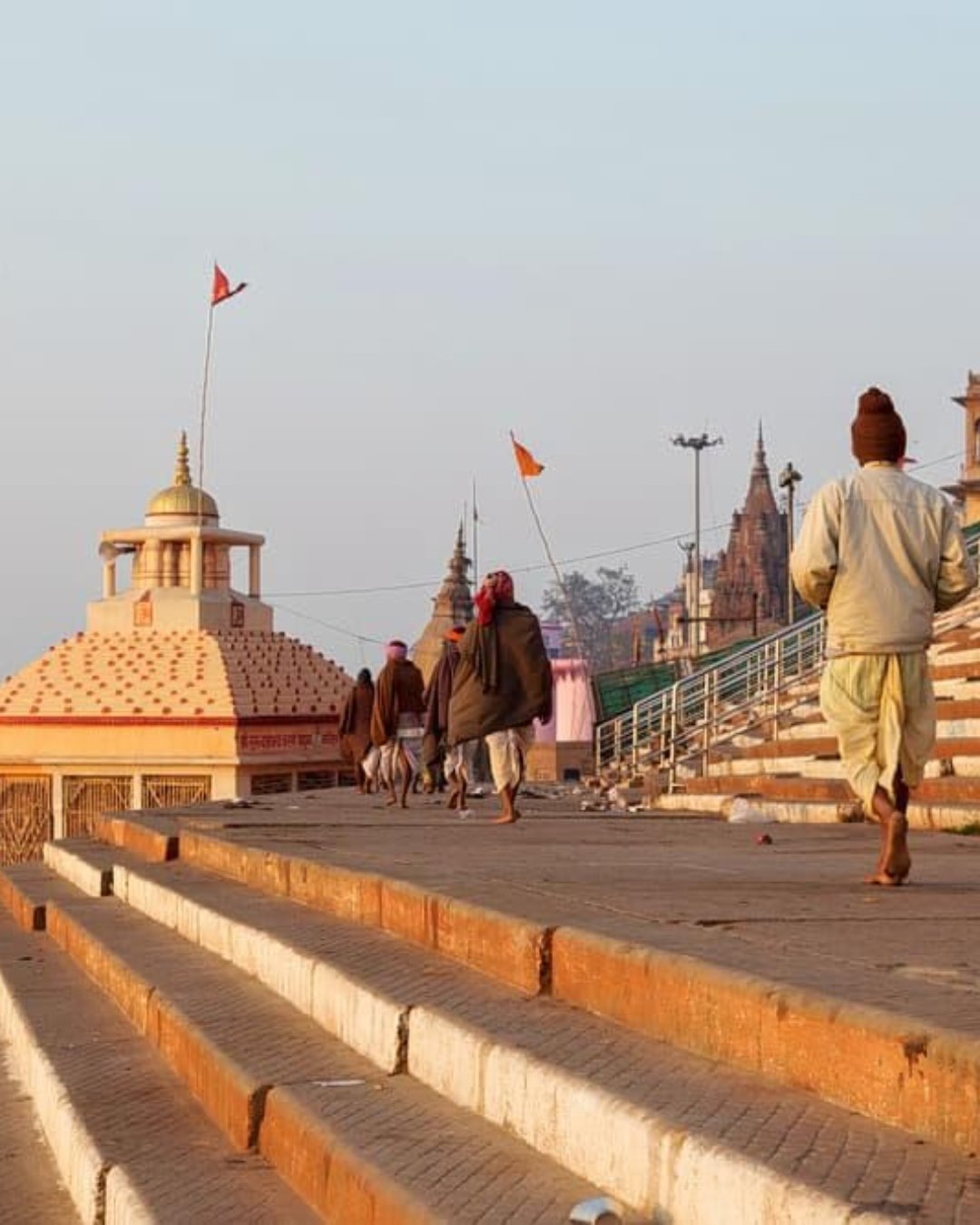
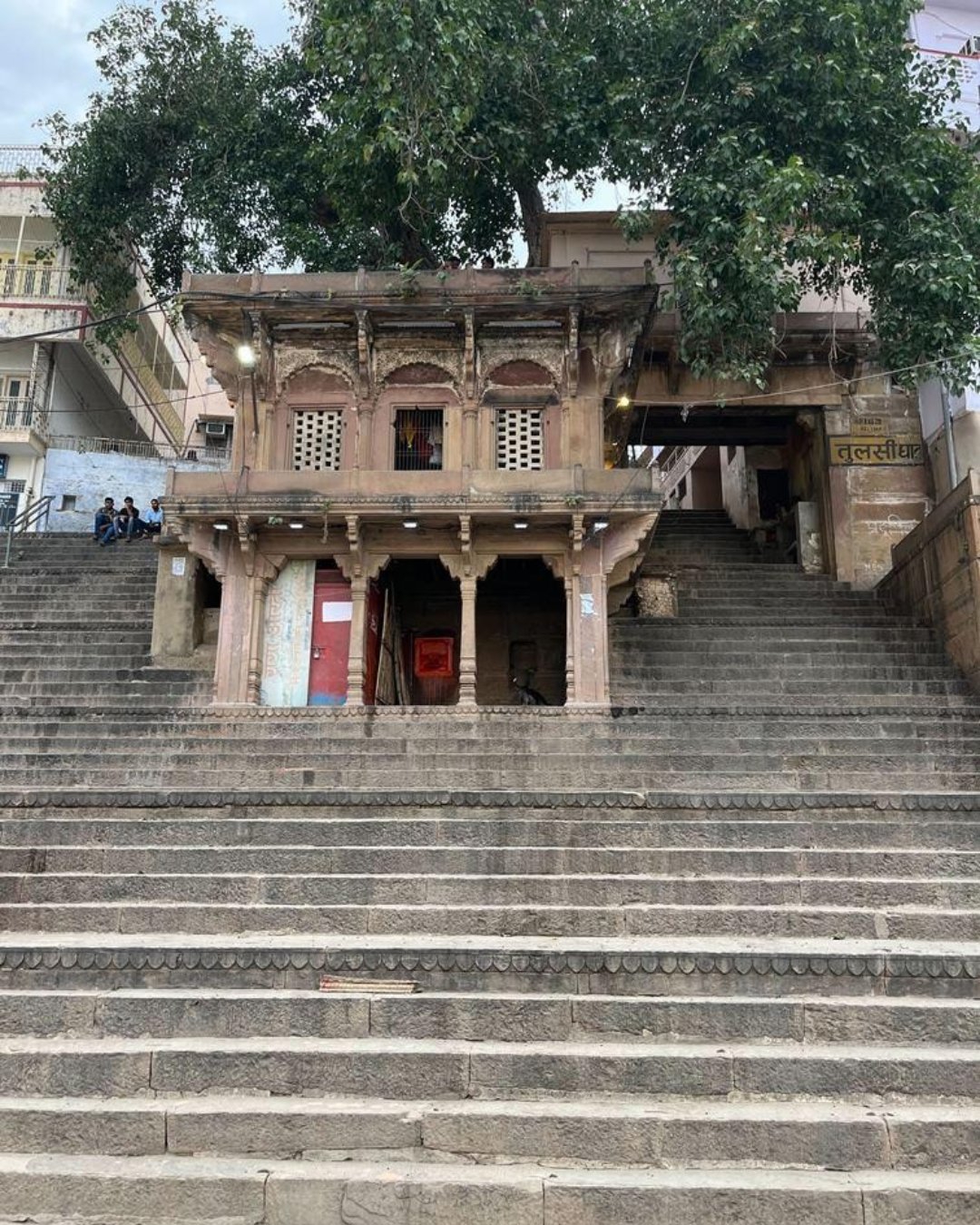
You've probably drifted past it without knowing. On the boat ride from Assi, it's the next ghat up — a steep flight of steps, some old buildings, nothing that stops you mid-sentence. But here's the thing nobody tells you: this is where Tulsidas lived and, by tradition, wrote the Ramcharitmanas — the retelling of the Ramayana in Awadhi that put Ram into the mouths of ordinary people across North India. Half a billion people know verses from a book written on these steps, and most visitors to Varanasi float straight past it looking for a photograph.
Let's fix that. Here's how Tulsi Ghat actually works, and how to get it right the first time.
Why it's a stop, not a view
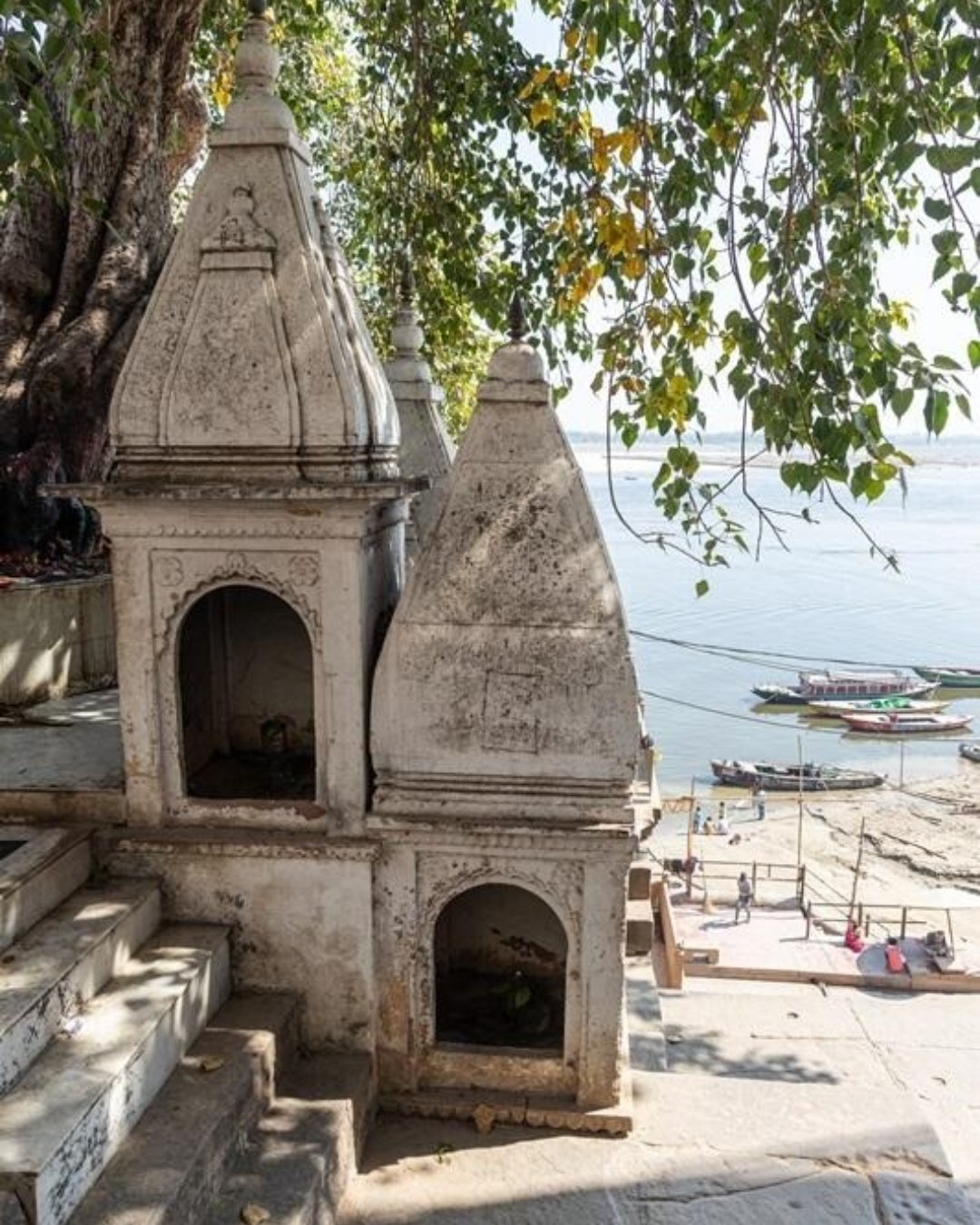
Tulsi Ghat gives you almost nothing from the water. There's no ceremony, no crowd, no dramatic frame — which is exactly why the boats don't stop and the tour groups don't come. What's here is inside: the small temple and the akhara, the old house associated with Tulsidas, his wooden sandals and manuscripts kept as relics, and a working wrestling pit that's been in use for generations.
So you come on foot, from Assi, in daylight. Ten minutes' walk along the ghats or the lane behind them, and you're at a place where something genuinely enormous in Indian literature happened, with nobody else there. Morning is best — the akhara is active early, and the light on the steps is good before the heat.
What you'll actually see
The Tulsidas Temple and relics — his sandals, and manuscripts preserved by the temple custodians.
The Akhara — a traditional mud wrestling pit, still used by pehelwans who train here at dawn.
The historic ghat steps — steep stone steps leading down to the Ganga, marking the beginning of Varanasi's southern ghat stretch.
Lolark Kund — the ancient stepped water tank nearby, famous for the annual Lolark Chhath festival and its centuries-old fertility rituals.
Dress modestly and wear footwear that's easy to remove — you'll need to go barefoot inside the temple, and the stone steps can be steep and slippery.
And put the phone away entirely for this one. Travellers who make the walk will tell you the same thing: there's nothing here that photographs — no grand vista, no elaborate ceremony, just old rooms and worn stone. What stays with you is the quiet realization that you stood where one of India's most influential literary works was created. That's the part no photograph can truly capture.
Pro tip: Always ask before photographing the relics or the wrestlers. This isn't a museum — it's a living temple and an active akhara, and permission is usually granted if you ask respectfully. Visit early in the morning to watch the pehelwans during practice. If you're visiting during Bhadrapada (roughly August–September), don't miss the vibrant Lolark Chhath festival at nearby Lolark Kund, though expect much larger crowds.
The mistakes that ruin it
Most first-time visitors make the same few mistakes. They only admire Tulsi Ghat from the boat and never step ashore. They arrive without knowing its incredible literary significance, making it seem like just another riverside staircase. Or they visit in the afternoon when the akhara is quiet and the temple may be closed during the midday break.
The easy fix is to walk here from Assi Ghat in the morning and take time to understand the story behind the place. Without the history, it's simply another ghat. With the history, it's one of Varanasi's most remarkable cultural landmarks.
Want the walk, the temple, and the story explained?
Hit Do this trip— we'll and Tulsi to the morning route.
92
MomentJain ghat, Varanasi

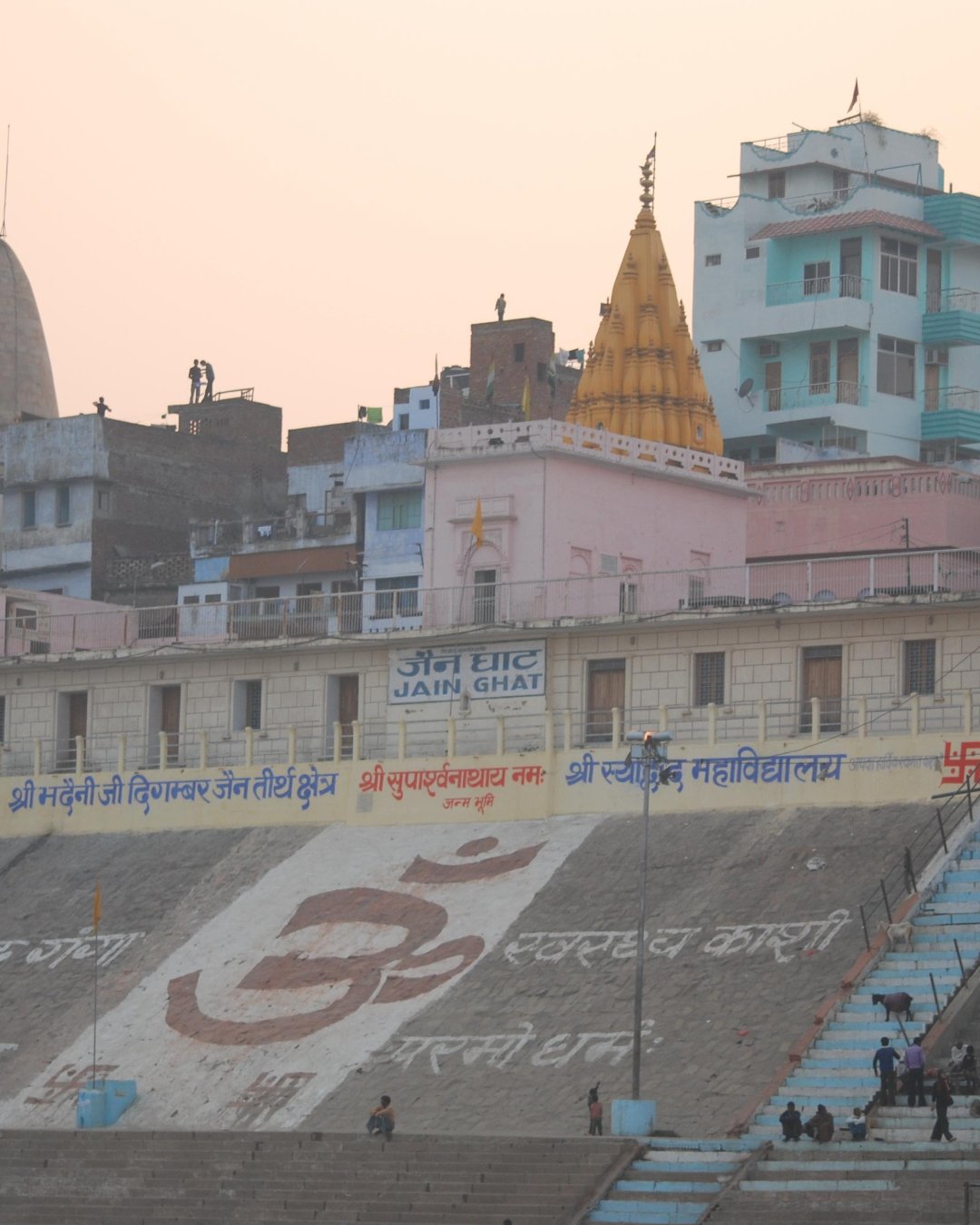
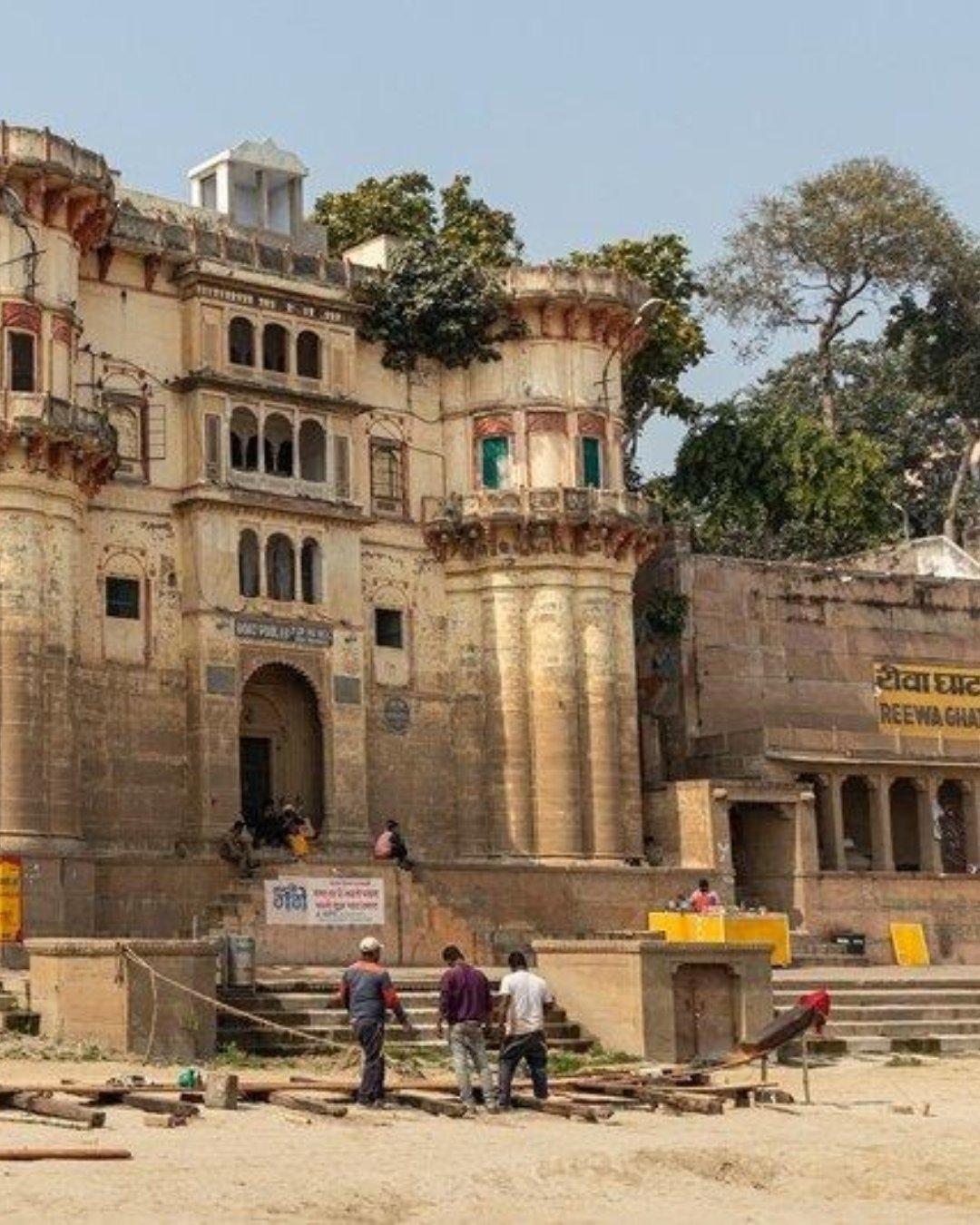
Jain Ghat & Rewa Ghat Walk
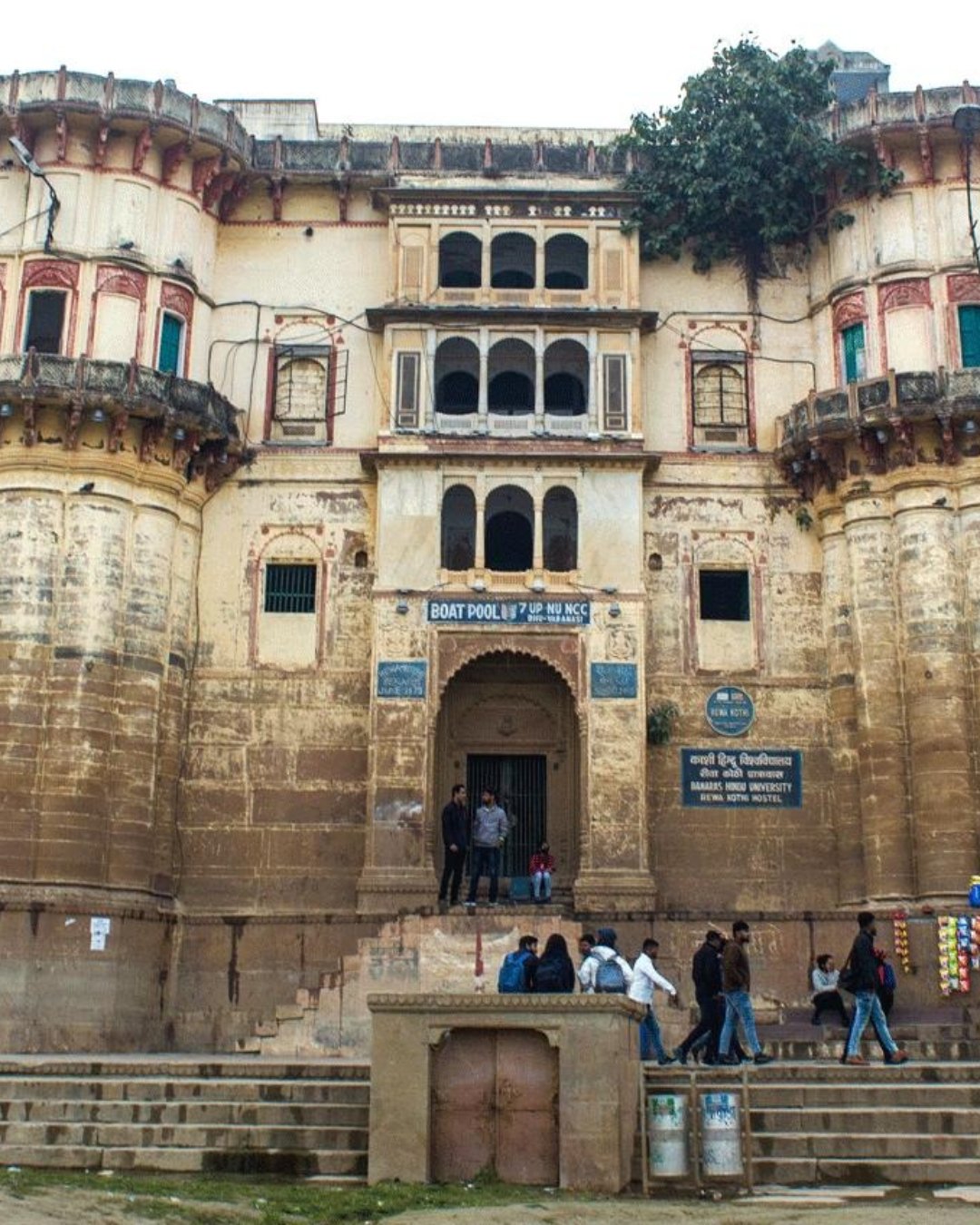
You've probably never heard either name. They're two ghats in the southern stretch that your boatman rows past without comment, on the way from Assi to the famous ones. But here's the thing nobody tells you: Varanasi isn't only a Hindu city, and this short strip is where that shows. Jain Ghat marks the birthplace of a Tirthankara, and Rewa Ghat carries the old Rewa state's palace above it — and the boats keep moving because nobody thinks to ask.
Let's fix that. Here's how Jain Ghat and Rewa Ghat actually work, and how to get it right the first time.
Why you walk this stretch instead of floating it
These two are quiet by nature. There's no aarti, no cremation fire, no crowd — nothing that reaches you from thirty metres out on the water. From a boat they're a wall of steps and old buildings, indistinguishable from the ten either side.
On foot they separate out. Jain Ghat is tied to Bhelupur and the Jain community — tradition places the birth of Parshvanatha, the twenty-third Tirthankara, in this part of Varanasi, and the temple above the ghat marks it. Rewa Ghat is named for the Maharajas of Rewa, who built the riverside palace overlooking the ghat — one of the many princely residences that define the southern riverfront. Walk here from Assi in the morning, when the lanes are quiet and you have time to appreciate the history beyond the river.
What you'll actually see
Half an hour, no tickets, no queues:
The Jain Temple — a peaceful temple above the ghat associated with Lord Parshvanatha, offering a calm contrast to the city's bustling Hindu temples.
Rewa Palace — the historic riverside residence of the Maharajas of Rewa, standing gracefully above the ghat.
The southern riverfront skyline — one of the finest surviving stretches of princely architecture along the Ganga.
Assi Ghat and Tulsi Ghat — both within easy walking distance, making this a rewarding heritage walk through Varanasi's quieter side.
Wear footwear that's easy to remove for the temple, dress modestly, and remember that Jain temples may have restrictions on leather items such as belts, wallets, or bags.
And keep the phone down and your voice low inside the temple. Travellers who take this walk often say the same thing: after the energy of Kashi's Hindu temples, the quiet atmosphere of a Jain shrine feels completely different. That sense of stillness, in one of India's busiest spiritual cities, is something no photograph can truly capture.
Pro tip: Walk the southern ghats in one continuous route — Assi → Tulsi → Jain → Rewa — during the morning. In about ninety minutes you'll experience one of the most peaceful stretches of the Varanasi riverfront. Ask before taking photographs inside the temple or of people at prayer, and check the temple's opening hours before you set out.
The mistakes that ruin it
Most first-time visitors make the same few mistakes. They only see these ghats from a boat and never step ashore. They visit the temple wearing shorts or carrying leather items and are turned away. Or they assume the southern ghats are less interesting than the famous central ones and skip them altogether.
The easy fix is to explore this stretch on foot in the morning with someone who can explain the stories behind each landmark. Without the context, it's simply another set of ghats. With it, the walk becomes one of Varanasi's most rewarding heritage experiences.
Want the southern ghats walk with someone who knows the lanes?
Hit Do this trip**** — we'll map the morning.
81
MomentChet Singh Ghat Varanasi, Varanasi

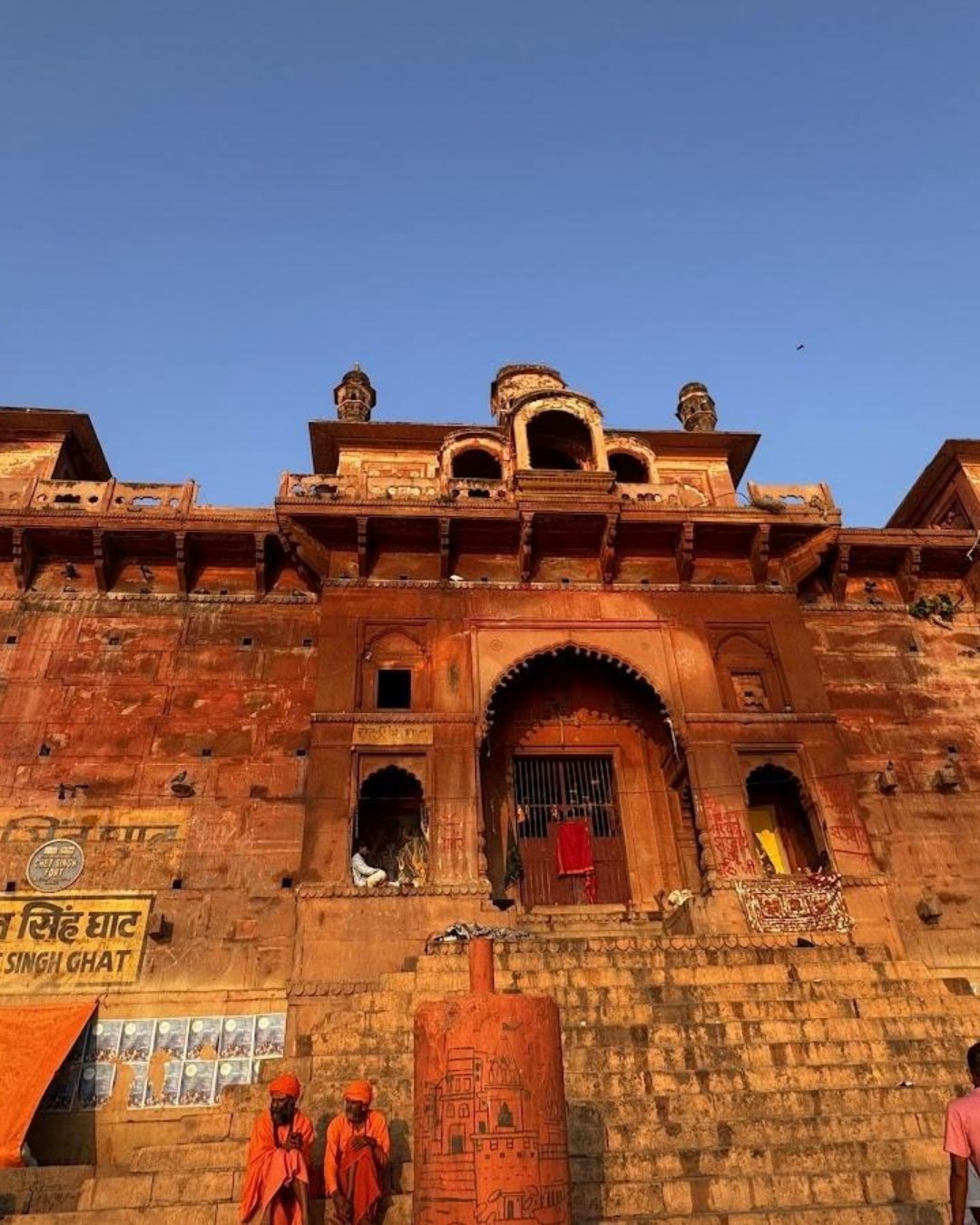
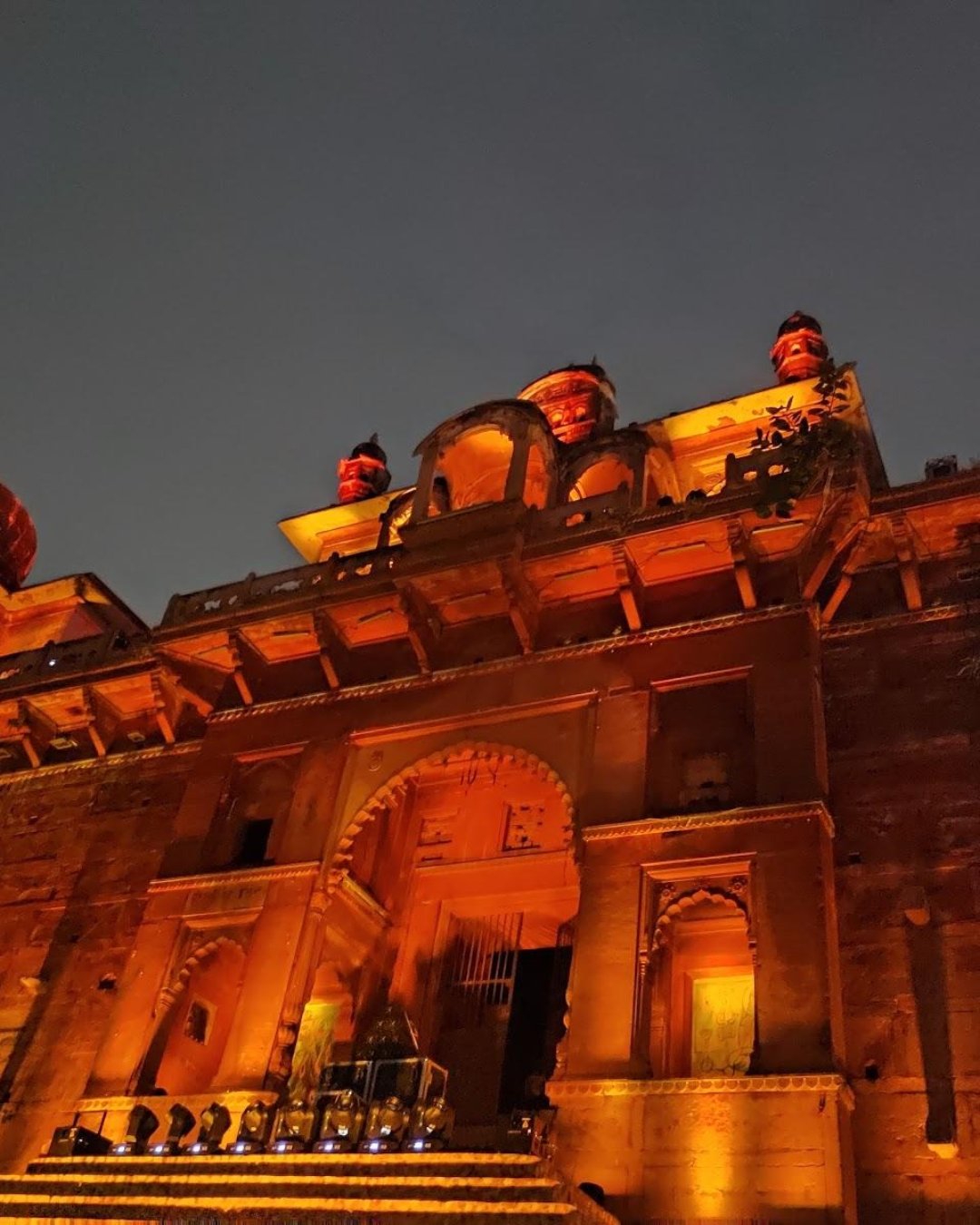
Chet Singh Ghat Fort
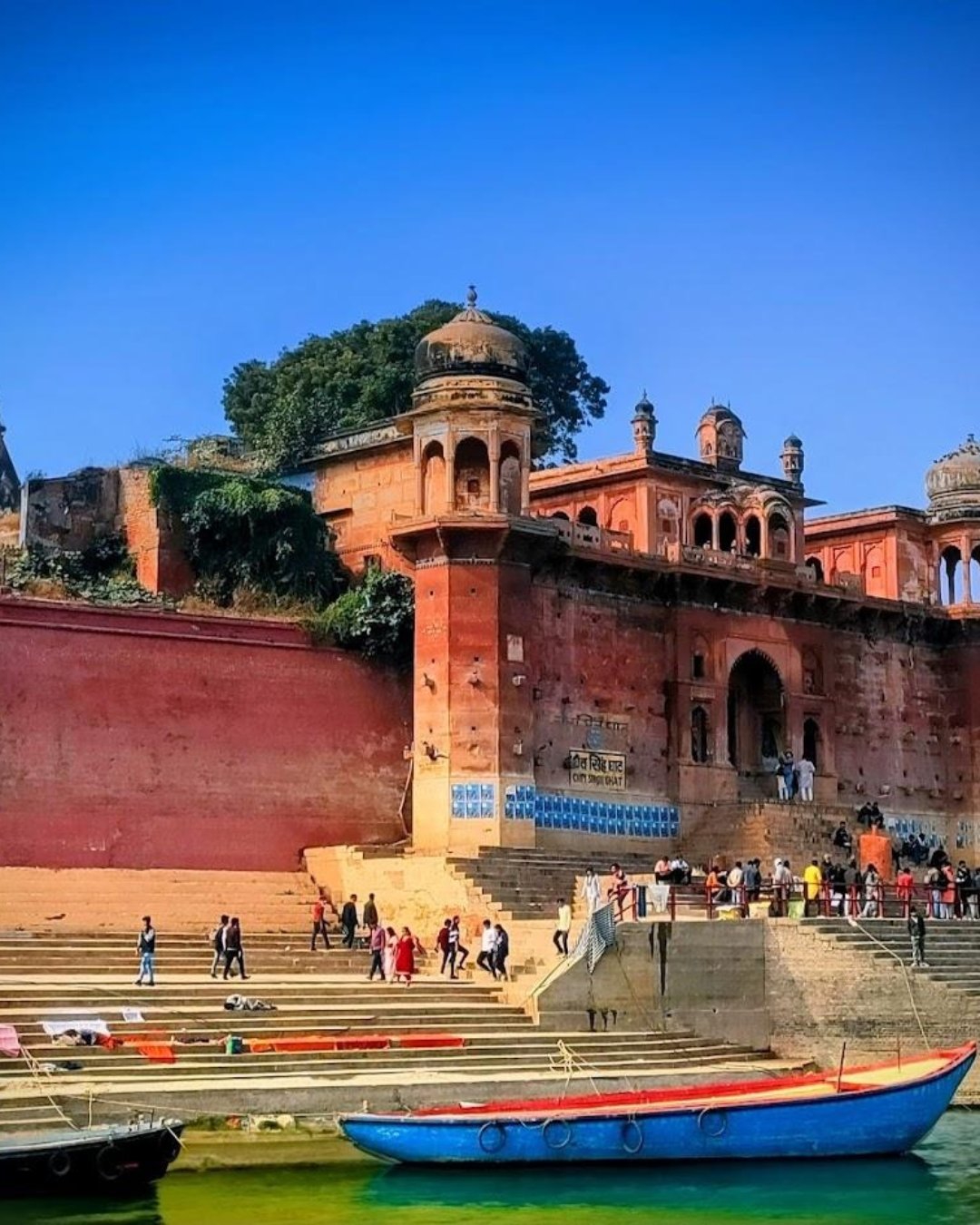
You've probably registered it as "the one with the walls." On the boat from Assi it's the first thing that looks properly fortified — sandstone ramparts and turrets rising straight out of the water, more castle than ghat. But here's the thing nobody tells you: this is where the British lost control of Varanasi for a day in 1781, where Warren Hastings had to flee the city, and where a rebellion nearly ended the East India Company's grip on the region. Everyone photographs the walls. Almost nobody knows what happened behind them.
Let's fix that. Here's how Chet Singh Ghat actually works, and how to get it right the first time.
Why you need the story, not just the frontage
From the water, Chet Singh Ghat gives you a striking photograph and little else. It's one of the most architecturally impressive sections of the southern ghats, but the real significance lies beyond its sandstone walls.
The story is what makes it unforgettable. Raja Chet Singh ruled Benares in the late 18th century. In 1781, when Governor-General Warren Hastings attempted to arrest him over disputed tribute payments, Chet Singh's supporters revolted. The British troops stationed here were overwhelmed, Hastings escaped to Chunar Fort in disguise, and for a brief moment the East India Company lost control of Varanasi. Although Chet Singh was eventually defeated and exiled, the fort overlooking the Ganga remains a silent witness to one of the city's most dramatic chapters in history.
What you'll actually see
Plan to visit on foot during daylight and allow around 30–45 minutes.
The riverfront fortifications — towering sandstone ramparts rising directly from the Ganga, making Chet Singh Ghat one of the most recognizable ghats in Varanasi.
Chet Singh Palace — an 18th-century riverside palace showcasing traditional Banaras architecture, with sections restored while others still retain their historic, weathered character.
The Shivala neighborhood — the surrounding heritage area filled with temples, old mansions, and narrow lanes that preserve the atmosphere of old Banaras.
The southern ghats — Assi Ghat, Tulsi Ghat, Jain Ghat, and Rewa Ghat are all within walking distance, making this an ideal heritage walk.
Wear comfortable shoes with good grip, as the stone steps can be uneven and slippery, especially during or after the monsoon.
And put the phone away once you've taken the riverfront photograph. Visitors who explore inside often say the same thing: the walls are impressive, but the quiet courtyards are what stay with you. Standing where Warren Hastings once fled for his life, surrounded by centuries-old stone and almost no crowds, gives the place a sense of history that no photograph can fully capture.
Pro tip: Check local access before visiting, as parts of the palace remain privately owned and accessibility can vary. During festivals such as Ganga Mahotsav, portions of the complex may host cultural events, offering a completely different experience. The best way to visit is as part of a morning heritage walk from Assi Ghat through Tulsi Ghat and onward to Chet Singh Ghat.
The mistakes that ruin it
Most first-time visitors make the same mistakes. They photograph the fort from a passing boat without stepping ashore. They visit without knowing the remarkable events of 1781, making it seem like just another old palace. Or they expect a fully restored museum and are surprised to find a partially private historic complex with very little signage.
The easy fix is to explore Chet Singh Ghat on foot with someone who knows its history and can explain what you're seeing. Without the story, it's simply an impressive fort. With the story, it becomes one of Varanasi's most fascinating historical landmarks.
Want the fort, the story, and the route in one walk?
Hit Do this trip— we'll handle the heritage morning.
88
MomentShivala Ghat, Varanasi

Shivala Ghat & Riverside Heritage
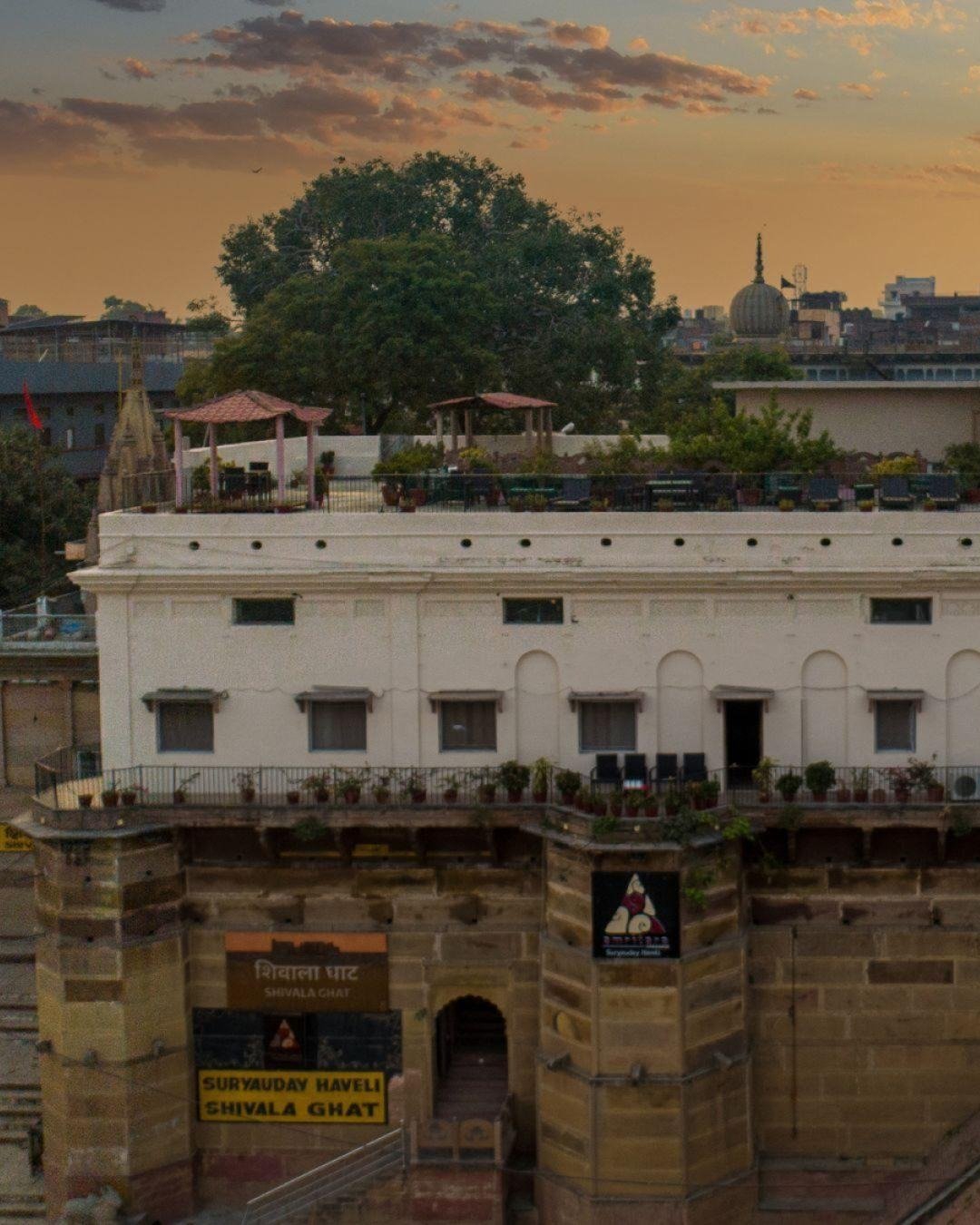
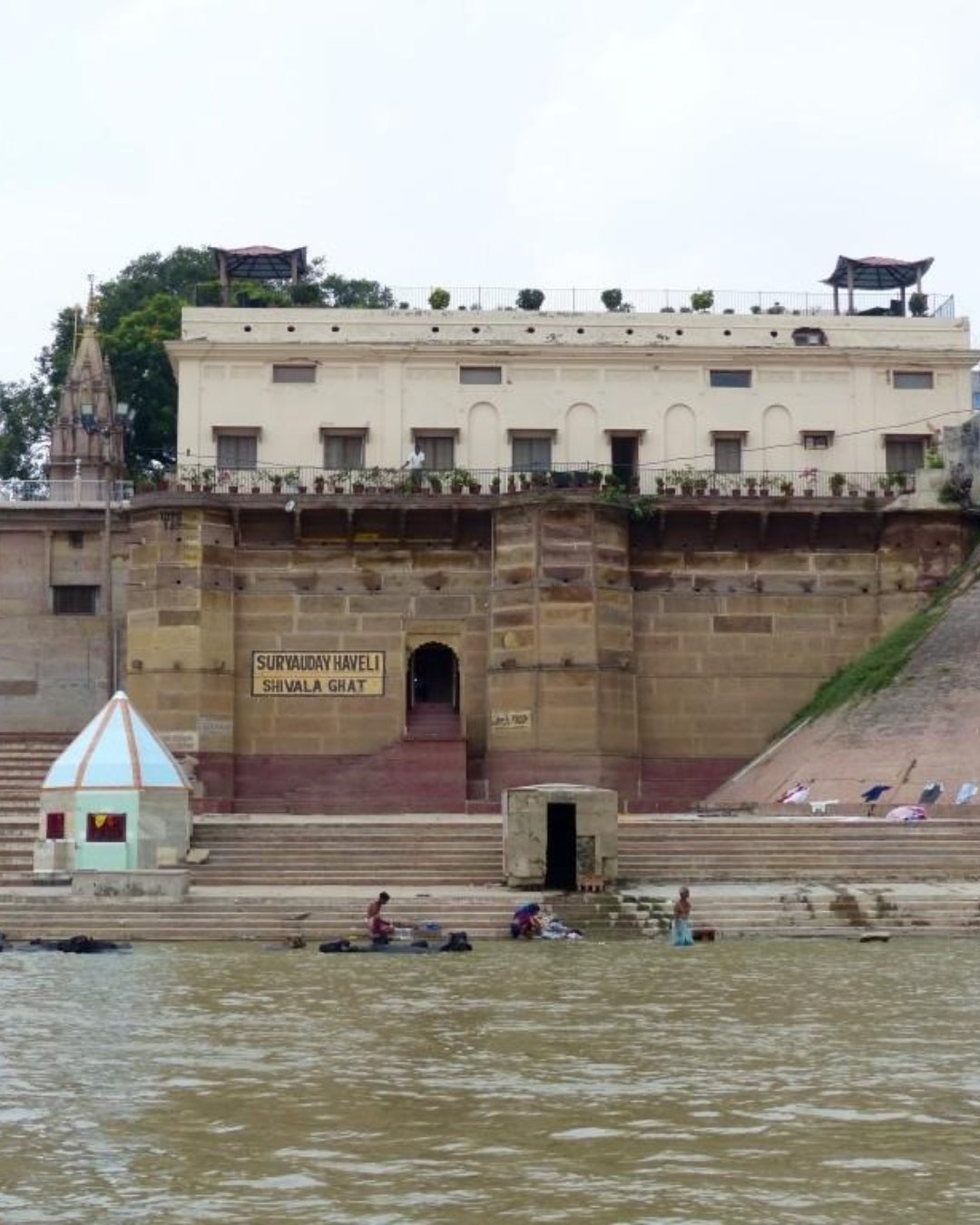
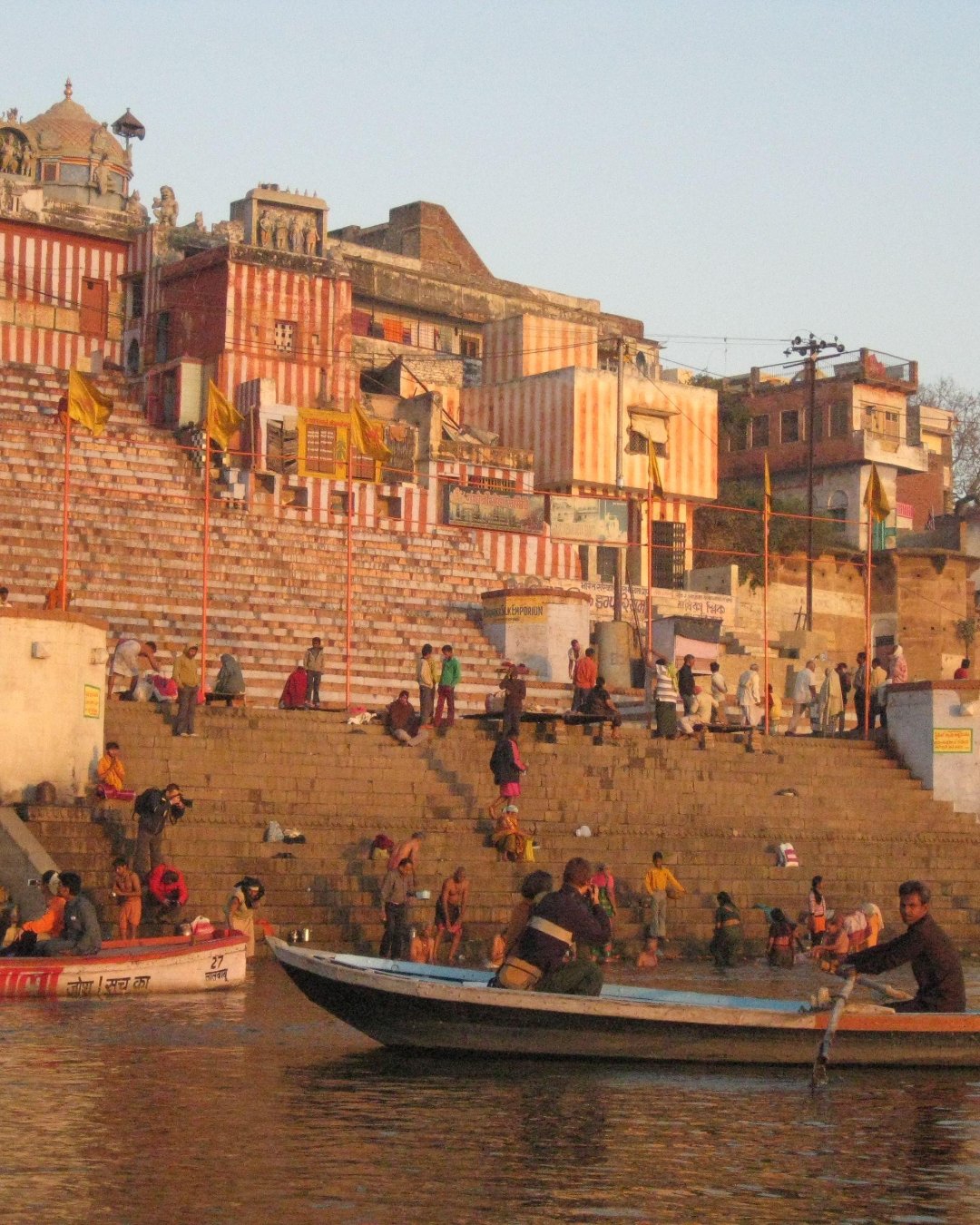
You've probably been told the ghats are one long stretch of steps. Eighty-odd of them, all much the same, and you see them from a boat. But here's the thing nobody tells you: the southern ghats are a skyline of princely palaces — Nepali, Rewa, Chet Singh, Shivala — built by kings from across India who wanted a foothold in Kashi, and almost every one of them is crumbling quietly while visitors float past photographing the famous three. Shivala is where you can actually see that heritage up close, and it's the stretch nobody walks.
Let's fix that. Here's how Shivala and the southern heritage stretch actually work, and how to get it right the first time.
Why you walk it in the morning, and slowly
This isn't a ghat with an event. There's no aarti to time, no queue, no ceremony. What's here is architecture and neighbourhood — and both need daylight and a slow pace to register.
Come mid-morning, after the boats have finished and before the heat. The lanes behind the ghats are awake, the temples are open, and the light is on the river frontage rather than behind it. Walk north from Assi and the palaces come one after another: each one a different state's Benares residence, each in a different stage of preservation, many of them still partially occupied or privately maintained.
What you'll actually see
Allow around 90 minutes on foot. No tickets. No crowds.
The Shivala Temple — the historic Shiva temple that gives both the ghat and the surrounding neighbourhood their name.
Chet Singh Palace — the impressive sandstone fortifications overlooking the river, one of the most iconic architectural landmarks on the southern ghats.
Tulsi Ghat — just a short walk away, where Goswami Tulsidas is traditionally believed to have composed the Ramcharitmanas and where the historic wrestling akhara continues to operate.
The heritage lanes — narrow streets lined with old Banarasi homes, hidden shrines, chai stalls, and a peaceful atmosphere far removed from the crowds around Dashashwamedh Ghat.
Wear comfortable shoes with good grip and footwear that's easy to remove when visiting temples. The stone steps can be steep and slippery, especially during or after the monsoon.
And this is one walk where it's worth keeping your phone in your pocket. Travellers who explore the southern ghats often say the same thing: there's no single postcard view to capture. Instead, it's the gradual discovery of palace after palace, each connected to a different royal family, that makes the walk memorable. Combined with the surprising quiet just a short distance from Varanasi's busiest ghats, it's an experience that photographs rarely convey.
Pro tip: Walk the southern ghats as one continuous heritage trail — Assi Ghat → Tulsi Ghat → Shivala → Chet Singh Ghat → Hanuman Ghat → Harishchandra Ghat. Mid-morning is the ideal time, after the sunrise boat traffic has ended and before the afternoon heat arrives. Since several heritage buildings remain privately owned, check local access before planning to enter any palace complexes.
The mistakes that ruin it
Most first-time visitors make the same mistakes. They admire the southern ghats only from a passing boat. They visit the famous central ghats and assume the rest of the riverfront offers nothing different. Or they attempt the walk during the hottest part of the day, when the exposed stone steps become exhausting.
The easy fix is to dedicate one relaxed morning to exploring the southern ghats on foot with someone who can explain the stories behind the palaces, temples, and neighbourhoods along the way.
Want the palaces, the temples, and the lanes in one stretch?
Hit Do this trip—we'll plan the southern walk.
69
MomentKedar Ghat, Varanasi

Kedar Ghat & Kedareshwar Temple
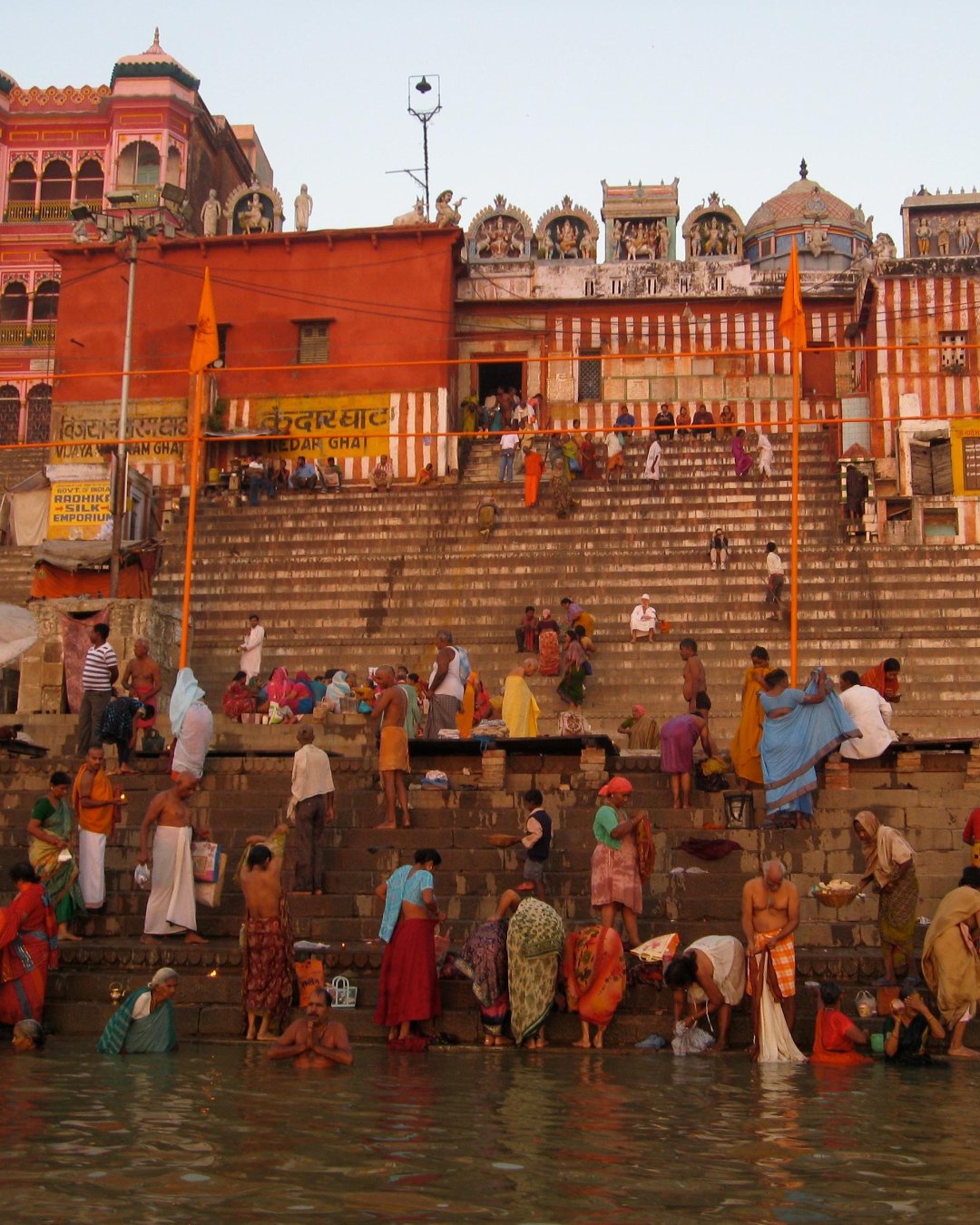
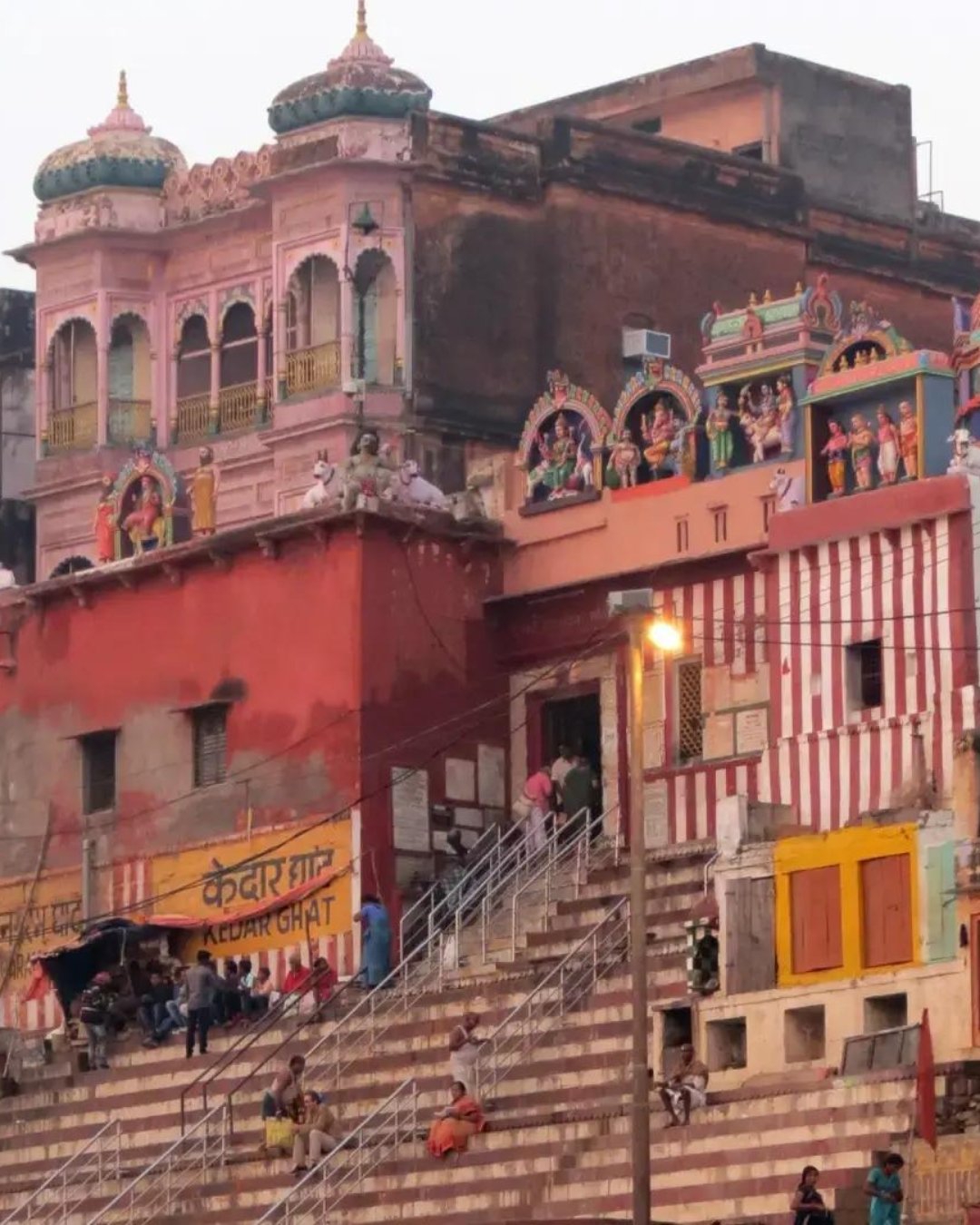
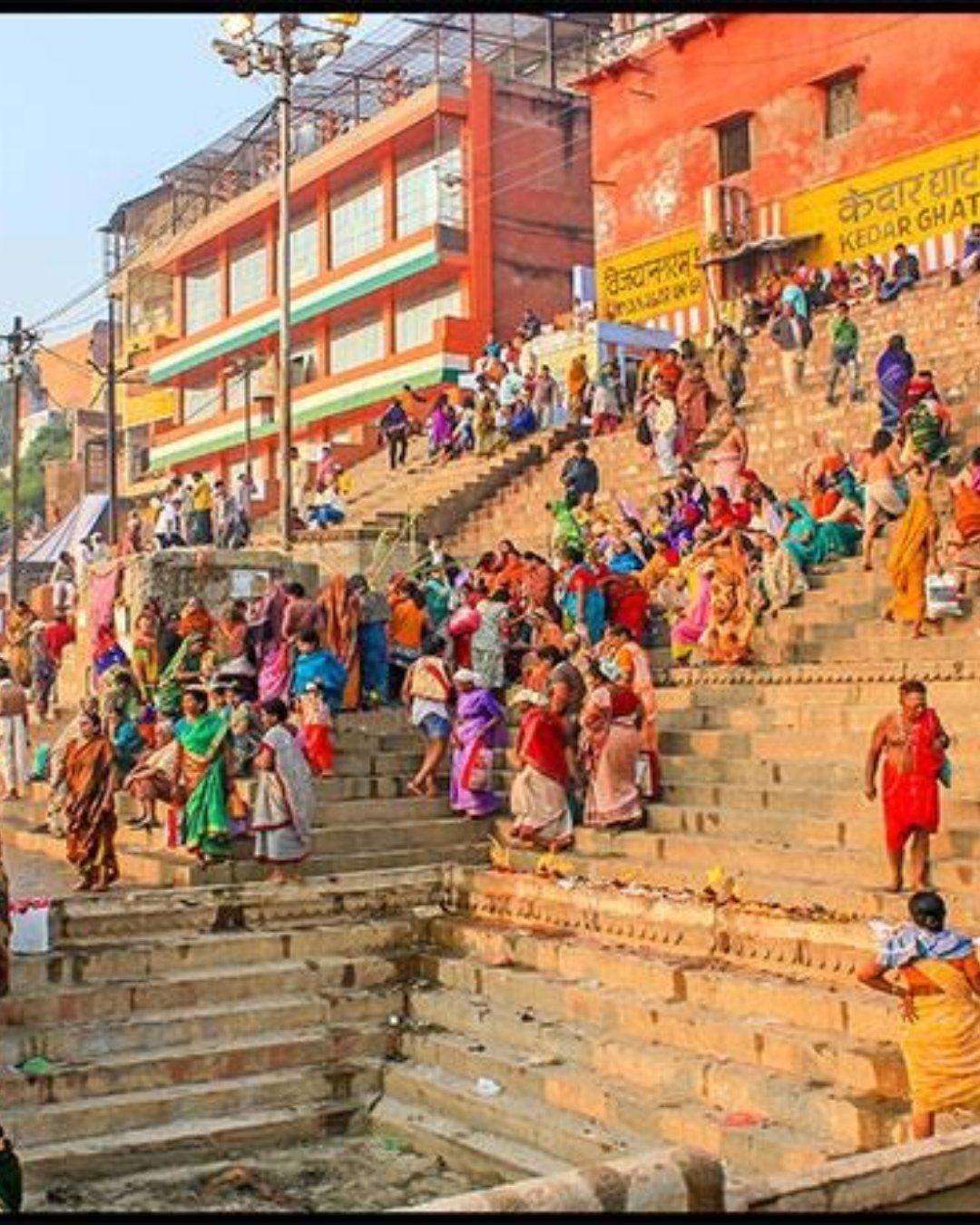
You've probably seen it and not known why it stood out. On the boat, one stretch of steps is striped in red and white ochre, unlike anything either side of it — and then you're past it. But here's the thing nobody tells you: those stripes belong to the temple above, and the belief here is that a darshan at Kedareshwar carries the merit of the Kedarnath pilgrimage in the high Himalaya. People who can't make the mountain journey come here instead. It's one of the most quietly significant temples on the river, and the boats don't stop.
Let's fix that. Here's how Kedar Ghat actually works, and how to get it right the first time.
Why the morning, and why on foot
Kedar has no evening spectacle. There's no aarti to sit through and no crowd to beat — what it has is a working morning temple with a genuinely devotional atmosphere, mostly South Indian and Bengali worshippers, and almost no tourists.
Come early, between the boat ride and breakfast. The temple is active from dawn, the queue is short or non-existent outside festival days, and the low light on those red-and-white steps is the one time they photograph properly. By mid-morning the devotion has thinned and you're looking at an empty courtyard.
What you'll actually see
Thirty to forty minutes, no ticket, no queue:
The striped ghat — the ochre bands running down the steps, the most distinctive frontage on the riverfront.
Kedareshwar Temple — above the steps, its lingam a rough natural stone rather than a carved one, which is the point.
Gauri Kund — the small sacred tank beside the temple, fed by a spring.
The stretch north and south — Harishchandra Ghat is close by to the south; do them in one walk.
Dress modestly and be ready to go barefoot from the shoe stand. Carry small notes for the shoe stand and an offering.
And keep your phone down inside. Travellers who come here will tell you the same thing: Kedar isn't performing for anyone — there's no ceremony staged for visitors, just people doing what they came to do, at seven in the morning, the way they have for centuries. Photography inside the sanctum is generally not welcome; ask before you point at anything. That ordinariness, in a city where so much is watched, is the part the photos never quite catch.
Pro tip: Go on a Monday if your dates allow — it's Shiva's day and the temple fills with real devotion rather than tourism, which is exactly what makes this stop worth it. In Sawan (roughly July–August) the queues get serious, so come very early or pick another day. And pair it with Harishchandra Ghat just south — the smaller of the city's two cremation ghats, and far quieter than Manikarnika, if you want to see that with less crowd.
The mistakes that ruin it
Most first-timers trip over the same few things. They photograph the stripes from a boat and never learn what they mark. They arrive at eleven, when the morning worship is over and it's an empty courtyard. Or they wander in filming and get, quite rightly, asked to stop.
The easy fix is to come early, on foot, knowing what the temple is — because without the Kedarnath connection, it's a nice set of steps and a small shrine.
Want Kedar in the early hours with the temple open?
Hit Do this trip — we'll time the morning around it.
81
MomentHarishchandra Ghat, Varanasi

Harishchandra Ghat
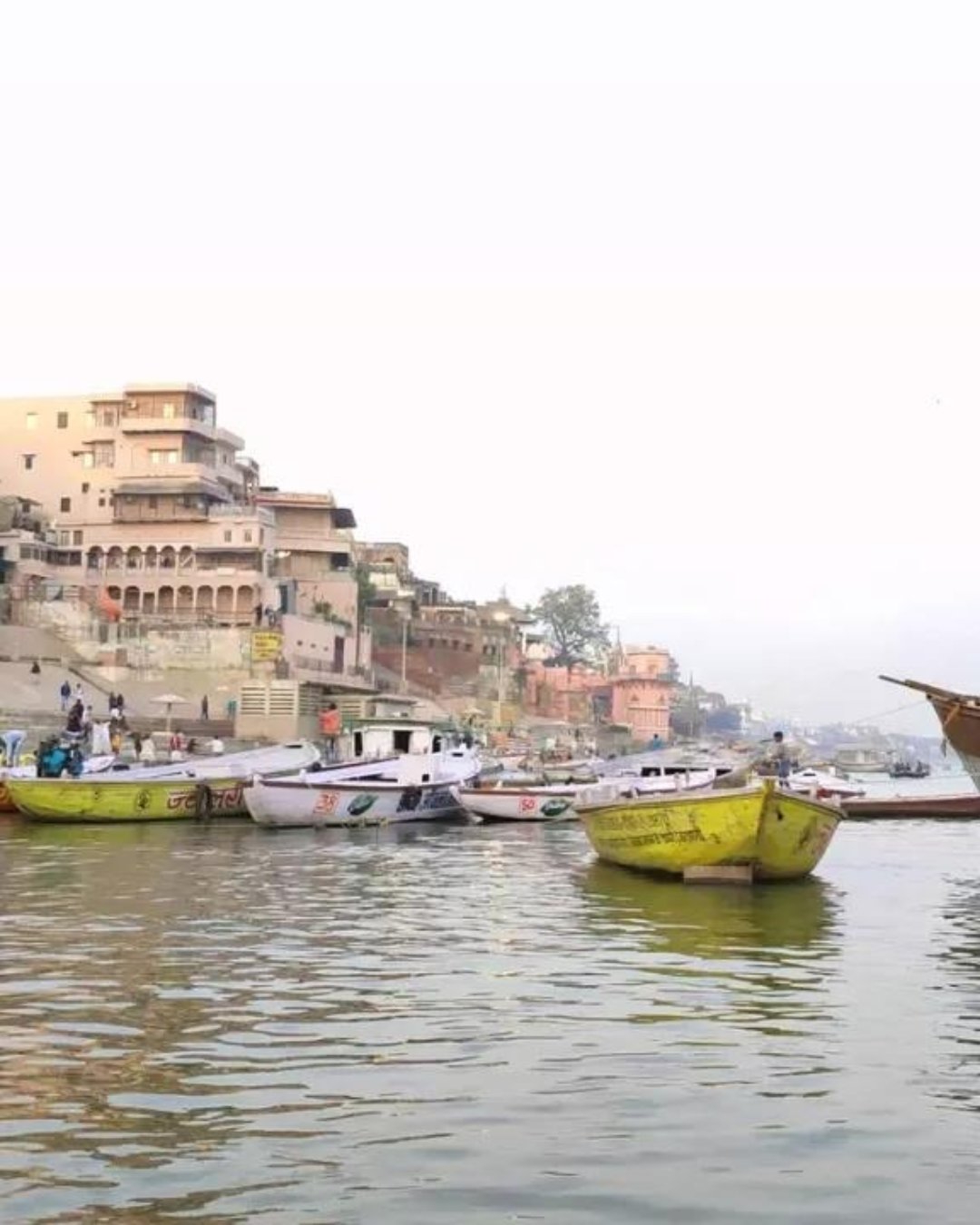
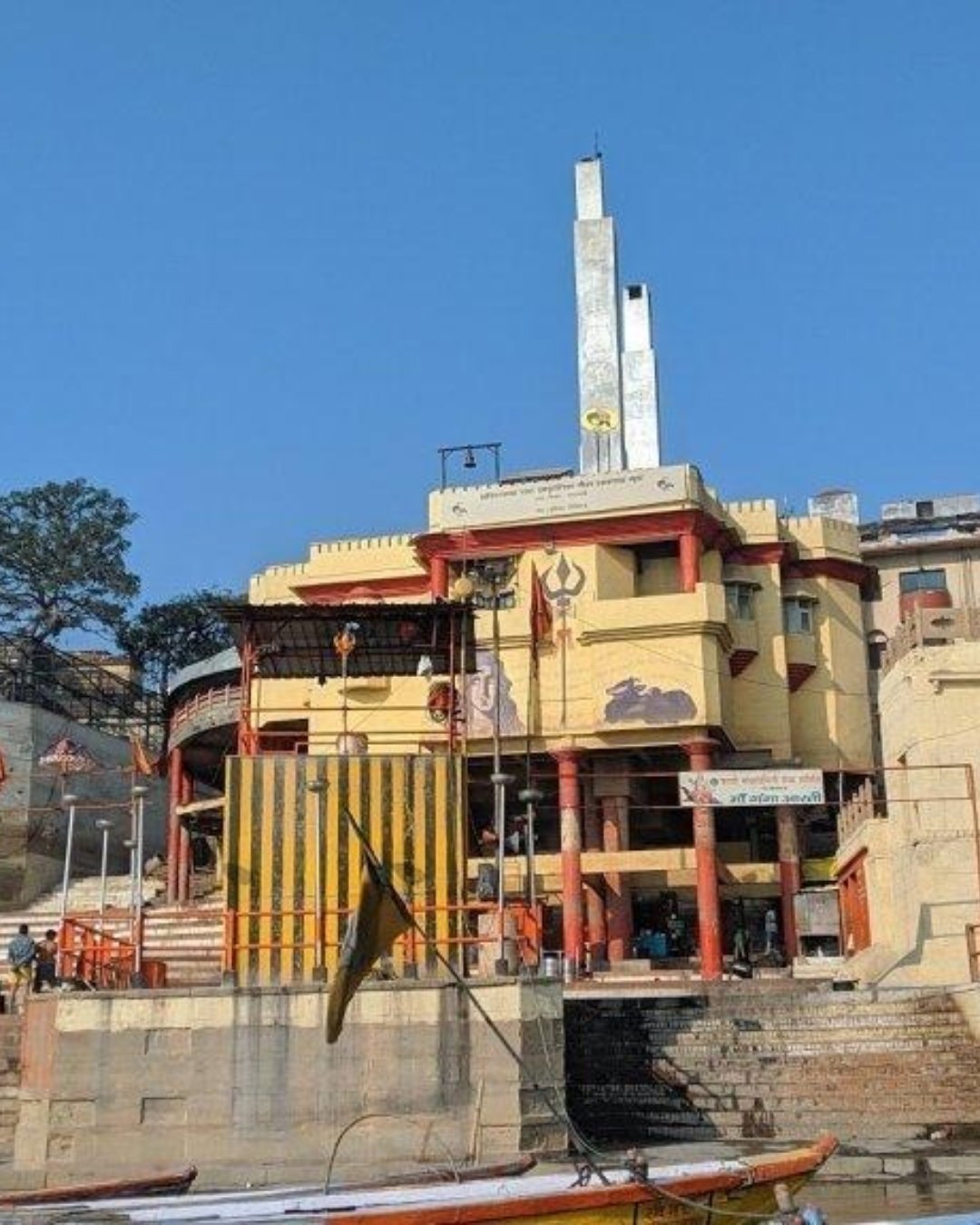
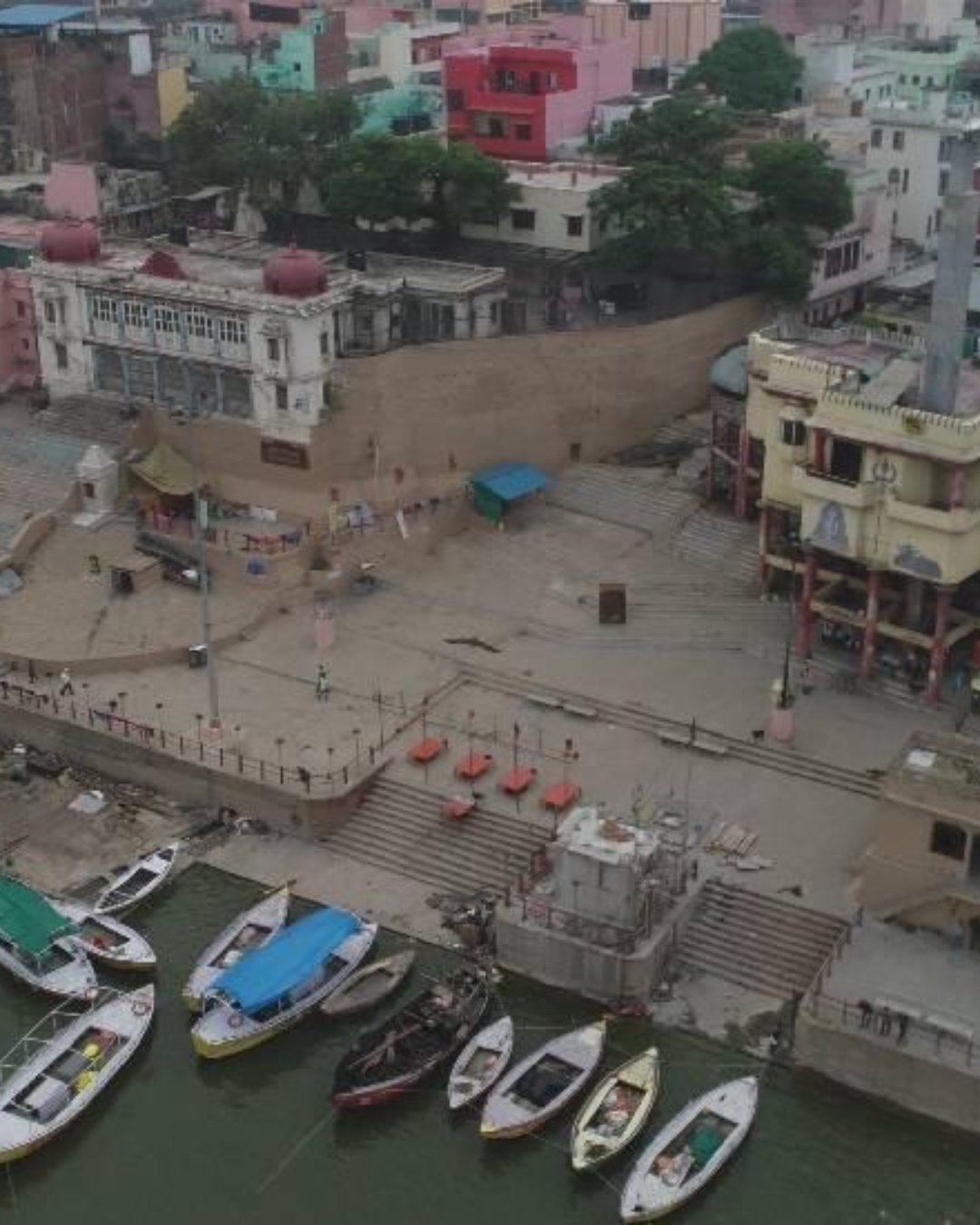
You've probably been steered to Manikarnika. It's the famous cremation ghat, the one on every itinerary, and Harishchandra — the city's other one, a little to the south — barely gets a mention. But here's the thing nobody tells you: this is a working cremation ground where families are grieving in the open, and the fact that it's quieter and less photographed than Manikarnika doesn't make it a gentler sightseeing stop. It makes it a place where a visitor's behaviour matters even more, because there's no crowd to disappear into.
Let's be clear about how to be here. Here's how Harishchandra Ghat actually works, and how to approach it the right way.
Why this isn't a sight, and why that matters
Harishchandra is one of Varanasi's two cremation ghats, named for King Harishchandra, who, according to legend, gave up everything, including working here, for the sake of truth. Cremations take place here day and night. Some are now carried out in the electric crematorium alongside the traditional open-air pyres, but the ghat remains exactly what it appears to be: a place where families come to perform the final rites of their loved ones.
That means you're not a spectator here — you're a bystander at a funeral, often many funerals at once. The appropriate response is quiet observation from a respectful distance. There is no performance, no attraction, and nothing intended for visitors. The value of coming here lies in understanding a deeply rooted tradition, not in seeking an experience. If you cannot approach it respectfully, it's better not to visit.
What you'll actually see, and how to hold it
From a boat, at a respectful distance, is the way most visitors should experience Harishchandra Ghat:
The funeral pyres — continuously burning on the steps. Do not photograph them.
The electric crematorium — a modern facility operating alongside the traditional cremation grounds.
The families and the Dom community — mourners performing final rites and the hereditary community responsible for maintaining the cremation fires.
Kedar Ghat — located just to the north, offering a quieter continuation of your walk or boat journey.
Dress simply and modestly. Avoid bright clothing and do not carry your camera as though this were a sightseeing stop.
Keep your phone away for your entire visit. Photography and videography of cremations are deeply disrespectful and should never be attempted. Travellers who experience Harishchandra Ghat thoughtfully often remember not what they saw, but what they understood — that in Varanasi, death is acknowledged openly as part of life's natural cycle. That quiet understanding is something no photograph could ever capture.
A note in place of a pro tip
The most respectful way to experience Harishchandra Ghat is from the river during an early morning boat ride. From the water, you gain context without intruding on private moments of grief.
If anyone offers to guide you into the cremation area for a "closer look" or asks for donations for funeral wood, grieving families, or similar causes, politely decline. These requests are common scams targeting visitors. If you wish to support charitable work in Varanasi, donate later through a recognised organisation instead.
The mistakes to avoid
Most visitors who get this wrong make the same mistakes. They treat the ghat as a photography stop. They follow touts into active cremation areas. Or they expect a quieter version of Manikarnika, forgetting that this is not a tourist attraction but a sacred place of mourning.
The respectful approach is simple: observe briefly, remain at a distance, ideally from the river, and learn about the traditions through a knowledgeable guide rather than through intrusion.
On seeing it as part of your journey
Harishchandra Ghat is the place many travellers overlook, yet it often leaves the deepest impression. Not because it is dramatic, but because it offers an honest glimpse into one of Varanasi's oldest spiritual traditions. Experienced with humility and respect, it becomes one of the city's most meaningful moments.
If you'd like to experience Harishchandra Ghat respectfully — from the river, with historical and cultural context, alongside the sunrise boat ride, Ganga Aarti, and Varanasi's other highlights — our Varanasi Tour Packages are designed to help you do exactly that. Pick your dates, and we'll take care of the rest.
Want to see this respectfully — from the river, with context?
Hit Do this trip — we'll handle it with care.
74
MomentGanga Aarti, Varanasi

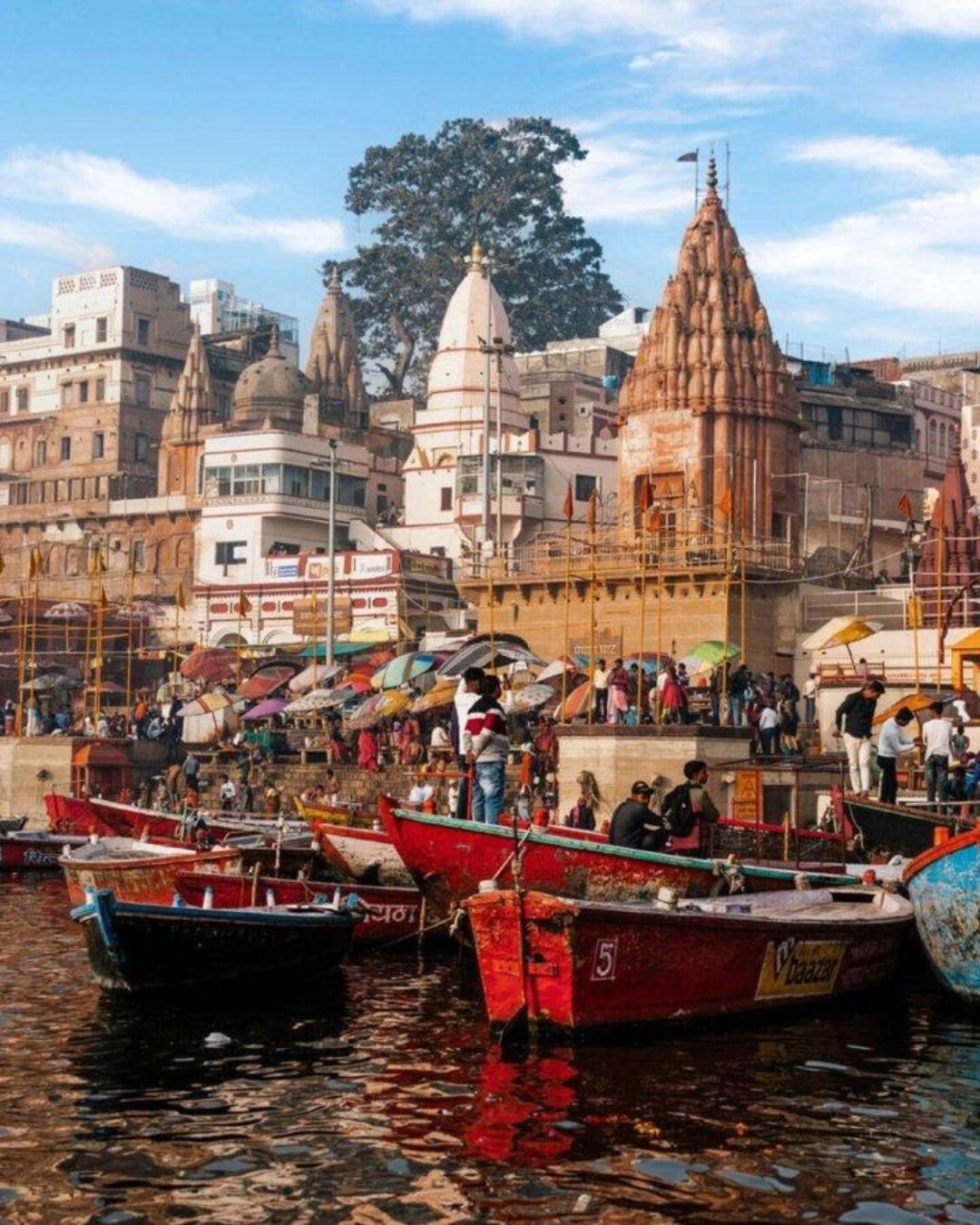
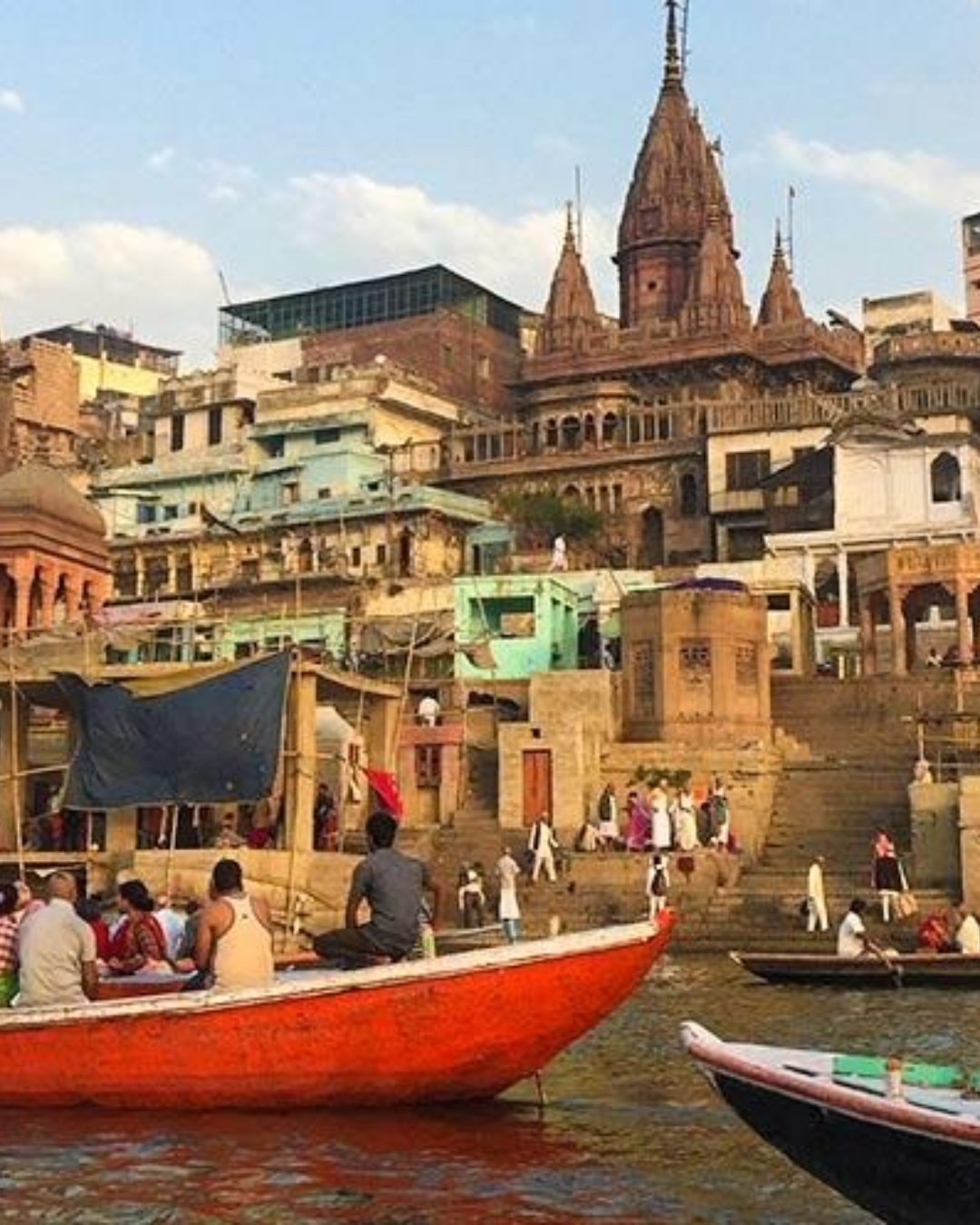
Dashashwamedh Ghat & Ganga Aarti
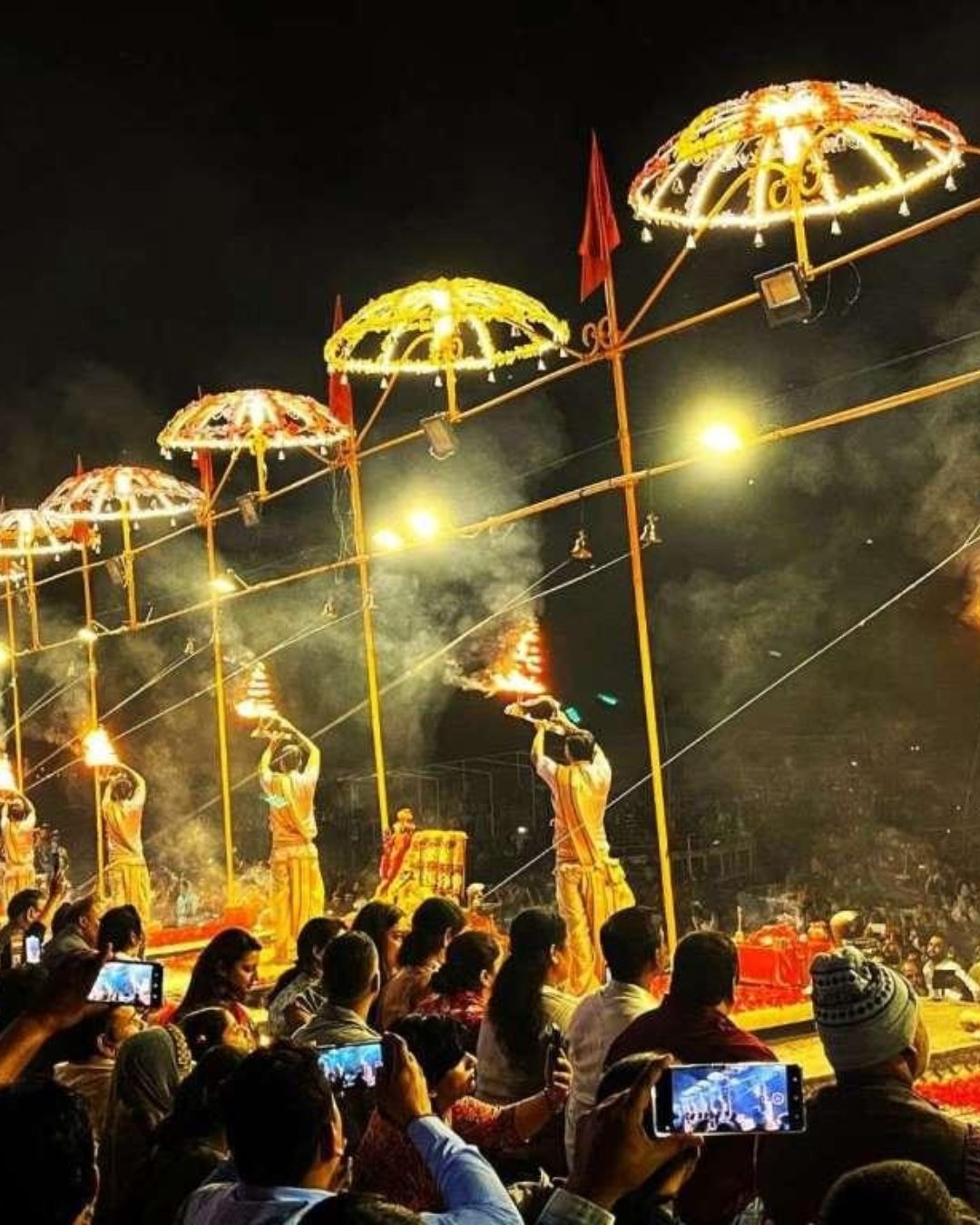
You've seen the clips. A row of priests swinging tall brass lamps in unison, fire against a dark river, bells and conch shells everywhere. So you turn up at seven for a seven o'clock aarti — and end up fifteen rows back, staring at the backs of heads and a forest of raised phones. You hear it. You barely see it. That's the trap most first-timers fall into at Dashashwamedh, and it's a shame, because this is the ghat the whole city turns around, and its aarti is one of the best hours you'll spend in India.
Let's fix that. Here's how Dashashwamedh and the Ganga Aarti actually work, and how to get it right the first time.
Why the hour before matters more than the aarti itself
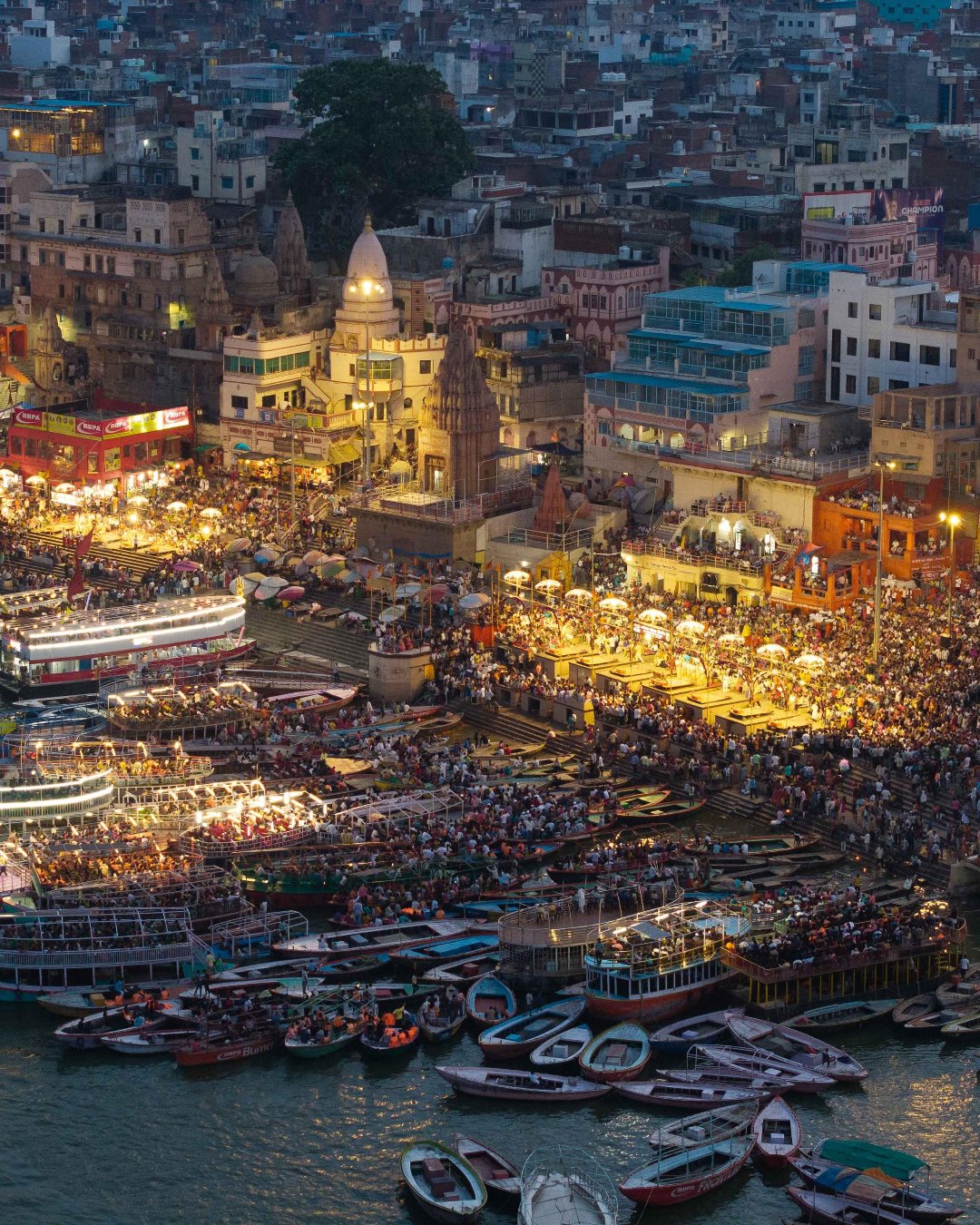
The aarti starts after sunset — roughly 6:45 p.m. in winter, closer to 7 p.m. in summer — and it happens every single night, rain or shine, for about 45 minutes. The start time isn't your problem. The crowd is. Good spots fill 45 minutes to an hour before the first lamp is lit.
So don't arrive at 6:45. Get there by six, earlier on weekends, full moons and festival nights, when the whole city comes down to the river. Yes, you'll wait. You'll also be sitting front and centre while everyone else cranes over shoulders behind you. Dashashwamedh is the busiest ghat on the Ganga — this is the one place where turning up "on time" means turning up too late.
What you'll actually see
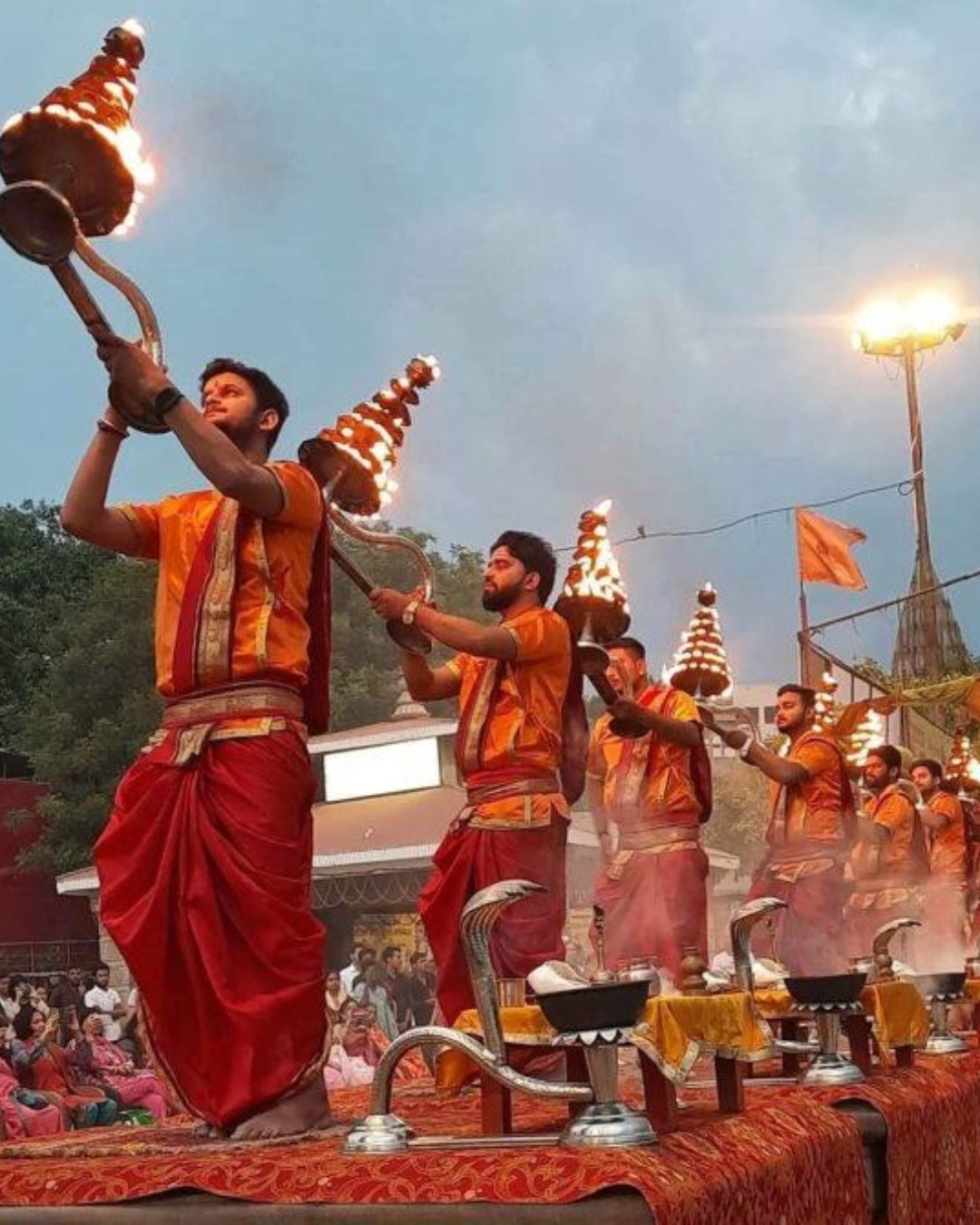
The ceremony is an offering to the River Ganga — fire, incense, conch shells, and chanting, the lamps growing heavier as it builds. Where you watch from changes everything:
The steps — free, close, and loud in the best way. Get there early and sit low.
A boat — the lamps line up straight in front of you with no crowd in between. This is the view you came for.
The upper platforms — a bit removed, but a clean, wide view when the steps are packed.
Floating diyas — little oil lamps you can set adrift on the water for a few rupees once the aarti ends.
If you do it once, take the boat. You drift in, you settle, and the whole thing plays out across the water like it's aimed at you.
And keep your phone down for the first ten minutes. Travellers who've been will tell you the same thing: the urge is to film everything, but it lands differently when you just watch it first. The bells, the chanting rolling off the ghat, the smoke over the river — that's the part the photos never quite catch.
Pro tip: Book your boat before the crowds thicken, and agree the price and duration before you step in. A shared boat runs cheaper; a private one lets you pick your angle and linger after. Keep your bag zipped and in your lap — the crush near the front is where pickpockets work. And carry a little cash for a diya. Setting a lamp adrift on the Ganga after the aarti is the part you'll remember.
The mistakes that ruin it
Most first-timers trip over the same few things. They arrive as it starts and see nothing. They get lost in the lanes behind the ghat and turn up flustered. Or they spend the whole ceremony filming through a screen instead of watching.
The easy fix is to come early, know your spot, and ideally take it from a boat — or let the evening be arranged so you're seated, not scrambling.
Want the boat held, the spot secured, and the aarti sorted?
Hit Do this trip— we'll get you front row.
76
MomentAhilyabai Ghat, Varanasi

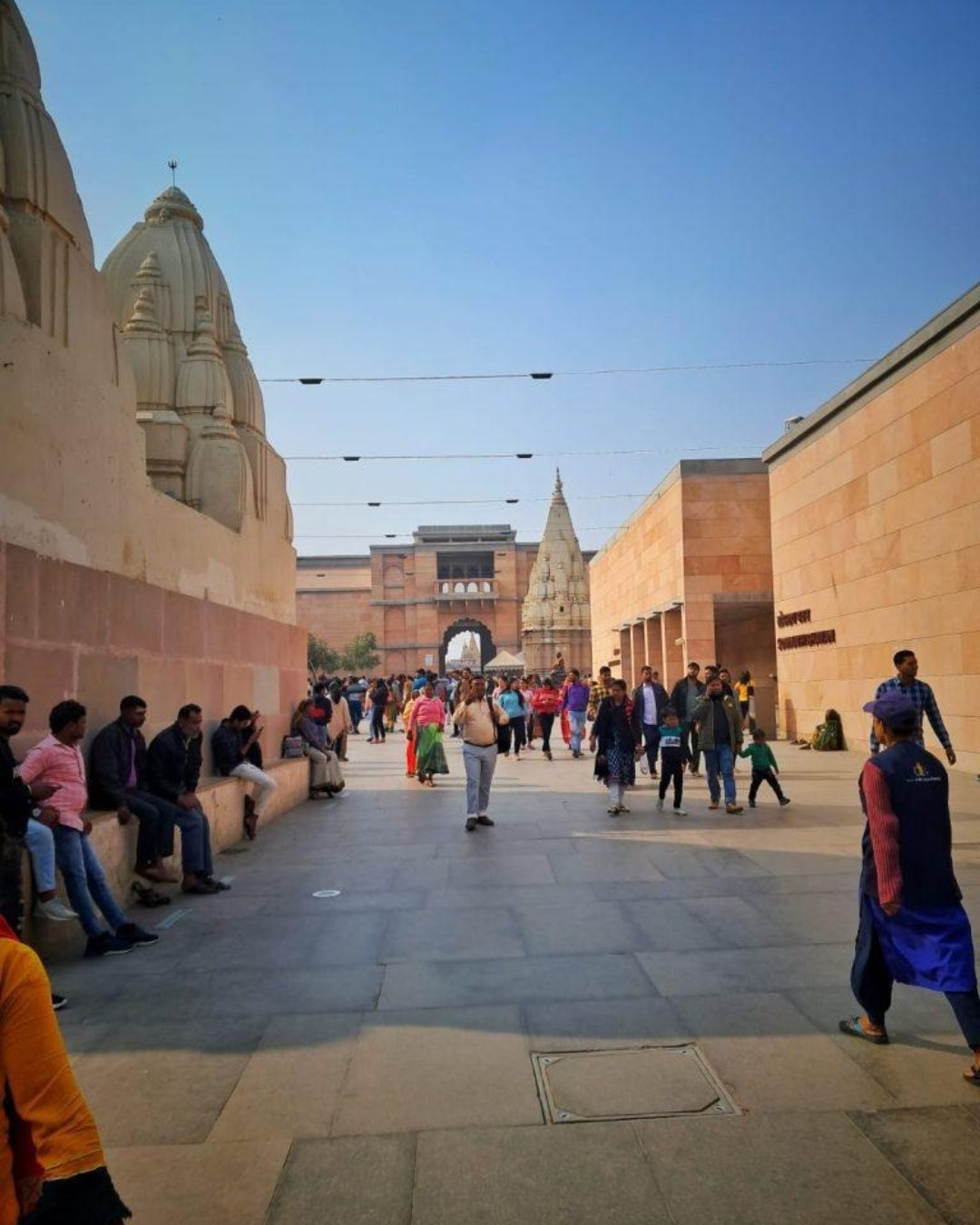
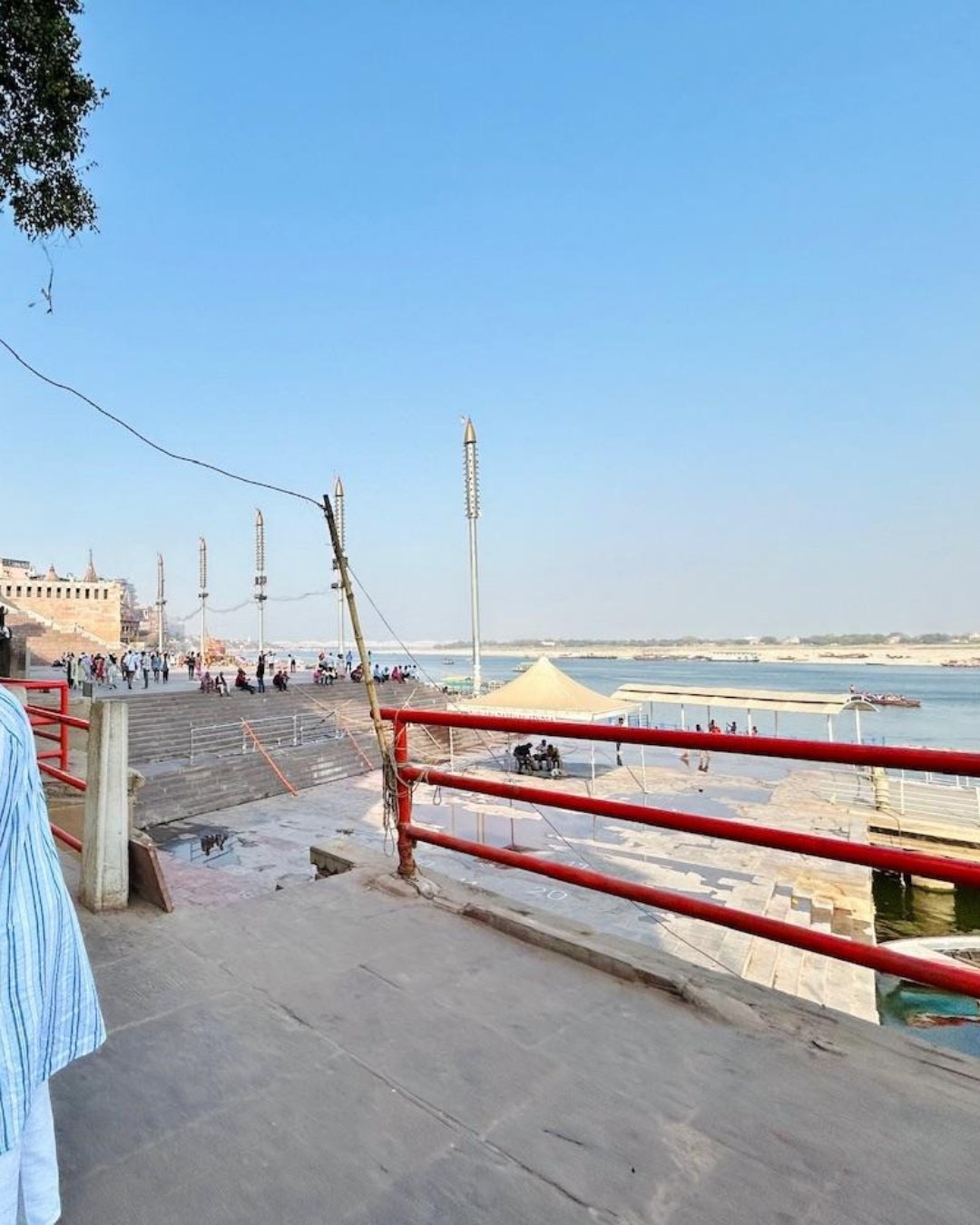
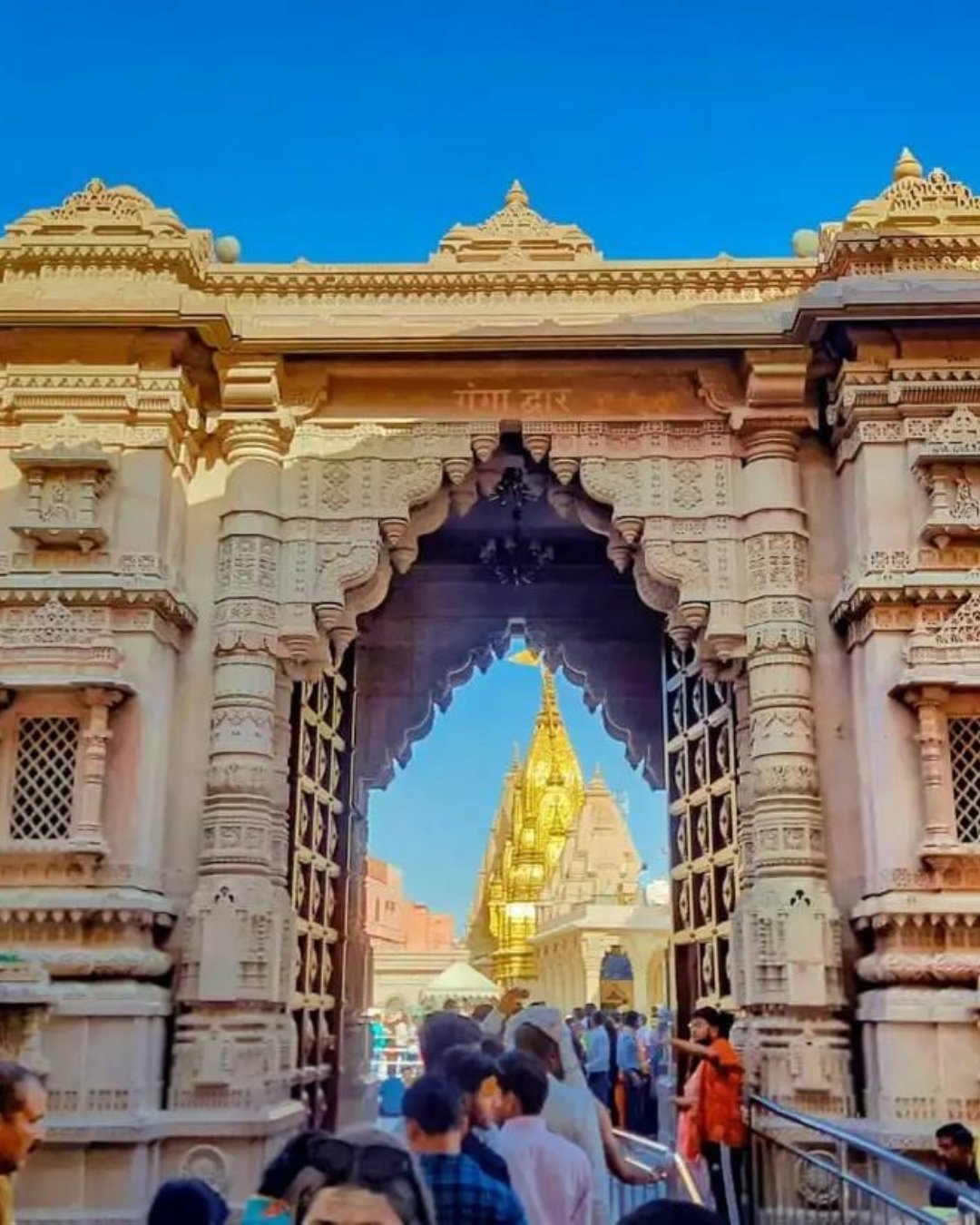
Ahilyabai Ghat & Kashi Vishwanath Corridor
You've probably planned to reach Kashi Vishwanath the hard way — through the old lanes, phone in pocket, following the crowd and hoping. But here's the thing nobody tells you: since 2021 there's a grand corridor running from the temple straight down to the river, and the ghat it lands on is Ahilyabai Ghat — named for the queen who rebuilt the temple itself in 1780. Come off a boat here and you walk up into the complex the clean way, past the crush of the galis entirely. Most people don't know the river entrance exists.
Let's fix that. Here's how Ahilyabai Ghat and the corridor approach actually work, and how to get it right the first time.
Why you arrive by water, and early
The classic route to Kashi Vishwanath is through the tangled old-city lanes — atmospheric, and a genuine ordeal at peak hours, with security checks and no phones allowed past a point. The Kashi Vishwanath Dham Corridor, opened in 2021, changed that: it links the sanctum directly to the Ganga at the ghats, and Ahilyabai Ghat is the riverside end of that axis.
So the smart approach is by boat, at the start of your sunrise ride or straight after it, before the day's queue builds. You step off at the ghat, walk up through the corridor, and you're at the temple having skipped the lanes. Early morning also means the shortest darshan queue — by mid-morning it thickens and doesn't ease until night, and Mondays and the month of Sawan are another order of crowd entirely.
What you'll actually see
Ahilyabai Ghat — named for Ahilyabai Holkar, the Maratha queen who rebuilt Kashi Vishwanath in 1780; the ghat is her riverfront legacy.
The corridor — a broad paved axis of buildings and courtyards running up from the river to the temple, opened in 2021.
The golden spire — the temple's gold-plated shikhara, best seen in the early morning light.
The river gate — where pilgrims step off boats and enter the temple complex directly.
Dress modestly, with your shoulders and knees covered, and be prepared to go barefoot from the shoe counter onward.
And here's the hard rule: carry as little as possible into the temple. Mobile phones, cameras, bags, and many other personal items are not permitted inside the temple complex and must be deposited at authorised locker or cloakroom facilities before entering. Carry only a valid ID and a little cash if needed. Travellers who've done this will tell you the same thing: the twenty minutes inside with nothing to film ends up being the part they remember most clearly — the chanting, incense, cool stone underfoot, and the devotion of thousands who have travelled across the country for a single darshan. That's the part no photograph could ever truly capture.
Pro tip: Approach from the river rather than the old lanes whenever possible. Arrive by boat at Ahilyabai Ghat and walk through the Kashi Vishwanath Dham Corridor. If you're planning to use a priority darshan option, arrange it in advance through the official system where available. Travelling early on a weekday usually means shorter queues. Mondays and the month of Sawan are the busiest times, so expect significantly longer waiting times if you visit then.
The mistakes that ruin it
Most first-time visitors make the same mistakes. They battle through the old lanes without realising the river entrance exists. They arrive carrying prohibited items and lose time depositing them before security. Or they visit on the busiest days without planning for the longer queues.
The easy fix is to arrive early, approach from the river through the corridor, travel light, and plan your darshan in advance — or let the approach be arranged so everything runs smoothly.
Want the river approach, the corridor,and darshan in one go?
Hit Do this trip — we'll handle the entrance.
62
MomentJantar Mantar Varanasi, Varanasi

Man Mandir Ghat & Historic Observatory
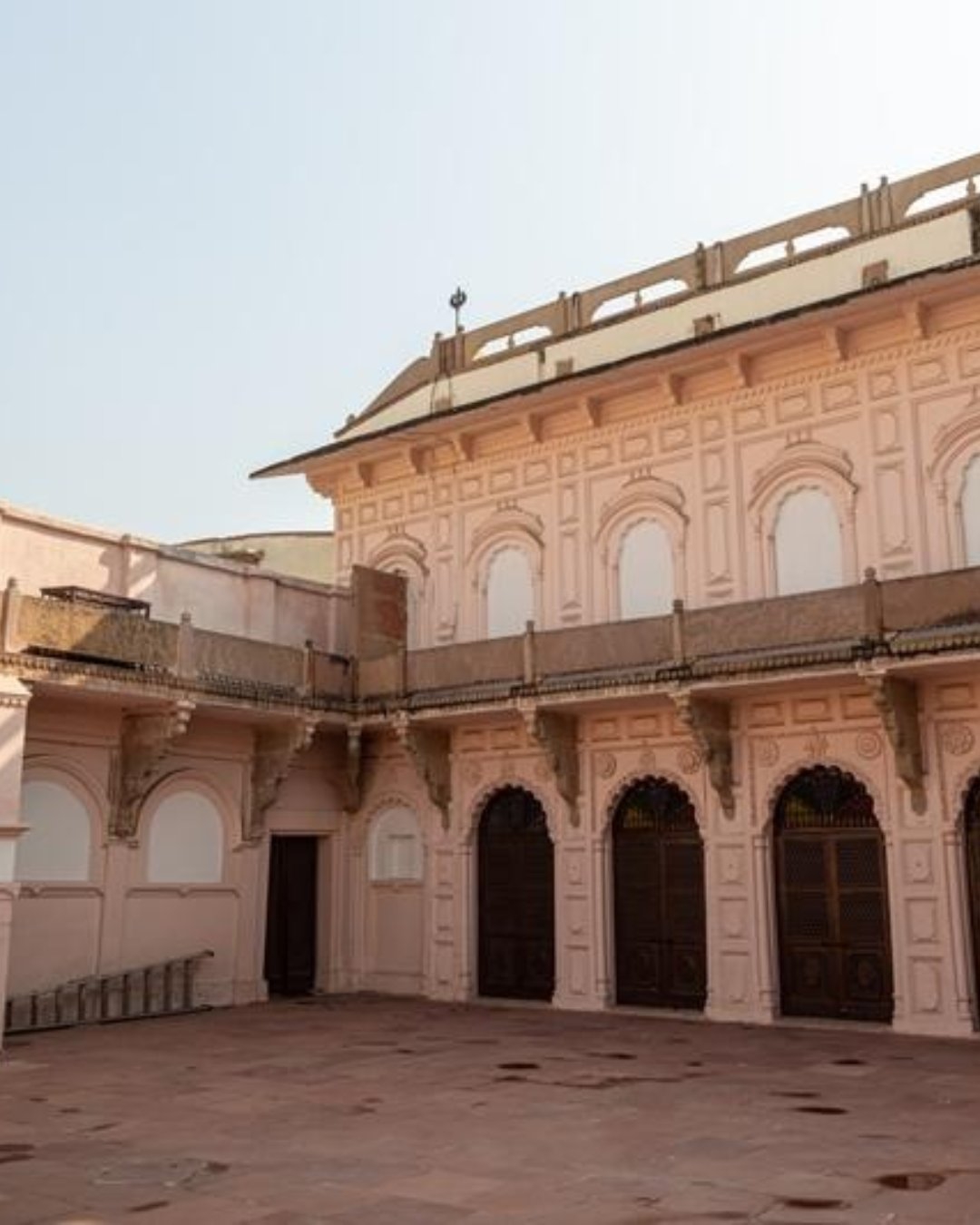
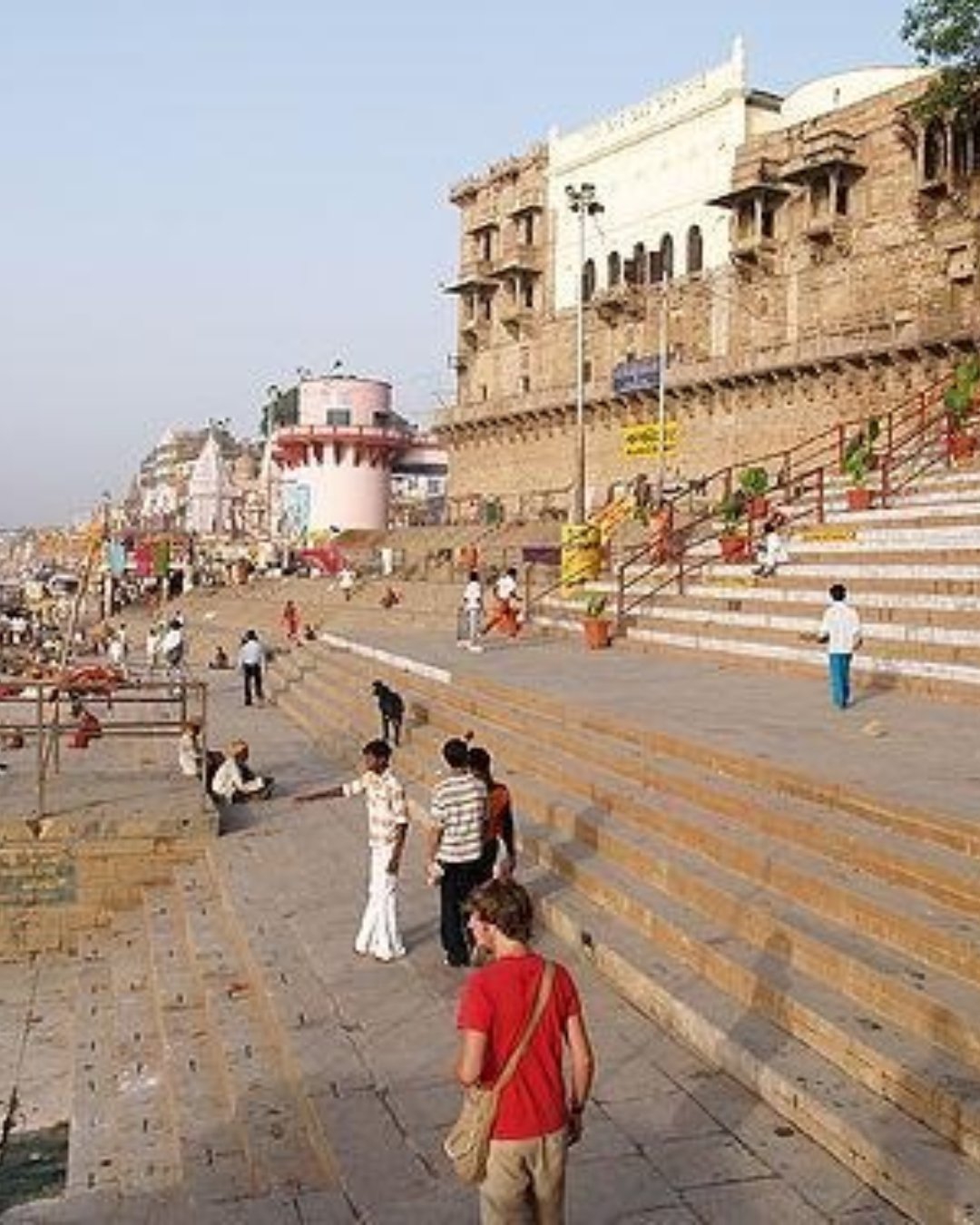
You've probably glided right past it. It sits just north of Dashashwamedh, so on the boat you're usually looking the other way, at the aarti crowd. But here's the thing nobody tells you: perched on top of this ghat is a Jantar Mantar — one of the stone astronomical observatories the astronomer-king Jai Singh II built in the 1730s, the same series as the famous one in Jaipur. Giant instruments for reading the sky, sitting above the river, and almost every visitor floats past without a glance up.
Let's fix that. Here's how Man Mandir Ghat and its observatory actually work, and how to get it right the first time.
Why you climb up, and go in the morning
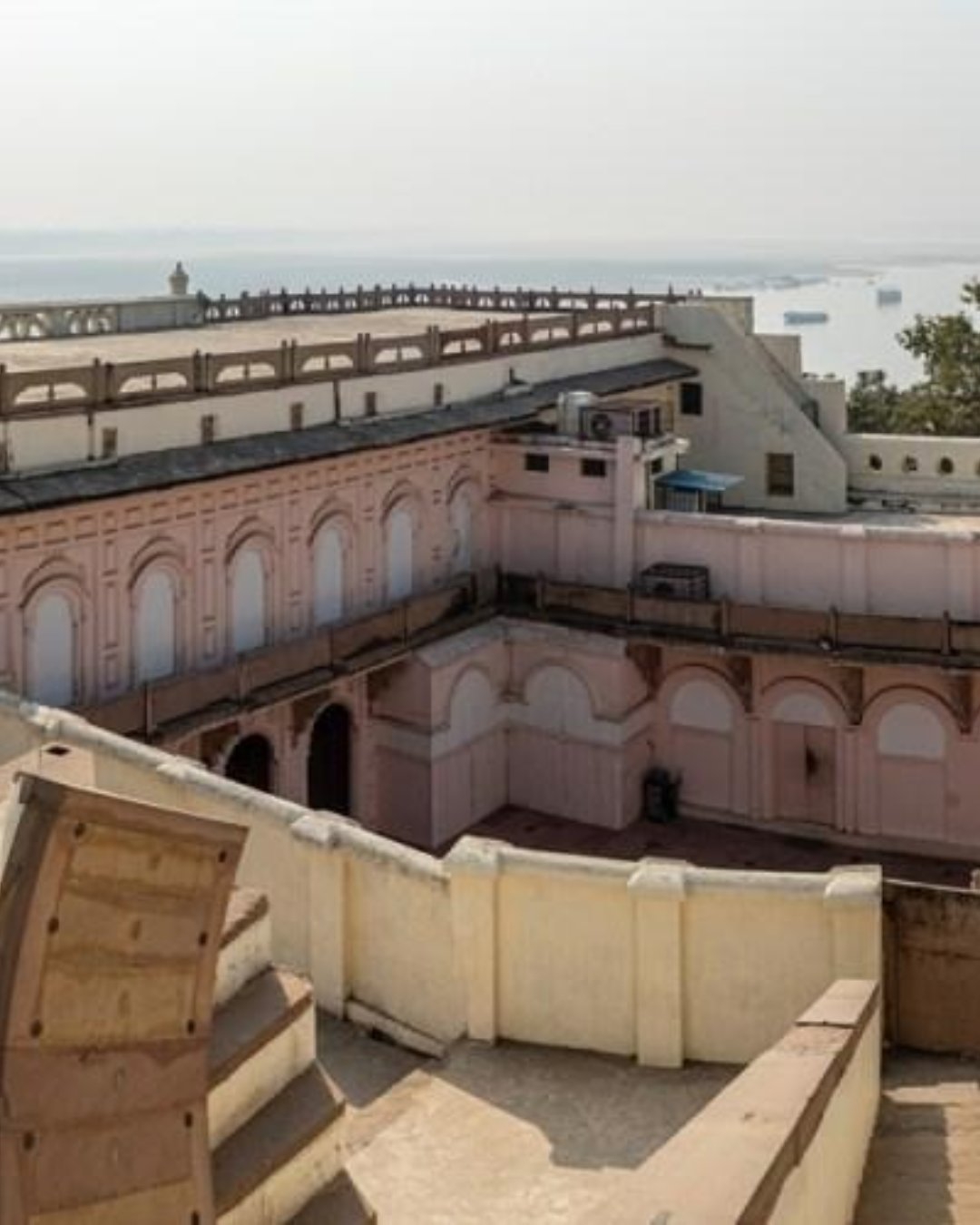
From the water you get a handsome Rajput palace facade and nothing more — the observatory is on the roof terrace, out of sight from below. The whole point of this stop is up there, which means you leave the boat and climb.
Go in the morning. The instruments are open to visitors in daylight hours, the terrace is quiet before the day heats up, and the low sun makes the stone shapes read clearly — which matters, because these are precision instruments disguised as sculpture, and flat midday light flattens them. It's a short, sharp visit: the palace below, the observatory above, half an hour well spent between the river and the lanes.
What you'll actually see
The Jantar Mantar instruments — masonry devices for tracking the sun, stars and time, built by Jai Singh II around 1737.
The palace — the Man Mandir itself, a Rajput-style riverfront mansion built by Raja Man Singh of Amber, which gives the ghat its name.
The terrace view — one of the best elevated vantage points over the central ghats and the curve of the Ganga.
Dashashwamedh Ghat — immediately to the south, making it easy to pair a morning observatory visit with an evening Ganga Aarti.
Take shoes with good grip — the stairs to the terrace are steep and centuries old — and carry sun protection, as the rooftop is open and largely unshaded.
And here's one place where it really is worth taking your phone out. Travellers who make the climb often say the same thing: unlike the temples or the cremation ghats, this is a site built to be observed and understood. Photographing the giant stone instruments against the backdrop of the river is genuinely rewarding. But look first, then take the picture. Spend a moment understanding what each instrument measures before framing it. Once you realise these enormous structures were designed to calculate time and track celestial movements with remarkable precision, they stop looking like abstract sculptures and begin to reveal their purpose.
Pro tip: Combine Man Mandir with Dashashwamedh Ghat. Visit the observatory in the cool morning light, then return to the same riverside area in the evening for the Ganga Aarti. Ask whether interpretive signage or a guide is available, because a few minutes of explanation makes the observatory far more meaningful. It's also worth checking opening hours in advance, as visitor access can occasionally vary.
The mistakes that ruin it
Most first-time visitors make the same mistakes. They admire the palace only from the boat without realising there's an observatory above it. They visit without learning what the instruments do, so everything looks like unusual stone architecture. Or they arrive in the middle of the afternoon, when the heat and harsh light make the experience less enjoyable.
The easy fix is to climb up in the morning and spend a little time understanding how the instruments work. Without the context, it's an interesting rooftop. With it, you're standing inside a 300-year-old astronomical observatory designed to measure the heavens.
Want the climb, the instruments, and someone to explain them?
Hit Do this trip— we'll arrange the visit.
70
MomentManikarnika Ghat, Varanasi

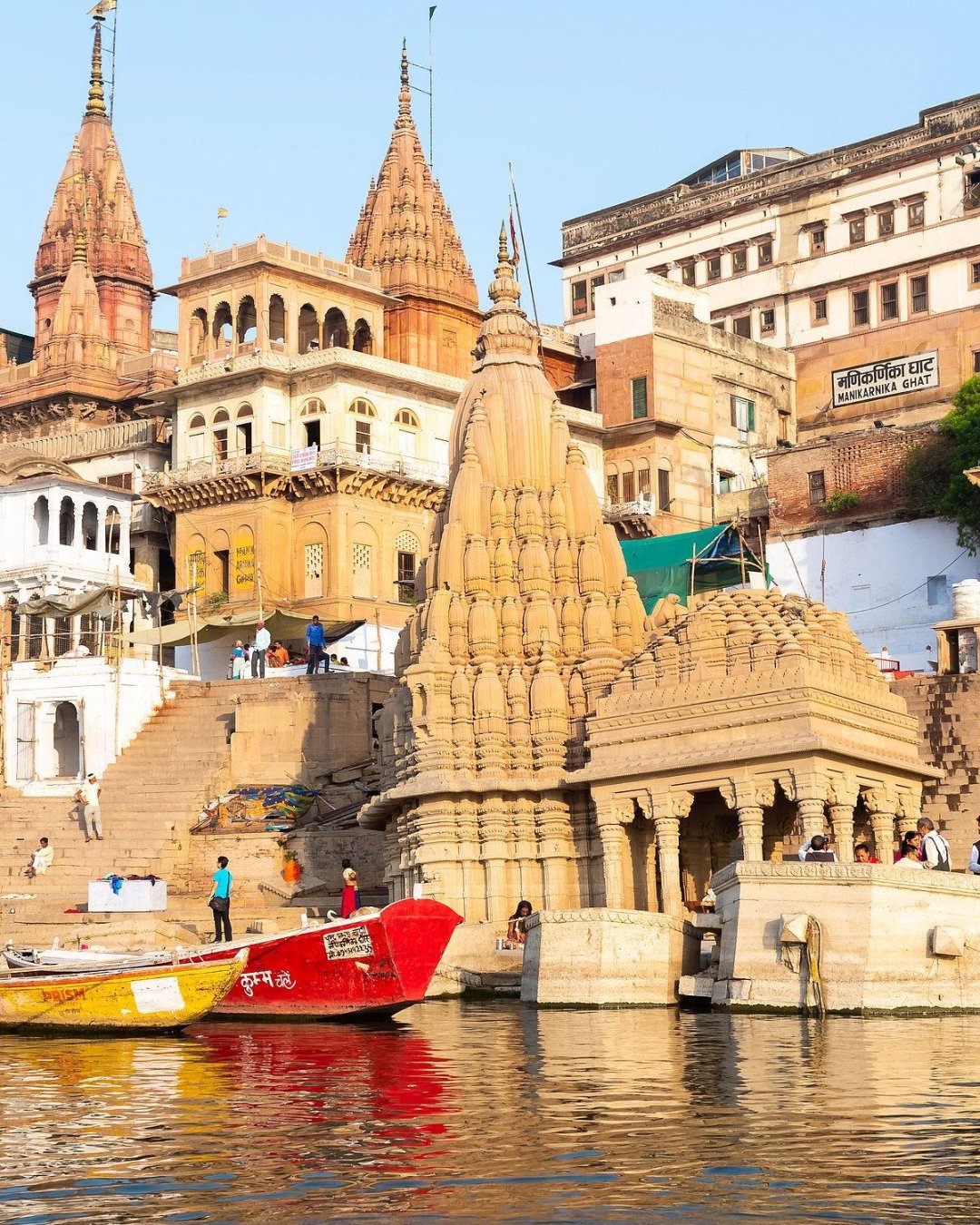
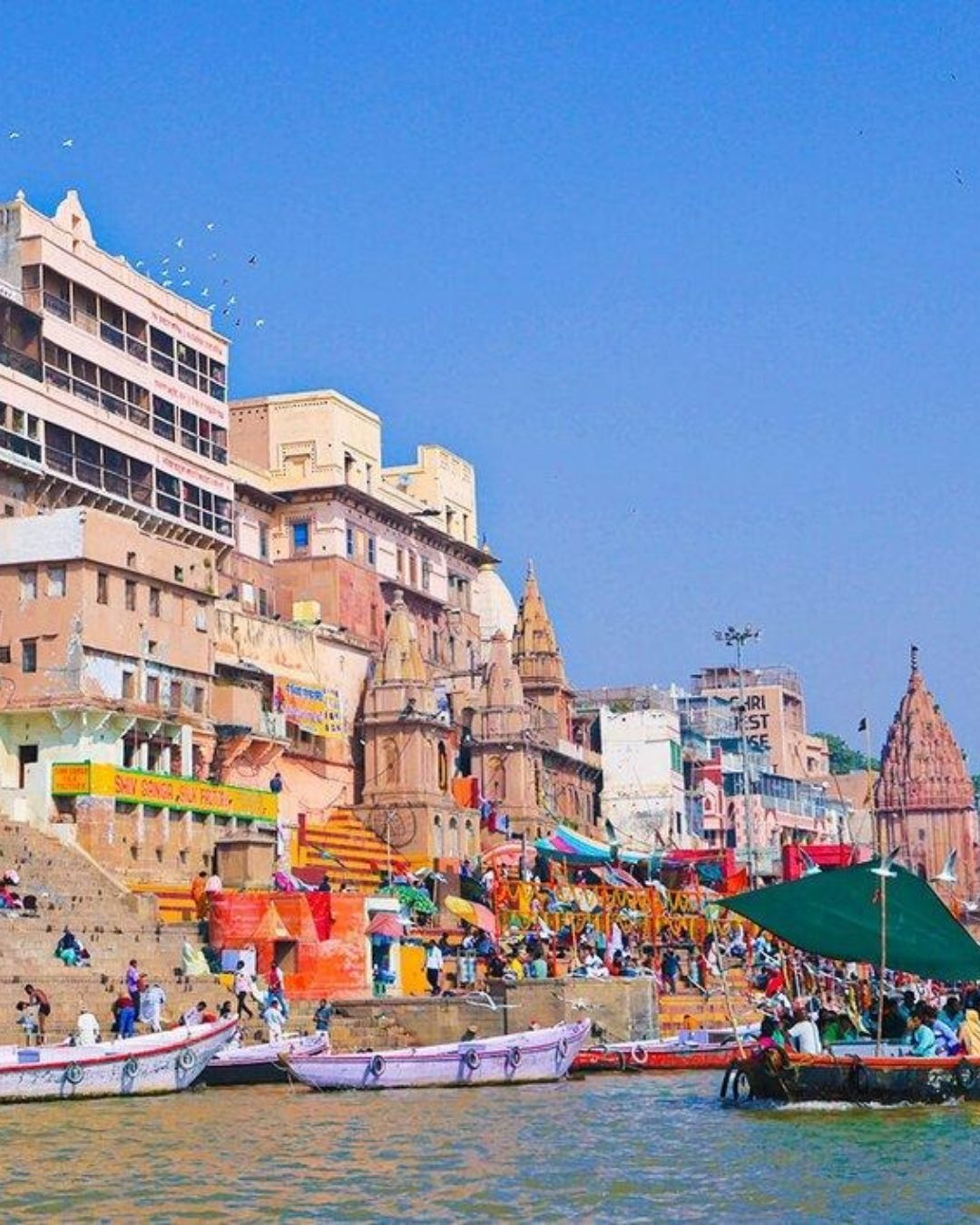
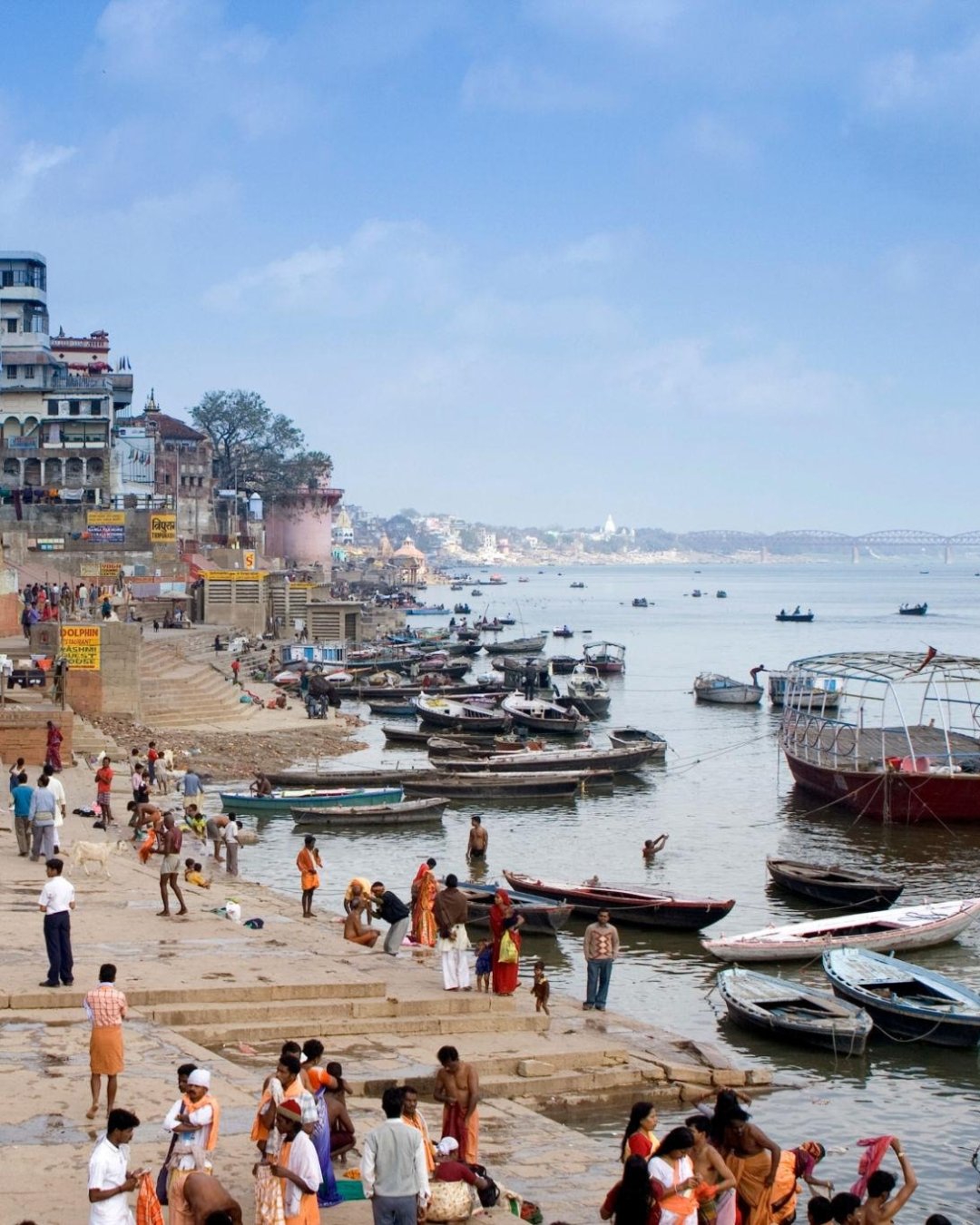
Manikarnika Ghat
You've probably been told you have to see it. The great burning ghat, fires day and night, the most famous cremation ground in the world — it's on every Varanasi list. But here's the thing nobody tells you: the way most visitors are steered to see it, walked in close by a "guide" who then asks you to buy wood for a grieving family, is both a scam and an intrusion on a real funeral. There's a better way to witness Manikarnika, and it's the one the touts don't offer.
Let's be clear about how to be here. Here's how Manikarnika actually works, and how to approach it the right way.
Why you see it from the water, not the steps
Manikarnika is a working cremation ground where roughly a hundred families a day bring their dead, in the belief that cremation here grants moksha — release from the cycle of rebirth. It is not a sight. It's a funeral, many funerals, happening in the open.
That single fact decides how you should approach it: from a boat, at a respectful distance, ideally as part of your sunrise ride. From the water you take in the scale of it — the pyres on the steps, the walls of stacked wood, the small flame said to have burned for centuries — without walking into the middle of someone's grief. On foot, at close range, you're intruding; from the river, you're witnessing. The distance isn't a compromise; it's the correct posture.
What you'll actually see, and how to hold it
The pyres — burning on the steps, day and night. You do not photograph them. Ever.
The stacked wood — sold by weight, a working economy, walls of it above the ghat.
The eternal flame — tended by the Dom community, who supply the fire for every pyre.
Manikarnika Kund — the ancient tank beside the ghat, older than the cremation ground itself.
Dress plainly and covered. This is not a place for bright clothes or a ready camera.
And the phone stays away completely — not for ten minutes, the whole time. Photographing cremations is forbidden and deeply offensive, and no image was ever yours to take. Travellers who approach this properly will tell you the same thing: you watch from the water, you take in what the city is showing you about death being ordinary and unhidden, and you leave. What stays with you isn't a picture — it couldn't be — it's having witnessed, quietly and at a remove, something most cultures keep behind closed doors.
A note in place of a pro tip: decline anyone who offers to walk you in close, show you a "rooftop view," or asks you to buy wood for a poor family — it's the oldest scam in Varanasi and the numbers climb fast. Nobody official will ever solicit you. You do not need a guide standing over a funeral. If you want to give, give to a registered charity later, not to a man on a staircase at night. And take it in from the boat you're already on rather than landing.
The mistakes to avoid
Most visitors who get this wrong do the same things. They let a tout walk them into a working ground for money. They raise a camera. Or they treat it as a dark-tourism box to tick and leave having understood nothing.
The right approach is to witness it briefly, from the water, at a respectful distance, with someone who can explain what you're seeing without turning it into a show.
On seeing it as part of your trip
Manikarnika is the moment most travellers remember longest — not because it's beautiful, but because it's honest. Approached with distance and respect, it's the most human hour the river will give you.
If you'd rather see it the right way — from the water, at a remove, with the context explained and none of the intrusion — our Varanasi journeys take it in properly as part of the sunrise boat passage, alongside the Ganga Aarti and the rest of the city. Pick your dates and we'll make sure it's done with care.
Want to see it the right way — from the water, at a remove?
Hit Do this trip— we'll make sure it's done properly.
59
MomentScindia Ghat, Varanasi

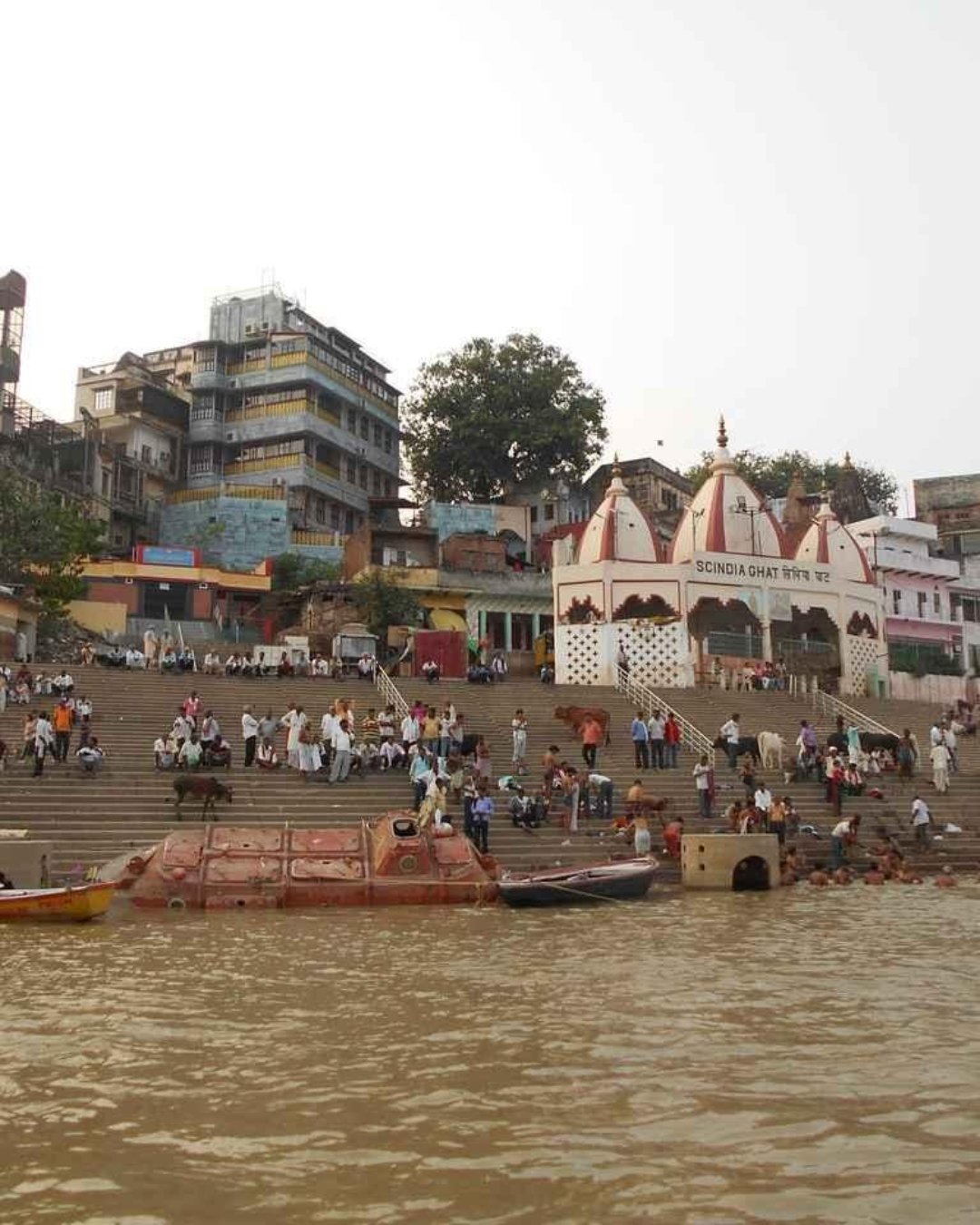
Scindia Ghat & Leaning Shiva Temple
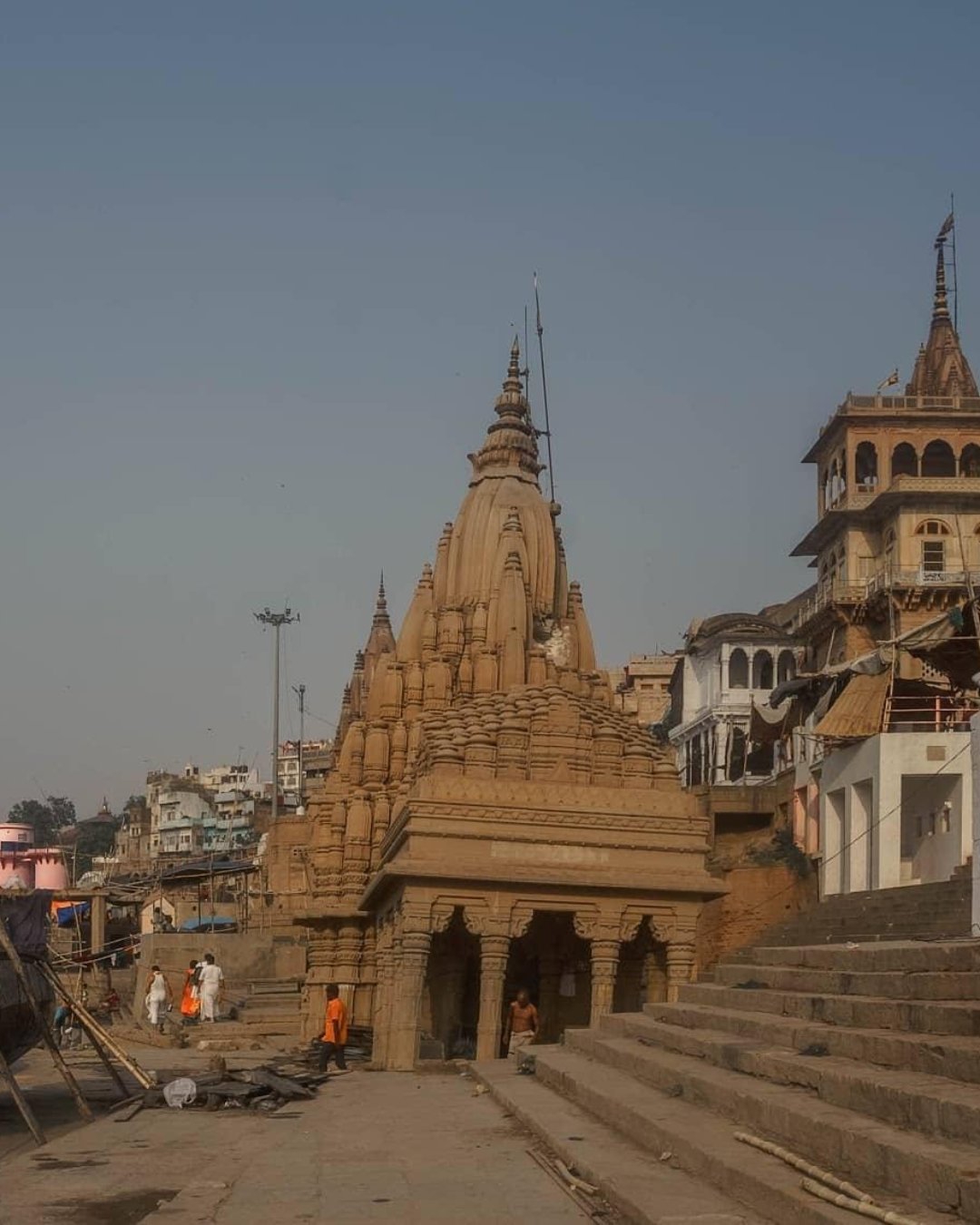
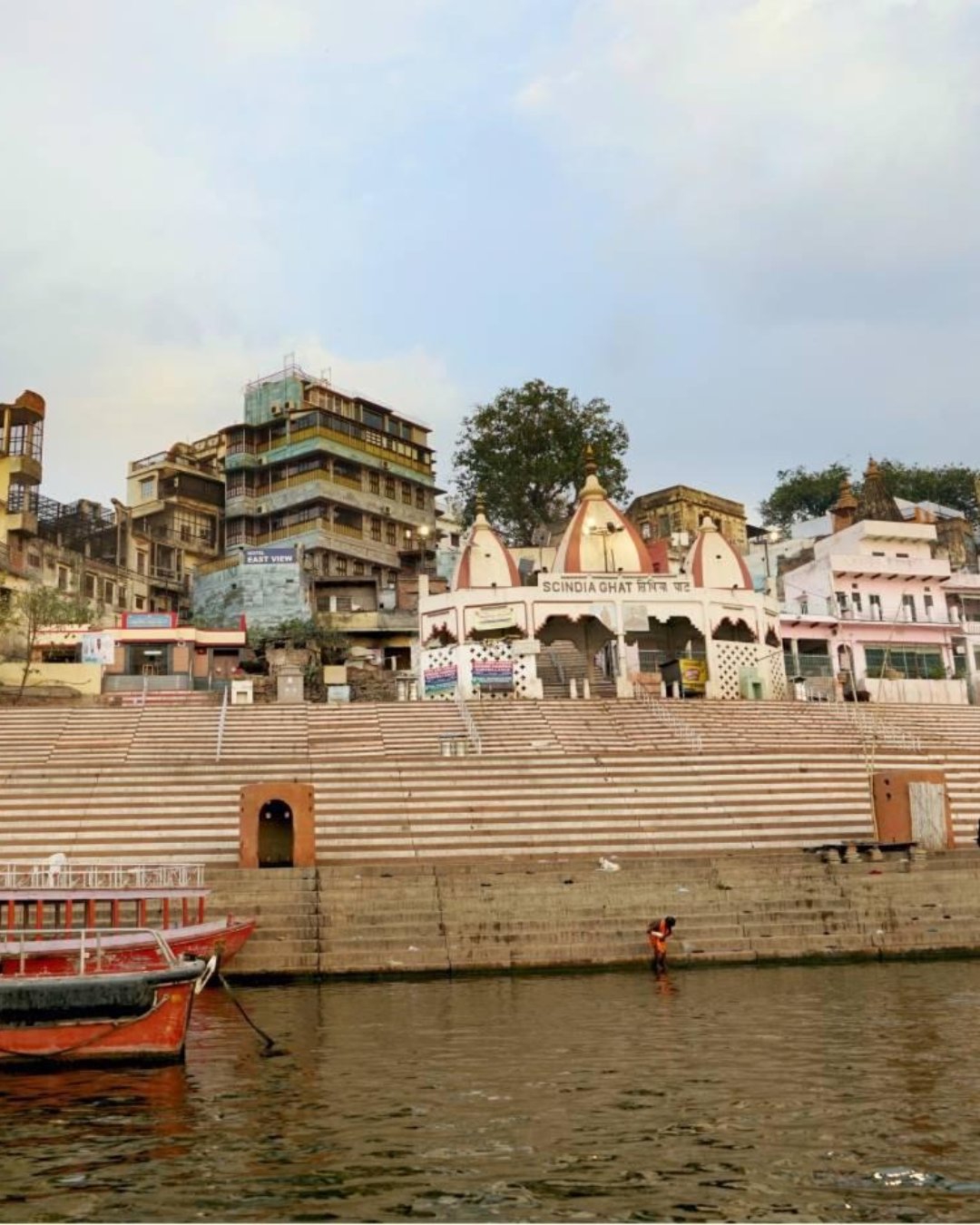
You've probably swept past it just after Manikarnika, when your attention's still on the burning ghat behind you. But here's the thing nobody tells you: half-submerged at the water's edge here is a Shiva temple that's sinking into the river — tilted, partly underwater, a spire leaning out of the Ganga at an angle no builder intended. It slid under its own weight when the ghat was built, and it's been leaning there ever since. It's one of the most photographed oddities on the riverfront, and half the boats glide past before anyone spots it.
Let's fix that. Here's how Scindia Ghat and its leaning temple actually work, and how to get it right the first time.
Why the water level, not the hour, decides your visit
This is the rare ghat where the season changes what you see. The leaning temple sits right at the waterline — so how much of it shows depends on where the river is. After the monsoon, when the Ganga is high, much of it is underwater and only the tilted spire breaks the surface. In the dry winter and spring months the water drops and more of the structure stands clear.
So if the sunken temple is what you've come for, the cooler, drier months (roughly November to May) show it best. Either way, the ghat reads well from the water in the morning light — Scindia rises steep and tall from the river, one of the more dramatic frontages north of the burning ghat, and dawn from a boat is when it looks its best.
What you'll actually see
The leaning Shiva temple — partly submerged at the water's edge, tilted from settling when the ghat was built in the 1830s.
The ghat frontage — steep, high steps built by the Scindia (Shinde) rulers of Gwalior, giving the ghat its name.
The lanes behind — a warren said locally to be the birthplace of Agni, the fire god, with old shrines tucked into the gullies.
Manikarnika — immediately south, so this comes right after the burning ghat on the boat.
If you land and explore the lanes, wear shoes you can slip off for the small temples, and go modestly dressed.
And here, as at Man Mandir, the phone earns its place — this is a secular curiosity, not a solemn site, so photographing the leaning temple is exactly the point. But look first. Travellers who spot it will tell you the same thing: from a moving boat it's easy to miss and easy to shoot badly, so ask your oarsman to slow or hold near it, take a moment to actually see the tilt against the water, then frame it. A rushed grab as you drift past never captures how strange it really is — that's the part the photos miss when you don't stop.
Pro tip: Ask your boatman to pause at Scindia — it comes just after Manikarnika, and a moving boat is why most people miss the temple entirely. Come in the drier months if you want to see more of the structure above water. And pair the ghat with a short walk into the lanes behind if you've time; the Agni legend and the old shrines are a quieter, stranger side of the city, well away from the crowds.
The mistakes that ruin it
Most first-timers trip over the same few things. They drift past without spotting the leaning temple at all. They come in high-water season expecting to see the whole structure and find most of it submerged. Or they shoot it in a blur from a moving boat and never really look.
The easy fix is to know it's coming, ask the boat to slow, and time your trip to the season that shows it — or let the ride be planned so this stretch isn't a blur.
Want the boatman to slow at the right spot? Hit Do this trip— we'll plan the pause into the ride.
53
MomentPancha Ganga Ghat, Varanasi

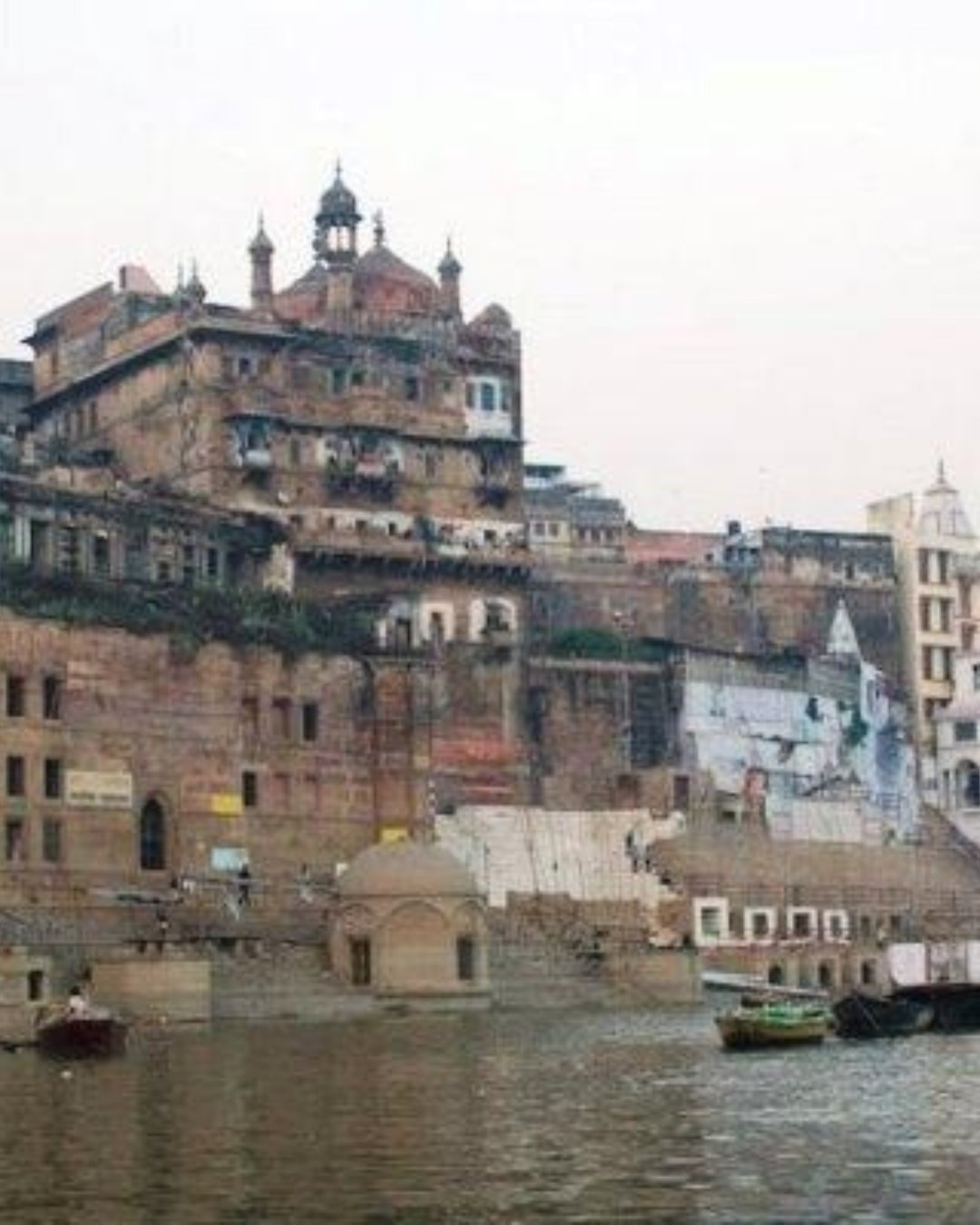
Panchganga Ghat
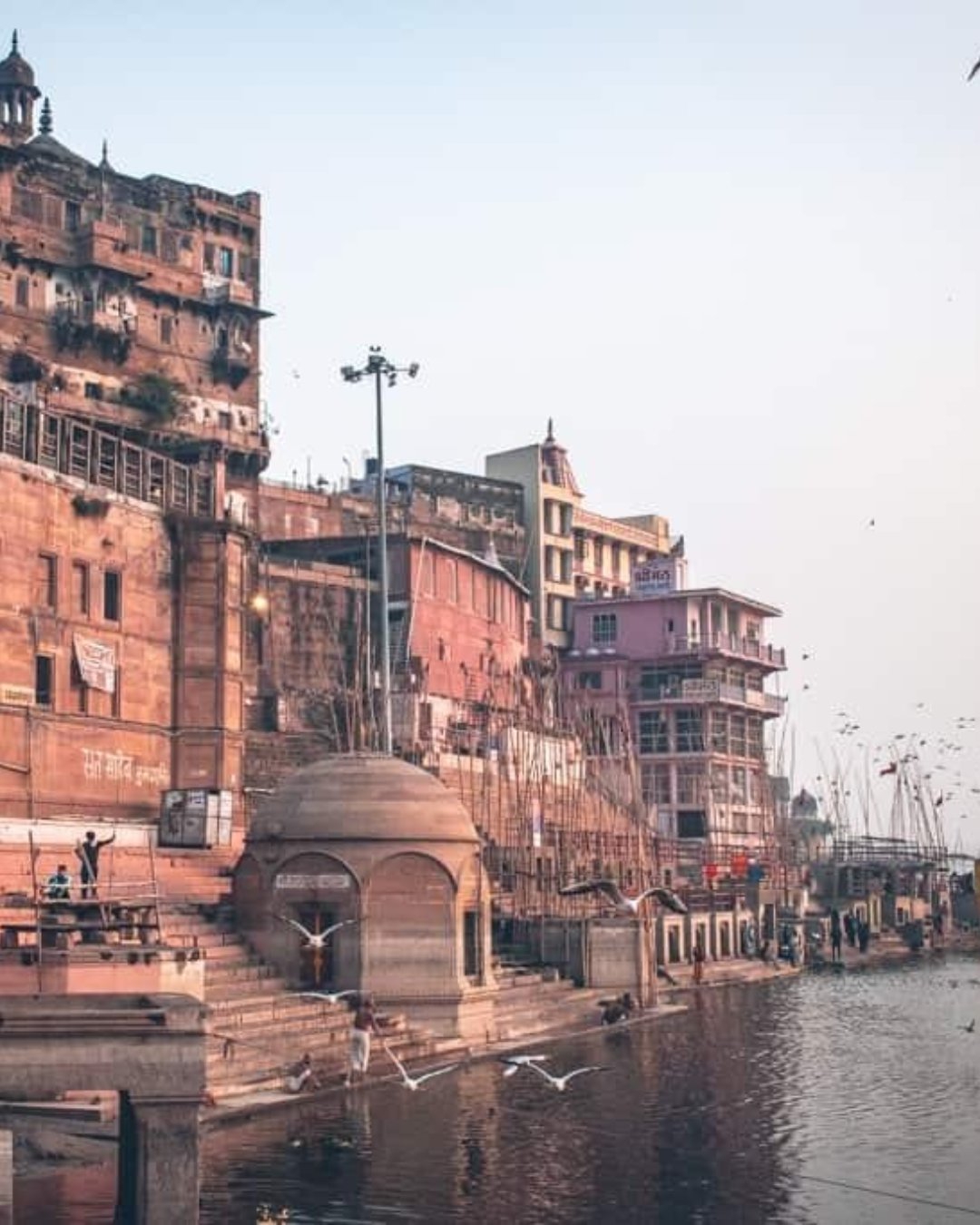
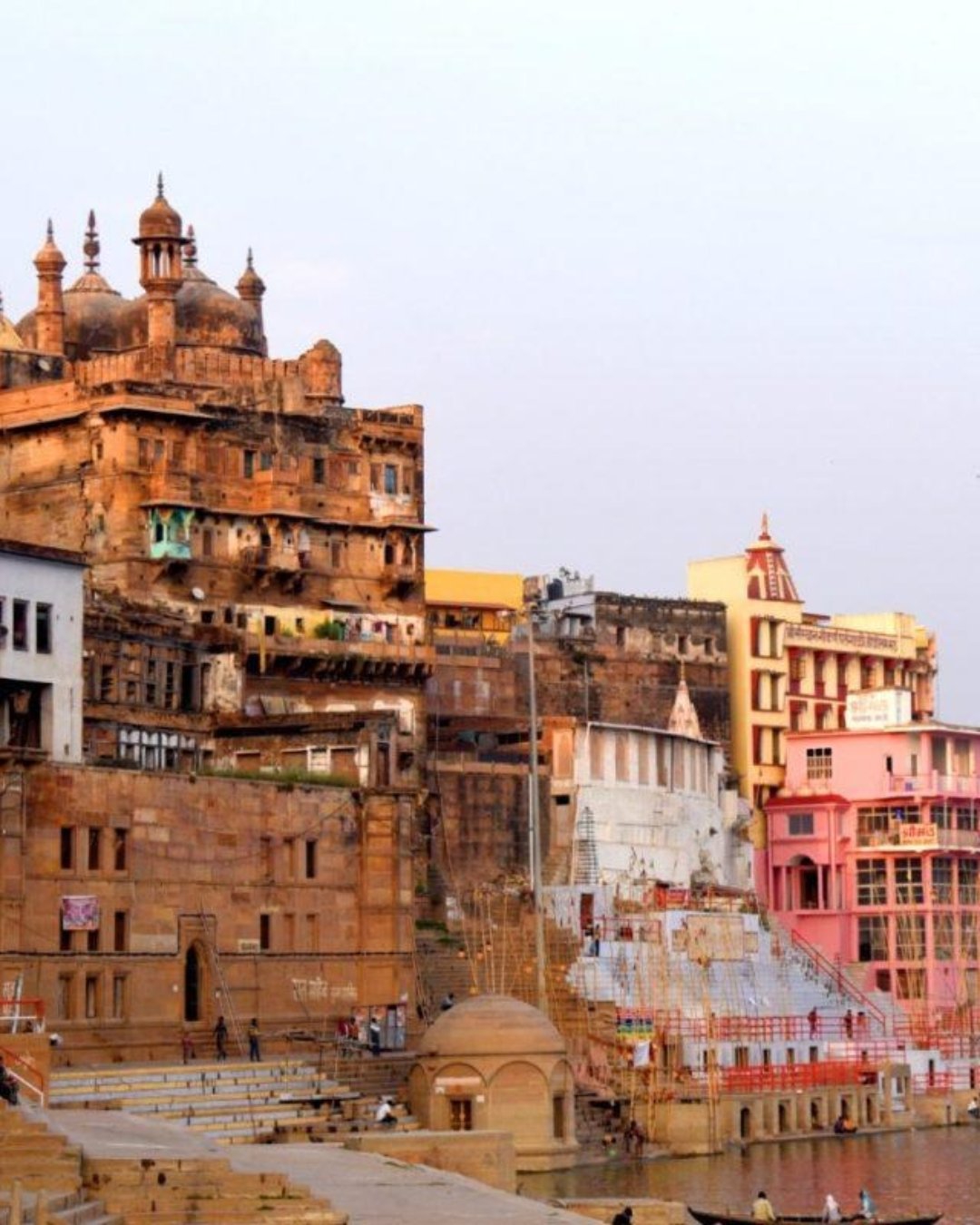
You've probably not had this one pointed out. It's further north than most boat rides go, past the busy central stretch, so a lot of visitors never reach it. But here's the thing nobody tells you: rising above Panchganga is the great Alamgir Mosque — Aurangzeb's mosque, built over a demolished Vishnu temple — and below it the ghat where, by tradition, five rivers meet, and where thousands of little lamps are lit each Kartik in one of the river's loveliest festivals. It's one of the most historically loaded spots on the whole waterfront, and it sits just past where most people turn their boats around.
Let's fix that. Here's how Panchganga Ghat actually works, and how to get it right the first time.
Why you go further, and ideally in Kartik
Panchganga is north of the central ghats, so reaching it means asking your boatman to row on past the usual turnaround. Most don't, unless you say so — which is exactly why it's quiet. On an ordinary morning it's a steep, historic ghat with a mosque looming over it and few other visitors.
But there's one time it transforms. Through the month of Kartik (October–November), and especially at Dev Deepavali — the full-moon festival when Varanasi lights up for the gods — Panchganga is famous for its hanging lamps, thousands of tiny diyas strung in tiered wooden frames down the ghat. If you can time your visit to Kartik, this is one of the most beautiful sights on the river. Outside it, come for the history and the calm.
What you'll actually see
Alamgir Mosque (Beni Madhav ka Dharara) — Aurangzeb's mosque on the height above the ghat, raised over an earlier Vishnu temple; its minarets are the northern skyline.
The five-rivers confluence — the tradition that gives Panchganga its name, where five sacred streams are said to meet.
The hanging lamp frames — the tiered wooden stands lit through Kartik, empty but visible the rest of the year.
Bindu Madhav Shrine — the Vishnu temple associated with the ghat, much reduced from its former size.
Dress modestly, particularly near the mosque, and take shoes you can remove. If you visit the mosque itself, cover appropriately and check whether non-worshippers are permitted that day.
And this stretch rewards putting the phone down at first — then, in Kartik, absolutely raising it. Travellers who reach Panchganga will tell you the same thing: on a normal day the pull is the layered history you can't photograph — a mosque over a temple over a confluence, centuries stacked on one hillside. During Dev Deepavali it flips, and the tiered lamps are one of the few genuinely photograph-worthy spectacles on the river. Either way, look before you shoot. The weight of the place, or the glow of a thousand flames, is the part a quick frame misses.
Pro tip: Ask your boatman in advance to row up to Panchganga — it's beyond the standard route and won't happen by default. If your dates fall in Kartik, prioritise it: Dev Deepavali here is extraordinary, though it's also crowded and best seen from a boat. Be respectful and discreet around the mosque, which is a sensitive as well as sacred site, and don't treat the layered temple-mosque history as a photo backdrop.
The mistakes that ruin it
Most first-timers trip over the same few things. They never get this far north because the boat turns back early. They come outside Kartik expecting the famous lamps and find empty frames. Or they treat a religiously and politically sensitive site casually.
The easy fix is to ask the boat to go the extra distance, time it to Kartik if the lamps are the draw, and come with a little context and a lot of respect for a complicated place.
Want the boat to row the extra stretch?
Hit Do this trip — we'll make sure you reach Panchganga.
51
MomentBanaras Ghat Rd, Varanasi

Lalita Ghat & Nepali Temple
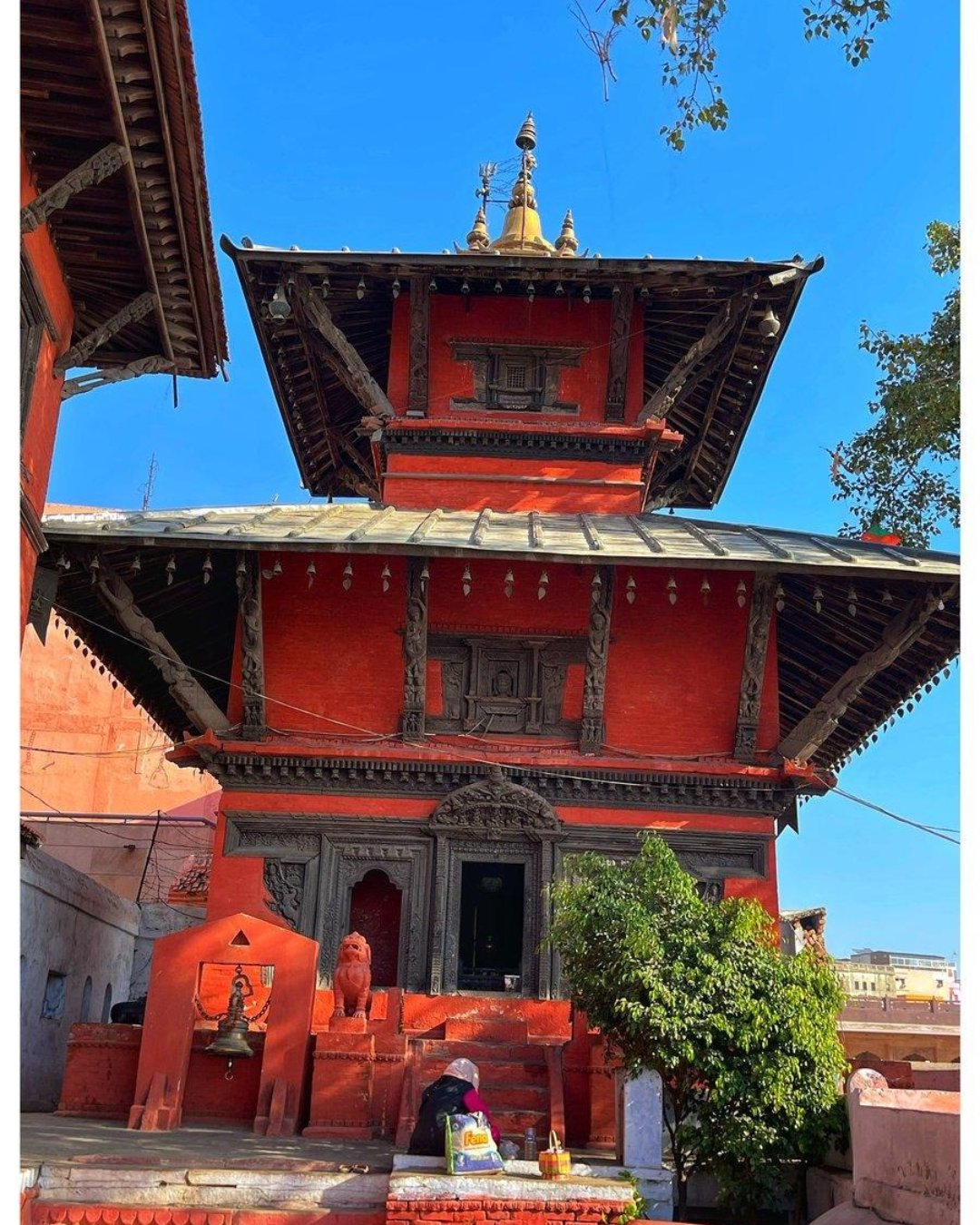
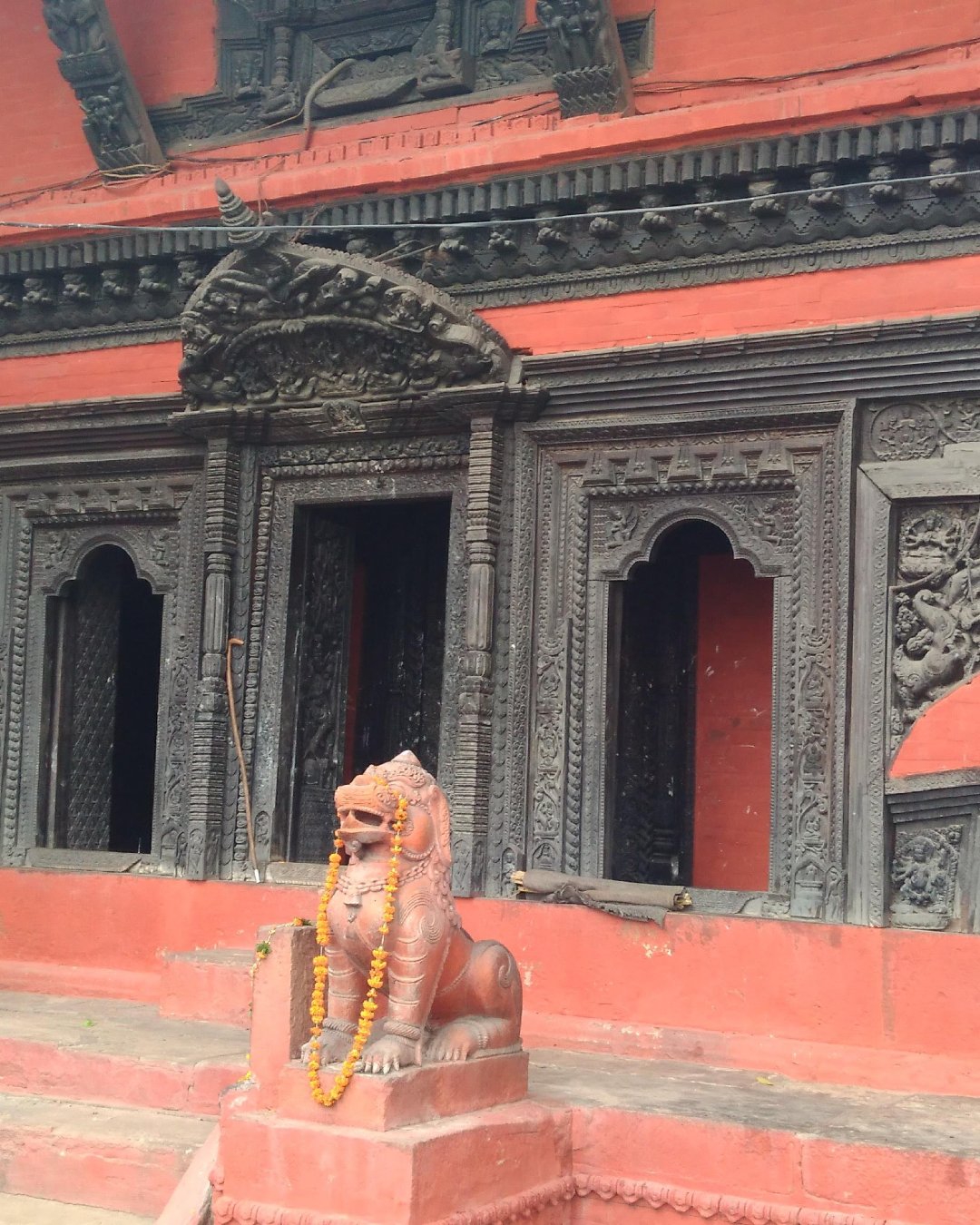
You've probably had your eye on the burning ghat right beside it and missed this one entirely. But here's the thing nobody tells you: just above Lalita Ghat stands a temple that looks like it was airlifted from Kathmandu — dark carved timber, a pagoda roof, struts covered in the kind of erotic carving you'd never expect on the Ganga. It's the Nepali Temple, built by a king of Nepal, and it's the single most architecturally surprising thing on the entire riverfront. Most visitors float past it looking the other way.
Let's fix that. Here's how Lalita Ghat and the Nepali Temple actually work, and how to get it right the first time.
Why you climb up, and go in the morning
From the water you get a glimpse of dark wood among the stone, but the temple sits up off the ghat, set back — you have to leave the boat and climb to see it properly. And it's worth the climb: this is a working Shiva temple (Kashi Vishwanath's Nepali counterpart, sometimes called Someshwar or the Kathwala Temple) built in Nepali pagoda style, entirely of timber, with carved wooden struts unlike anything else in the city.
Go in the morning. The temple is open in daylight hours, quiet before the day's heat, and the low sun catches the carved wood — which reads as a flat dark mass at midday. It's a short visit paired naturally with the ghat below, half an hour between the river and the lanes.
What you'll actually see
The Nepali Temple — a wooden pagoda-style Shiva temple built by a 19th-century king of Nepal, with intricately carved struts, some of them erotic in the Nepali tradition.
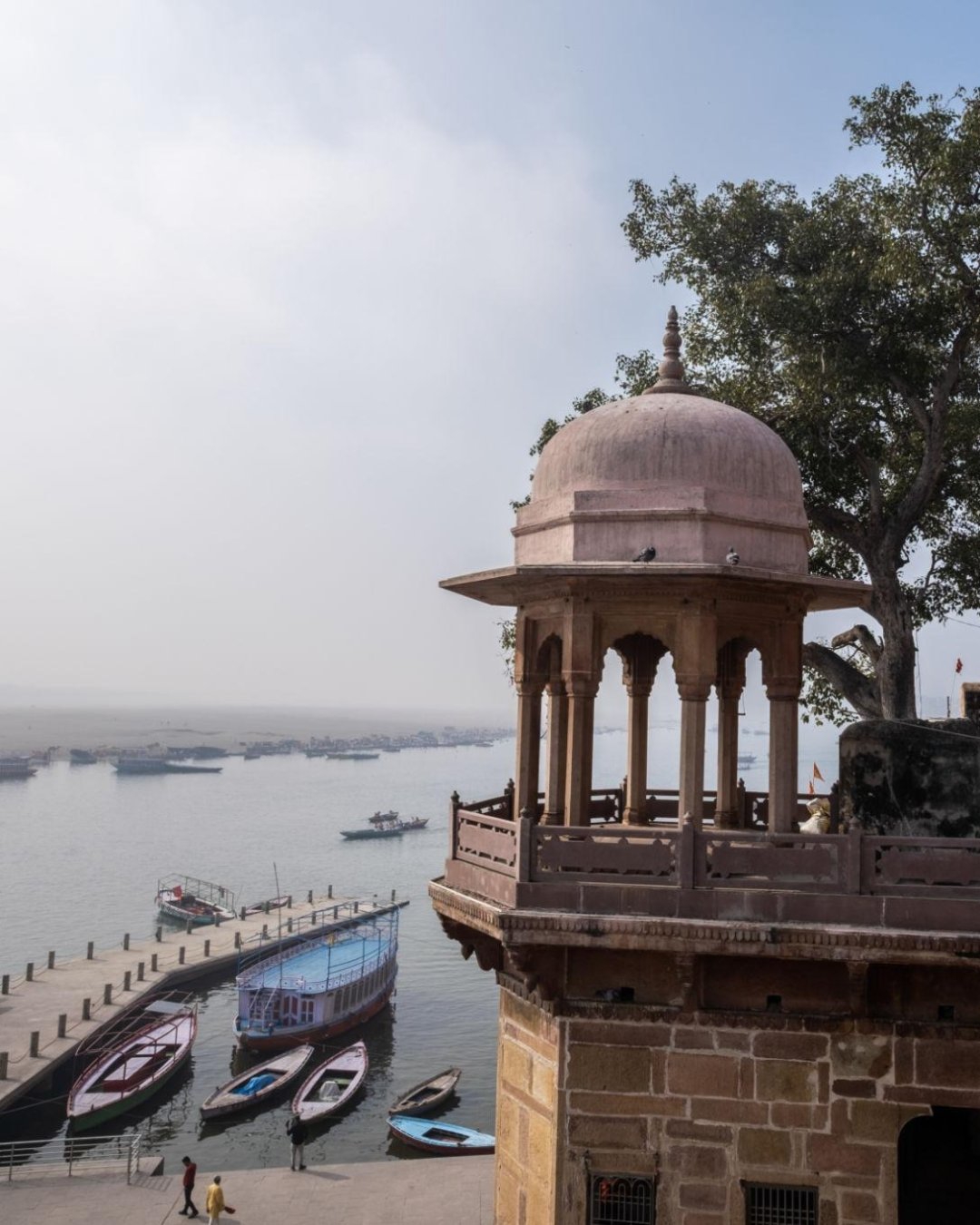
Lalita Ghat itself — the steps below, close to the Kashi Vishwanath Corridor's river end.
The Ganga view — the temple terrace looks out over the river and, just south, the smoke of Manikarnika.
The proximity to the Corridor — Lalita sits near the new Vishwanath Dham river gate, so it pairs with that approach.
Dress modestly and go barefoot from the shoe stand into the temple. Photography of the building is generally fine; be discreet and respectful about the carvings, especially with children present.
And this is one to look at properly before you shoot. Travellers who climb up will tell you the same thing: the instinct is to photograph the erotic carvings and giggle, but the temple is a genuine and rare piece of cross-Himalayan architecture, a bit of Nepal on the Ganga, and it repays a proper look. Stand under the eaves, take in the woodwork, understand what you're seeing — a Kathmandu temple on a Varanasi ghat — and then photograph it. That context is the part a quick snap of the carvings misses entirely.
Pro tip: Combine it with the Kashi Vishwanath Corridor, since Lalita Ghat sits right by the Corridor's river gate — do the temple, then walk up to the Dham, or arrive by boat and take both. Come in the morning for the light on the wood and the quiet. And be respectful about the erotic carvings: they're a normal part of Nepali temple tradition, not a novelty, and photographing them mockingly reads badly in a place of active worship.
The mistakes that ruin it
Most first-timers trip over the same few things. They see it only from the boat, distracted by Manikarnika beside it, and never climb up. They come at midday, when the carved wood goes flat and dark. Or they treat the temple as a joke rather than the rare piece of architecture it is.
The easy fix is to climb up in the morning, pair it with the Corridor next door, and come with a little context about what a Nepali pagoda temple is doing on the Ganga.
Want the climb, the woodwork, and the Corridor in one morning?
Hit Do this trip — we'll map the route.
57
MomentRaj Ghat, (Varanasi), Varanasi

Raj Ghat & Adi Keshava Temple
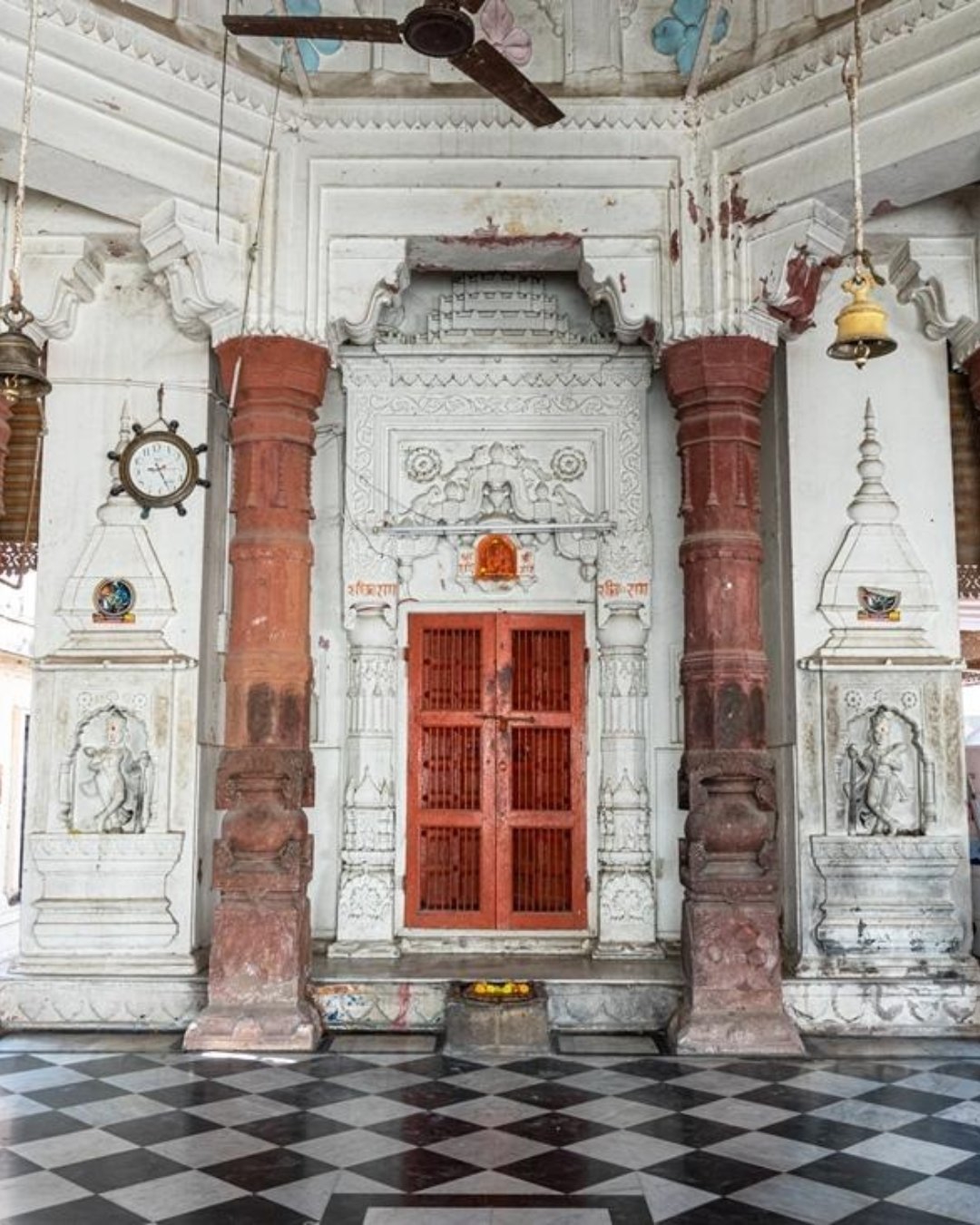
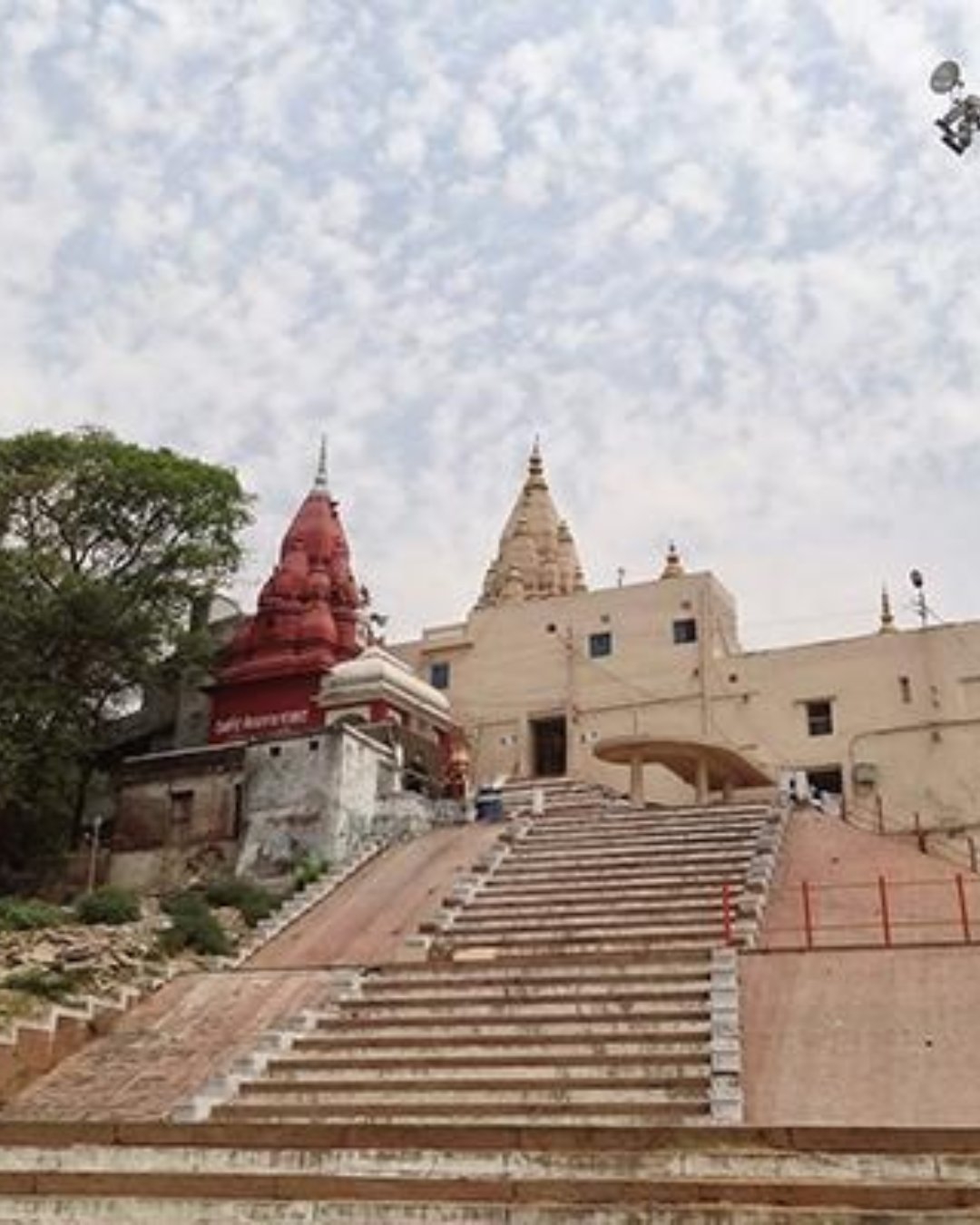
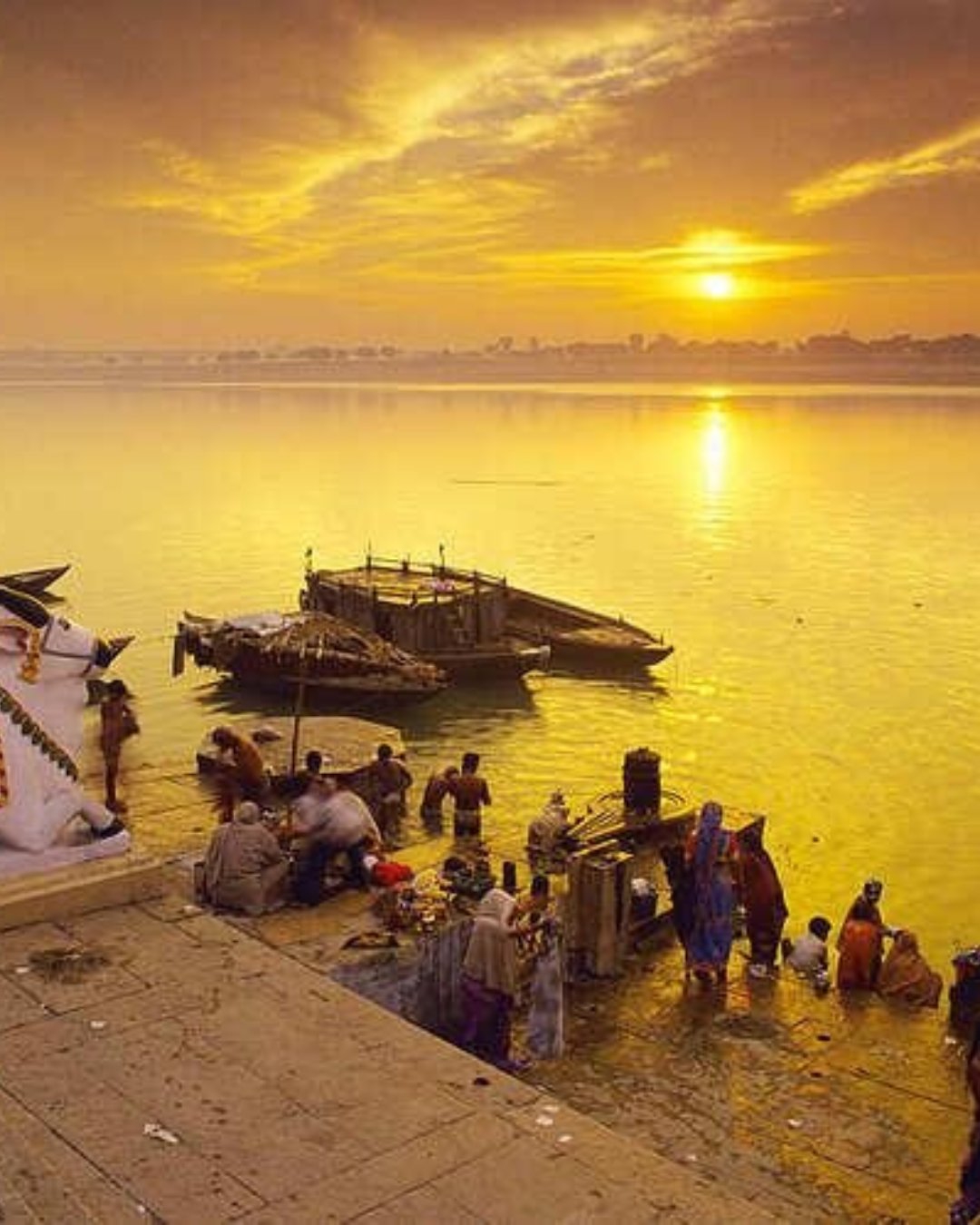
You've probably never been rowed this far. Raj Ghat sits at the very northern end of the waterfront, up where the Varuna River joins the Ganga — past every ghat on the standard route, past where the boats turn back. But here's the thing nobody tells you: this quiet, overlooked spot is where Varanasi began. The Adi Keshava Temple here marks the original settlement, the oldest sacred core of the city, and beneath the ground archaeologists have found the earliest layers of Kashi. Everyone crowds the central ghats; almost nobody visits the place the whole city grew from.
Let's fix that. Here's how Raj Ghat and the Adi Keshava Temple actually work, and how to get it right the first time.
Why you go to the very end, and by land
Raj Ghat is genuinely out of the way — the far northern edge, at the Varuna–Ganga confluence, well beyond the usual boat-ride turnaround. Rowing all the way here from the central ghats is a long haul, so this is often better reached by road, as a short dedicated trip, than tacked onto a dawn boat ride.
And it's not about a view. This is history you come to stand in, not photograph. Adi Keshava — "the First Vishnu" — marks the mythic and archaeological origin point of Varanasi, the spot where the Ganga meets the Varuna (one of the two rivers that give Varanasi its name, along with the Assi). Come in the morning, when the small temple is active and the confluence is calm, and give it the context it deserves, because without that it's simply an unremarkable ghat at the edge of the city.
What you'll actually see
Adi Keshava Temple — the "Original Vishnu" shrine marking the ancient nucleus of the city, at the Varuna–Ganga confluence.
The confluence — where the Varuna joins the Ganga; the northern bookend of the waterfront, just as Assi Ghat marks the southern end.
Raj Ghat itself — quiet, simple, and historically layered; nearby excavations have revealed some of the oldest settlement remains in Varanasi.
The Malviya Bridge — the historic road-and-rail bridge spanning the Ganga, one of the city's best-known landmarks.
Dress modestly and be prepared to remove your shoes before entering the temple. This is a working local shrine rather than a tourist attraction, so keeping a respectful, low profile is appreciated.
And this is a place to look and understand rather than photograph. Travellers who make the journey out here often say the same thing: there's no spectacle — no grand aarti, no burning ghat, no dramatic scene — only the quiet knowledge that the entire city stretching downstream grew outward from this modest point. Standing where Kashi began, away from the crowds, is the experience that stays with you long after you leave, even though there's very little that seems extraordinary in a photograph.
Pro tip: Treat Raj Ghat as a dedicated heritage visit rather than the final stop of a boat ride. It's too far north to comfortably include in a standard river excursion, and the reward here is historical context rather than scenery. Visit with someone who can explain the significance of Adi Keshava, and take a few moments at the Varuna–Ganga confluence and the Malviya Bridge to appreciate the city's original northern boundary.
The mistakes that ruin it
Most first-time visitors make the same mistakes. They never come because the boats don't usually travel this far. They arrive without knowing this is considered the birthplace of Varanasi, so it feels like just another quiet riverside ghat. Or they expect a grand attraction and instead find a peaceful temple on the city's edge.
The easy fix is to make a short, intentional visit with someone who can explain why this place matters — because without the story, Raj Ghat is simply where the riverfront seems to end.
Want to reach where Kashi began? Hit Do this trip — we'll arrange the drive and the temple visit.
Destination
Varanasi, Uttar Pradesh, India
People also ask
01Question
How much does a boat ride cost at Varanasi ghats?
Yes. For your Varanasi Ghats Journey, a Ganga boat ride is one of the most important experiences. The price varies considerably depending on whether you take a shared boat, hire a private rowboat, choose a motorboat, or book a special Ganga Aarti boat. Current 2026 sources show this variation clearly.
Before boarding, confirm these 5 things
- Total price — per person or entire boat?
- Duration — 60 minutes, 90 minutes or 2 hours?
- Route — which ghats will you actually see?
- Aarti included? — especially for evening rides.
- Life jackets — confirm availability, particularly for children.
02Question
What time does Ganga Aarti start at Dashashwamedh Ghat?
The Ganga Aarti at Dashashwamedh Ghat is held every evening. The exact start time shifts with sunset and the season.
The 6:15 PM winter / 6:45 PM summer figures should be treated as approximate rather than a fixed daily timetable because the ceremony follows the evening/sunset schedule. The official Varanasi district tourism site confirms that the evening Ganga Aarti is a major attraction and that Dashashwamedh Ghat is one of the principal access points to the ghats.
03Question
Is it safe to take a boat ride in Varanasi during monsoon?
Yes—but not throughout the monsoon. A boat ride on the Ganga can be safe during periods of normal river conditions, but high water, strong currents, heavy rain and flooding can lead authorities to suspend boat operations.
There is no blanket rule that boats stop for the entire June–September monsoon. Restrictions are imposed according to actual river conditions. After a major suspension in 2025, authorities later allowed boats to resume only during restricted daytime hours and continued to prohibit evening Aarti boat rides because of strong currents.
04Question
Can you take photos at Manikarnika Ghat?
No — you should not photograph the cremation ceremonies at Manikarnika Ghat. This is an active Hindu cremation site, not a normal sightseeing spot, and photographing people, bodies, funeral rituals, or grieving families is deeply disrespectful and can lead to confrontation.
What happens if you try?
* 🚫 Do not point a camera or phone toward a cremation.
* 📵 If attendants, family members, or locals ask you to stop, put the phone/camera away immediately.
* ⚠️ Don't use zoom lenses or secretly photograph from a boat or nearby rooftop.
* 👮 Local rules and enforcement can vary, but you should not assume that something is acceptable simply because you can physically take the photograph.
05Question
Which side of the boat is best for Ganga Aarti viewing?
For the best view of the Dashashwamedh Ghat Ganga Aarti, try to position your boat slightly upstream/north of the main Aarti platforms, facing the ghat. This gives you a clear view of the priests, lamps, and beautiful reflections across the Ganga. Arrive 45–60 minutes early and confirm your preferred position with the boatman before boarding.
06Question
How many days do you need for Varanasi ghats?
To experience the Varanasi Ghats without rushing, we recommend keeping at least 2 days. On the first day, begin with a peaceful sunrise boat ride on the Ganga, followed by a walk through the historic ghats, important temples, and the evening Ganga Aarti at Dashashwamedh Ghat. On the second day, explore the deeper heritage of Varanasi—from Manikarnika, Scindia and Panchganga Ghats to the northern riverfront and Sarnath.
07Question
What should I wear when visiting Varanasi ghats?
When exploring the Varanasi Ghats, choose clothing that keeps you comfortable while respecting the spiritual character of the city. For temple visits, modest clothing covering the shoulders and knees is the safest choice, while lightweight cotton or linen outfits work well for walking along the ghats and taking boat rides.
Comfortable full-length trousers, kurtas, salwar-kameez, sarees, or long dresses are practical options. Most importantly, wear sturdy sandals or shoes with good grip—the stone ghat steps can become wet and slippery, particularly during the monsoon.
Experience layers
Go further into one part of this trip.