
Narrative Travelogues: Types & How to Write One
Learn what narrative travelogues are, explore the different types, and discover how to turn your journeys into powerful travel stories worth reading.

Someone asks you about your trip. You start listing: "We went to Jaipur, then Udaipur, then Jodhpur. Saw the forts. The food was good. Weather was nice." And somewhere around the third city name, you realise you're boring yourself. Because the trip wasn't about the forts. It was about the moment your mother got lost in the old city market and came back laughing with a bag of bangles she didn't need. It was about the silence at the lake at five in the morning when the whole city was asleep. It was about the autorickshaw driver who told you a story about his daughter's wedding that made you cry.
That's the difference between describing a trip and telling its story. A narrative travelogue doesn't list destinations. It takes you inside the experience — the emotions, the details, the moments that made the journey matter. It turns a holiday into something someone else can feel. And that transformation — from itinerary to story — is what this guide is about.
What Is a Narrative Travelogue?
A narrative travelogue is a travel story that combines personal experience, observation, emotion, and reflection into a meaningful narrative. It doesn't just tell you where someone went — it tells you what it was like to be there. What they saw that nobody else noticed. How the journey changed the way they think. What happened between the destinations that mattered more than the destinations themselves.
Think of it this way: a travel guide says, "Visit the temple at sunrise." A narrative travelogue says, "I reached the temple before the sun, when the stone was still cold and the only sound was a priest chanting somewhere inside. The light arrived slowly, turning the walls from grey to gold. And for a few minutes, I forgot I had anywhere else to be."
Narrative travelogues focus on story flow — not just facts or locations. They follow the emotional arc of a journey. They use sensory details to make places vivid. They include honest reflection that gives the story meaning. And they trust the reader to feel something rather than just learn something.
What Makes a Narrative Travelogue Powerful
A Storytelling Perspective
Every narrative travelogue is told through someone's eyes — and that perspective shapes everything. The same mountain looks different to a first-time trekker, a grieving widow, and a child on their first holiday. Travel narrative writing works because it doesn't pretend to be objective. It's personal. It's "here's what I saw, here's what I felt, here's what I think it means." That honesty is what makes readers trust the story.
An Emotional Journey
The best narrative travelogues don't just move through geography — they move through emotion. The nervousness of arriving somewhere alone. The surprise of discovering beauty where you expected nothing. The quiet sadness of leaving a place that felt like home after only three days. These emotional shifts are the real plot of a travelogue. Without them, it's just a list of places.
Meaningful Moments
Not every moment of a journey belongs in a travelogue. The powerful ones do — the conversation with a stranger that changed your perspective, the wrong turn that led to the best view, the meal that tasted like someone's love. A narrative travelogue selects moments with intention, giving each one enough space to breathe and resonate.
Descriptive Observations
Sensory detail is the language of travelogues. Not "the market was busy" but "the market smelled of cumin and diesel and marigolds, and the noise was so thick you could lean against it." Details make a place real for someone who's never been there. They're the difference between reading about a place and visiting it through words.
Reflection and Insight
The moment that separates a good travelogue from a forgettable one is reflection — when the writer pauses and asks, "What did this mean to me?" Travel without reflection is tourism. Travel with reflection is a travelogue. It's the sentence after the beautiful description that says, "And standing there, I understood something about myself that I'd been avoiding."
What moment from your travels would make the beginning of a story? Not the most famous place you visited — the most honest moment you experienced.
The Different Types of Travelogues
Not all narrative travelogues tell the same kind of story. The types of travelogues vary based on what the writer focuses on — their inner world, the culture around them, the physical challenge of the journey, or the images they capture. Here are the main forms.
Personal Travel Narratives
This is the most common and perhaps the most intimate type. A personal travel narrative centres on the writer's own experience — their thoughts, feelings, fears, joys, and realisations during a journey. The destination is the backdrop. The real subject is the person moving through it. A solo trip to Varanasi that becomes a meditation on grief. A road trip with friends that becomes a story about growing apart. These travelogues resonate because they're universal — we recognise our own emotions in someone else's journey.
Cultural Travelogues
A cultural travelogue shifts the lens outward — toward the people, traditions, customs, and everyday life of the places visited. It's less about what the writer felt and more about what they observed. The spice trader in Kochi who explained why his family has sold the same blend for four generations. The women in a Rajasthani village who draw water from the same well their grandmothers used. The festival preparation in a small town that transforms quiet streets into a riot of colour and sound.
Cultural travelogues capture what guidebooks ignore — the living, breathing texture of how people actually exist in a place. They require patience, curiosity, and the willingness to sit with people rather than just photograph them.
Adventure Travel Narratives
When the journey itself is the challenge — a Himalayan trek, a cycling trip across a state, a kayaking expedition through backwaters — the travelogue becomes an adventure narrative. These stories carry physical stakes: exhaustion, weather, terrain, the body's limits. But the best adventure travelogues go beyond adrenaline. They find quiet moments inside the struggle — the view after twelve hours of climbing, the silence at a camp where the only sound is your own breathing, the moment your legs give up but your mind doesn't.
Reflective Journeys
Some travelogues are less about the place and more about what the place unlocks inside the writer. A spiritual pilgrimage where every temple is a doorway into a personal question. A return to a childhood hometown that's changed beyond recognition. A journey taken after loss, where every landscape echoes something that's no longer there. Reflective travelogues are philosophical without being preachy. They use the journey as a mirror — and the reader sees their own reflection in it.
Photographic Travelogues
A photographic travelogue uses images as the primary narrative vehicle — supported by written reflections that add context, emotion, and meaning. The photograph shows you what a place looks like. The text tells you what it felt like. Together, they create something neither could achieve alone. A photo of a foggy mountain road is beautiful. The same photo with three lines about why the writer was driving that road at four in the morning — running from something or toward something — becomes unforgettable.
Photos and stories work like music and lyrics. Either can exist without the other. But together, they hit harder. Platforms like Pinaak are built around this principle — helping travellers combine their photos with personal reflections to create photographic travelogues that preserve both the visual and the emotional truth of a journey.
What journey changed the way you see the world? Was it a place — or was it a moment inside a place that you weren't expecting?
How to Write Your Own Narrative Travelogue
You don't need to be a professional writer. You don't need to have visited exotic destinations. You just need a journey that meant something to you — and the willingness to tell it honestly. Here's how to begin.
Start with a Meaningful Moment
Don't start with the airport. Don't start with "We left on Tuesday." Start with the moment that made the trip worth telling. Maybe it's the instant you saw the valley and stopped breathing. Maybe it's the argument in the car that somehow led to the best conversation of the trip. Begin where the emotion begins.
Follow the Emotional Flow
A narrative travelogue doesn't need to follow the chronological order of your itinerary. It needs to follow the emotional order of your experience. If the most powerful moment happened on day three, that might be where your story starts. The emotional arc — from anticipation to surprise to reflection — is more compelling than the travel timeline.
Fill the Story with Sensory Details
What did the place smell like? What sound woke you up in the morning? What did the chai taste like at the roadside stall where you waited for the bus? Sensory details transport the reader. They turn your words into an experience rather than a description. Write with your senses, not just your memory.
Reflect on What Changed
Every meaningful journey changes something — a belief, a fear, a relationship, a perspective. Your travelogue should acknowledge that change. Not dramatically. Not artificially. Just honestly. "Before this trip, I thought I needed plans. After three days of getting lost, I realised I needed fewer of them." That's reflection. And that's what makes a reader nod and think, "I know exactly what that feels like."
Narrative Travelogues in the Modern World
Narrative travelogues were once the territory of published authors and explorers. Today, they live everywhere — in books, blogs, podcasts, social media captions, and digital platforms. The format has democratised. Anyone with a journey and a voice can create a travelogue that resonates with someone on the other side of the country or the world.
Platforms like Pinaak continue this evolution by giving travellers the tools to organise their photos and reflections into structured narrative travelogues — combining the visual power of photographic travelogues with the emotional depth of personal narratives. Whether you write three paragraphs or three thousand words, the principle remains the same: tell the truth about what you experienced, and someone will connect with it.
Frequently Asked Questions
What are the types of travelogues?
The main types of travelogues include personal travel narratives (focused on individual experience), cultural travelogues (focused on local customs and everyday life), adventure travel narratives (focused on physical journeys and challenges), reflective travelogues (focused on inner transformation), and photographic travelogues (combining images with written reflections). Each type offers a different lens for experiencing and sharing journeys.
What is a narrative travelogue?
A narrative travelogue is a travel story that combines personal experience, observation, emotion, and reflection into a meaningful narrative. Unlike a travel guide that lists facts and recommendations, a narrative travelogue follows the emotional flow of a journey — telling what happened, how it felt, and what changed in the traveller. It reads like a story, using storytelling techniques to make the reader feel present.
What is a cultural travelogue?
A cultural travelogue focuses on capturing the culture, traditions, customs, and everyday life of places visited. Rather than describing landmarks, it explores how people live — their food, rituals, conversations, and community dynamics. It emphasises human connection and cross-cultural understanding, revealing insights that surface-level tourism often misses.
What is a photographic travelogue?
A photographic travelogue combines travel photography with written reflections and narrative storytelling to create a visual journey. Unlike a photo album, it adds context, emotion, and meaning to each image. The photographs and words work together to create a richer experience than either could alone. Platforms like Pinaak help create photographic travelogues by combining photos with personal reflections.
How is a narrative travelogue different from a travel guide?
A narrative travelogue tells the story of a journey — focusing on personal experience, emotions, and reflection. A travel guide provides practical information like recommendations, directions, and tips. Travel guides answer "where to go and what to do." Narrative travelogues answer "what it was like and why it mattered." The key difference is purpose: one helps you plan a trip, the other helps you feel one.
Your Journey Is Already a Story
You don't need to climb a mountain or cross an ocean to write a narrative travelogue. You need to have been somewhere — anywhere — and paid enough attention to remember how it felt. The weekend drive that turned into an unexpected detour. The train ride where you watched the landscape change and something shifted inside you. The quiet morning in a place that wasn't home, where you realised you were happy.
Those are stories. They're already inside you. A narrative travelogue is simply the act of giving them shape — a beginning, a middle, a reflection. It's choosing to remember with intention rather than let the details dissolve into the noise of daily life.
A journey becomes unforgettable not when it ends — but when it becomes a story worth telling and remembering. Every trip you've taken holds the seed of a travelogue. Every unexpected moment, every quiet observation, every honest emotion is a sentence waiting to be written.
So start writing. Pick a journey. Find the moment that mattered most. And tell it the way you'd tell a friend sitting across from you at a table — with warmth, with detail, and with the kind of honesty that makes someone lean in and say, "Tell me more."
Your journey is already a story — give it shape.
Ready to turn your journeys into narrative travelogues?
Pinaak helps you combine photos and reflections into structured travelogues — not a photo dump, but a real story worth reading.

Keep Reading

Photo Travelogue: Turn Travel Photos into Stories
Learn how to transform travel photos into meaningful travelogues. Why photos alone lose meaning over time, and how to preserve the full story of your journeys.
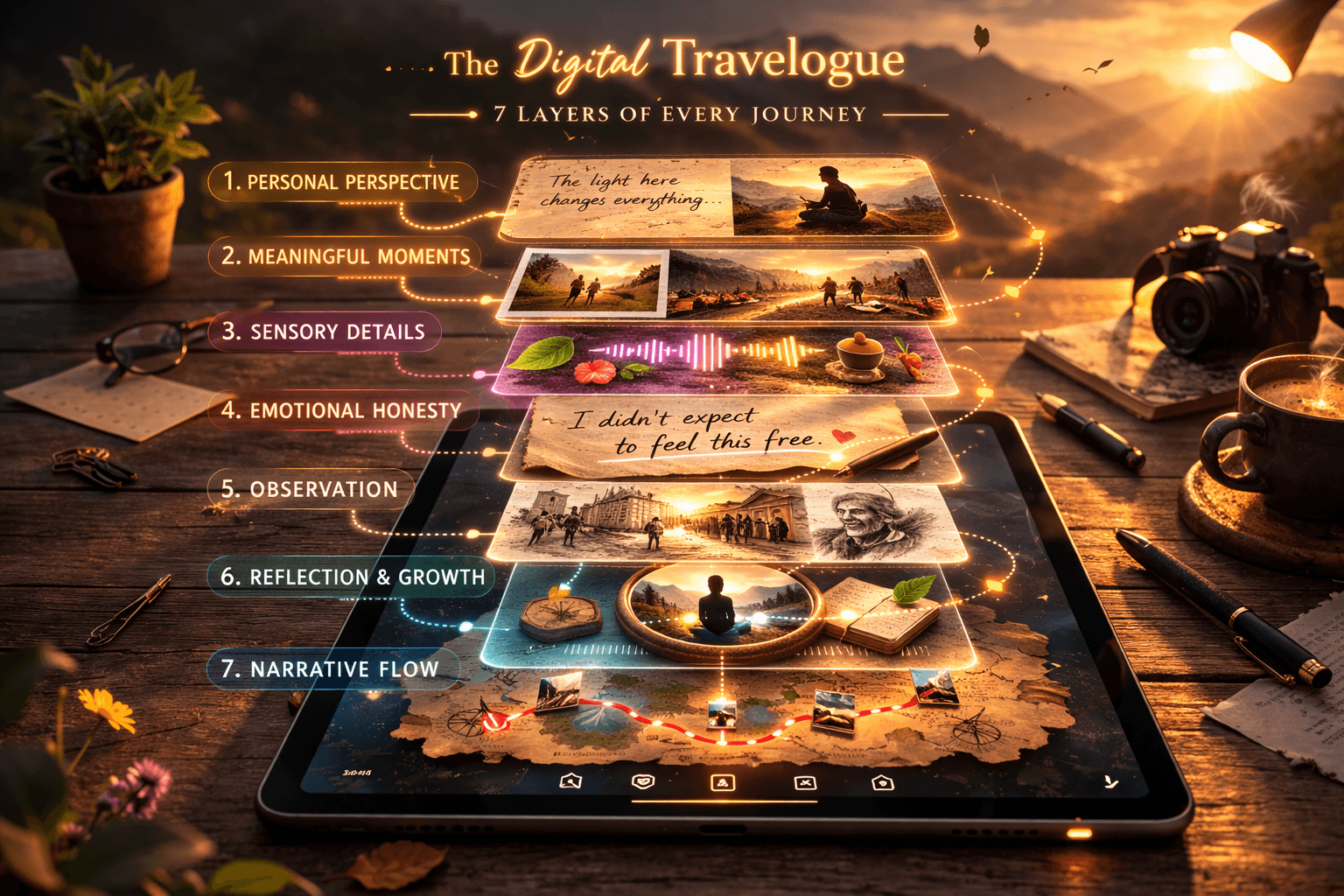
7 Key Elements Every Travelogue Needs
Discover the 7 essential elements of a great travelogue — from sensory details and personal perspective to emotional honesty. A practical guide for travelers.