
Photo Travelogue: Turn Travel Photos into Stories
Your phone has 847 photos from that trip. But how many of them still make you feel something?

You're scrolling through your camera roll on a quiet Sunday evening. Hundreds of photos from a trip you took six months ago — mountains, temples, street food, sunsets, a blurry selfie at a viewpoint. You swipe through them quickly at first, then slow down. There's one photo — a cup of chai on a wooden railing with fog behind it — that makes you pause. You remember the morning it was taken. The cold air. The silence. The feeling that everything, for ten minutes, was exactly right.
But you can't quite remember what came before that moment. Or what the guesthouse owner said that made you laugh. Or why that particular morning felt different from all the others. The photo shows you a cup of chai and some fog. The experience — the one that actually mattered — is somewhere behind the image, fading a little more with every month that passes.
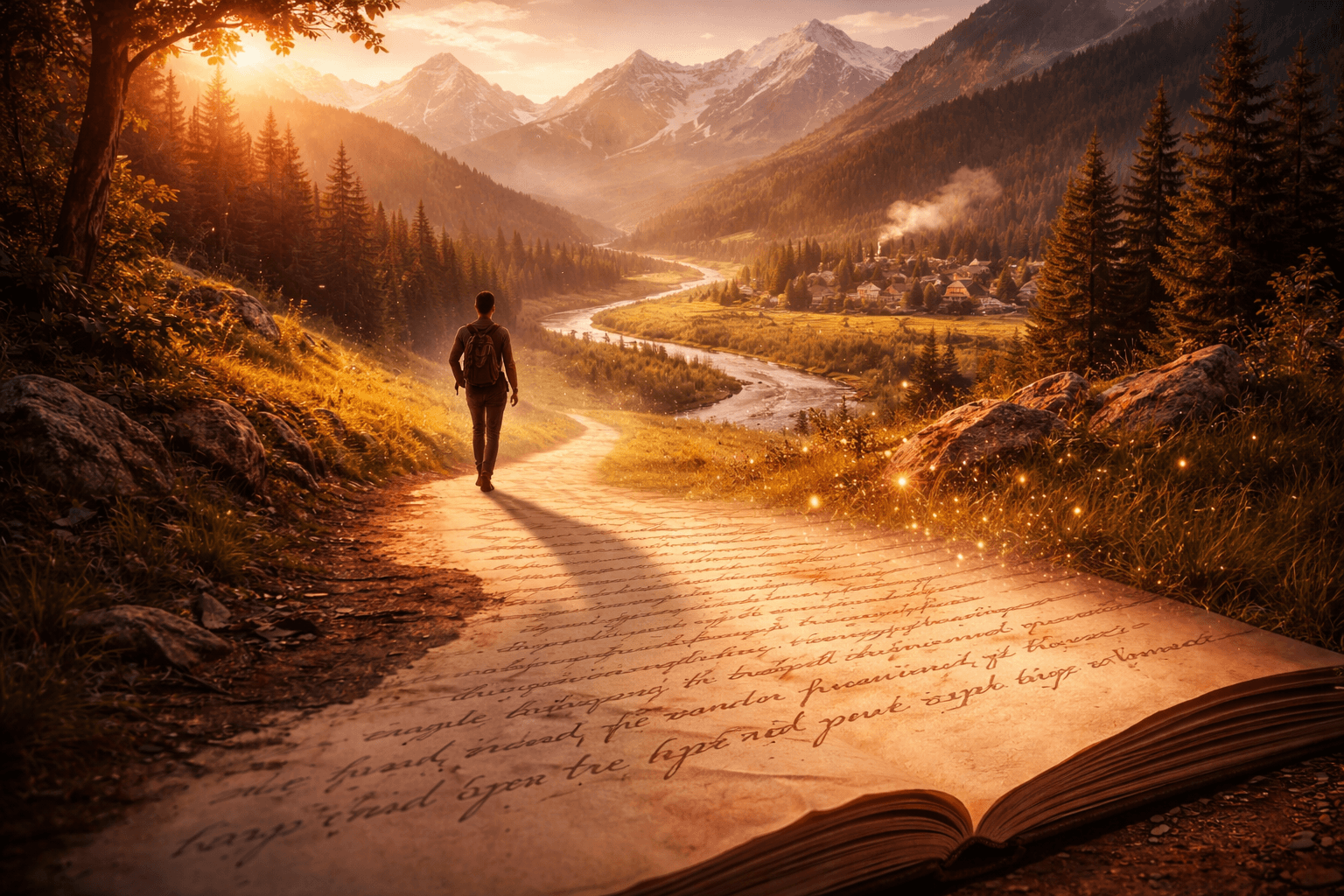
This is the gap that almost every traveler lives with: hundreds of photos that capture what we saw, but almost nothing that preserves what we felt. The photos are beautiful. But they're incomplete. They're the cover of a book that was never written. And the story inside — your story — is the part worth keeping.
The Problem with Travel Photos Nobody Talks About
We take more travel photos than any generation in history. The average smartphone trip generates hundreds of images — sometimes thousands. We photograph meals, views, streets, signs, and sunsets with an urgency that suggests we're terrified of forgetting. And yet, within a year, most of those photos become exactly what we feared: forgotten digital files sitting in a gallery we never open.
The reason is simple but painful: photos capture surfaces. They record light, color, and composition. They show you where you were. But they don't show you who you were in that moment — what you were thinking, feeling, realizing, or struggling with. A photo of a mountain pass doesn't record that you were exhausted and elated and questioning every choice that led you there. A photo of a temple doesn't record the silence inside that made you hold your breath. A photo of a stranger's face doesn't record the conversation that shifted something in your chest.
Without context, without words, without the emotional layer that only you can provide — photos lose their meaning. Not immediately. Slowly. The way memories always fade: quietly, without announcement, until one day you look at a photo and feel nothing except a vague sense that something important once happened here. And you can't remember what.
What photos from your travels still hold untold stories? Not the ones that look best — the ones that, when you see them, make you feel something you can't quite name. Those are the ones waiting for words.
What Travelogues Add That Photos Can't
A travelogue is the missing layer. It's the story behind the photo — the context, the emotion, the reflection, the personal perspective that transforms an image from a file into a memory. When you pair a photo with a travelogue, something remarkable happens: the photo stops being a record of what you saw and becomes a portal to what you experienced.
That cup of chai in the fog? With a travelogue, it becomes: "It was 6 a.m. and I was the only person awake. The guesthouse owner had left a thermos outside my door without being asked. The fog was so thick I couldn't see the valley, but I could hear the river somewhere below. I held the cup with both hands and thought: this is the first morning in months where I don't want to be anywhere else." Now the photo isn't just chai and fog. It's a moment of peace in a life that needed one. That's what a photo travelogue preserves.
A travelogue adds four things a photo cannot: context (what was happening around the moment), emotion (what you were feeling), sensory depth (what you heard, smelled, touched, tasted), and reflection (what the moment meant). Together, these turn a collection of images into a narrative — a story you can return to years later and still feel something real.
How Pinaak Makes This Natural
The idea of writing a travelogue sounds meaningful in theory — but in practice, most travelers don't know where to start. Your photos are scattered across your camera roll. Your memories are fading. You don't have a notebook full of reflections. And the thought of sitting down to write a structured travel narrative feels overwhelming.
This is exactly the problem Pinaak was designed to solve. Not by making you a better writer — but by making it natural to turn your photos into a meaningful travelogue. Pinaak helps you organize your photos into journeys — not as a gallery, but as a narrative. Each photo becomes a moment in a story, and for each moment, you add what the camera couldn't capture: what you were thinking, what you noticed, how you felt, what the moment meant.
It's not about writing long paragraphs or producing polished prose. It's about adding two or three honest sentences to a photo — the kind of sentences you'd say to a close friend over dinner: "This was taken the morning I realized I was actually happy." "The woman in this photo told me about her daughter who moved to the city, and I thought about my own mother." "I have no idea why I took this photo of a door, but I can still feel the temperature of the air when I stood there."
Those sentences — raw, honest, personal — are the travelogue. And Pinaak holds them alongside your photos so that when you revisit the journey a year later, or five years later, or twenty — you don't just see what you saw. You remember what you lived. That's the difference between a digital travel journal that stores images and one that preserves meaning.
A Traveler's Story: From 400 Photos to One Meaningful Travelogue
Imagine this: you've just returned from a week in Himachal Pradesh. Your phone has 400 photos. Some are stunning — the Himalayan sunrise, the monastery on the cliff, the river turquoise with snowmelt. Most are decent. A few are blurry. All of them, in this moment, feel important.
Three weeks later, you open Pinaak. You start selecting photos — not all 400, just the ones that make you feel something when you see them. The sunrise where you cried. The roadside dhaba where the driver told you about his village. The monastery courtyard where the silence was so complete you could hear your own heartbeat. The photo of the road disappearing into clouds that you took from the passenger seat without thinking. Maybe twenty photos. Maybe fifteen.
For each one, you write what the camera missed. It comes easier than you expected — because the photos unlock the memories. You see the dhaba and suddenly you can smell the dal fry and hear the driver saying: "City people think mountains are for vacation. For us, this is Monday." You see the monastery courtyard and remember the monk who nodded at you like he'd been waiting. You write it down. Three sentences. Four. Not literature. Just truth.
When you're done, you look at what you've built. It's not a photo album. It's not a blog post. It's your journey — the real one, the inner one — organized into a travel memory journal that you can return to whenever you need to remember what it felt like to stand on that mountain and realize that you didn't need anything you'd left behind. That's what Pinaak creates: not content, but a record of who you were in the moments that mattered.
What journey would you want to revisit years from now — not just the photos, but the full feeling of being there? That journey is worth more than a gallery. It's worth a travelogue.
Why This Matters More Than Ever in Modern Travel
We live in the most photographed era of travel in human history. Every traveler carries a camera that would have astonished professionals twenty years ago. We capture thousands of moments per trip. And yet — paradoxically — we preserve less meaning from our journeys than travelers who carried nothing but a notebook and a pen.
The notebook traveler wrote down what they saw, felt, and understood. They described the color of the sky in words. They recorded conversations. They reflected at the end of each day. Their journals, decades later, still bring back the full texture of the journey — not just how it looked, but how it felt to be alive in that place, at that time.
Modern travelers have better tools but worse records. We have the photos but not the stories. We have the surfaces but not the depth. And the irony is: we travel more than ever, spend more than ever, photograph more than ever — and remember less than ever, because we never sit down and add the meaning.
Pinaak exists at this intersection — a travelogue creation platform for the modern traveler who wants to create a travelogue online that combines the visual richness of digital photography with the emotional depth of personal storytelling. Not as a replacement for the experience — but as a way to make sure the experience survives it. Because your journey deserves more than a photo gallery. It deserves its story.
From Files to Stories: What Changes When You Write the Travelogue
Something shifts when you add words to your photos. The photo of the mountain sunset stops being "Himalayas, Day 3" and becomes "the evening I sat on a rock and realized I hadn't thought about work in four days." The photo of the old woman at the market stops being a portrait of a stranger and becomes "she told me her husband built their house with his own hands fifty years ago and she still talks to him every morning."
The transformation isn't in the photos — it's in you. When you write the travelogue, you process the journey. You understand it more deeply. You notice things you missed in the moment. And you create something that your future self will be grateful for — a version of the trip that includes not just what happened, but what it meant.
A photo gallery is a collection of moments. A photo travelogue is a collection of meanings. The difference between the two is a few honest sentences per image — and a platform that makes adding them feel natural instead of effortful. That's what Pinaak is. Not a writing tool. A remembering tool.
Frequently Asked Questions
How do you turn travel photos into a travelogue?
Select the photos that carry a story — not every image, just the meaningful ones. Arrange them in journey order. For each photo, write what was happening beyond the frame: what you were feeling, thinking, or noticing. Add sensory details the camera missed. Include a reflection on what the moment meant. Pinaak is designed to make this process natural and intuitive.
What is a photo travelogue?
A photo travelogue combines travel photography with personal narrative — each image paired with the story behind it, sensory details, emotional reflections, and personal perspective. It preserves both the visual and the emotional record of a journey, creating something richer than either a photo album or a written travelogue alone.
What is the best digital travel journal?
The best digital travel journal preserves not just what you saw, but what you felt and realized. It should let you organize photos into journeys, add written context and reflections, and revisit your travelogues meaningfully over time. Pinaak is built specifically for this — helping travelers turn photos and memories into meaningful, structured travelogues.
Why do travel photos lose meaning over time?
Photos capture only the visual surface of a moment — not the emotions, thoughts, or context that made it meaningful. Without written words alongside them, the emotional layers fade as memory naturally deteriorates. Even a few sentences of context per photo can preserve the meaning that the image alone cannot hold.
Your Photos Are Not Just Files. They're Stories Waiting to Be Told.
Right now, somewhere on your phone, there are photos from a journey that changed something in you. Maybe it was a week in the mountains. Maybe a weekend drive. Maybe a solo trip that nobody else will ever fully understand. Those photos hold the visual surface of those moments. But the real story — the one that matters — is the one you haven't written yet.
Photos capture moments. Travelogues preserve meaning. And the distance between the two is smaller than you think — just a few honest sentences per image, a little reflection, and a place to hold it all together.
Pinaak exists for exactly this moment — the moment when you look at your photos and think: these deserve more than a gallery. They deserve the story that only I can tell. Because every photo you took was a decision — a decision that this moment was worth keeping. Now give it the words it deserves.
Open your camera roll. Find the photo that still makes you feel something. Write three sentences about what was happening when you took it — not what's in the frame, but what was in your heart. That's not just a photo anymore. That's the beginning of your travelogue.
Ready to turn your photos into a travelogue?
Pinaak turns your travel moments into travelogues worth keeping. No writing skills needed — just your photos and your story.

Keep Reading

20 Best Travelogue Examples: Classic to Modern Stories
Explore 20 powerful travelogue examples — from Ibn Battuta and Mark Twain to modern digital stories. Discover what makes a great travelogue worth reading.
How to Write a Travelogue: A Beginner's Guide
Learn how to write a travelogue with this beginner-friendly step-by-step guide. Includes travelogue format, structure, writing tips, real examples, and FAQs.