
Why Is Shiva in Kashi? The Sacred Story of Varanasi
Discover why Lord Shiva chose Kashi as his eternal city — the legends of Kashi Vishwanath, Kal Bhairav, Ganga, and moksha.
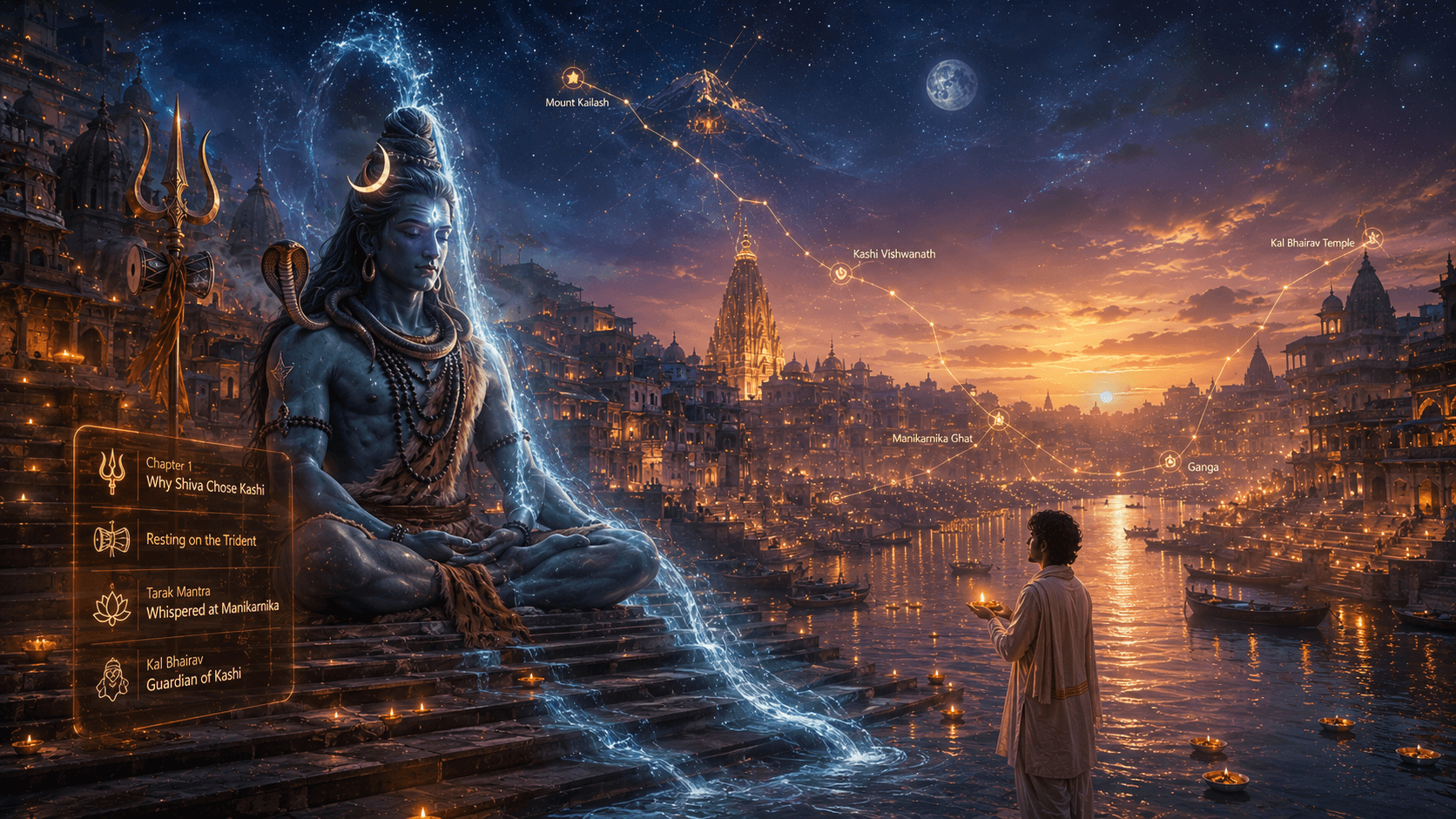
You walk through Varanasi.
You hear people call it "Mahadev's city."
Every few minutes, someone passes you chanting "Har Har Mahadev."
Strangers say it. Boatmen say it. Tea sellers say it.
And eventually, the question comes to you naturally.
Why is shiva in kashi?
Why here? Why not anywhere else in the country, or the world?
I had the same question on my first visit. I sat at a ghat and asked an old pandit. He smiled, and said something that stayed with me — "Shiva didn't choose Kashi. Kashi chose him."
This story will walk you through the legend, the meaning, and the feeling. Why Kashi is believed to be Shiva's eternal city. Why millions still feel his presence here. And why even non-believers walk away from this city changed.
Why Is Kashi Called the City of Shiva?
In Hindu belief, Kashi is more than a city. It's an idea.
Mythology says Kashi rests on the tip of Lord Shiva's trident. When the rest of the world is destroyed at the end of an age, Kashi remains. It is "avinashi" — the city that cannot be destroyed.
That alone makes it special. But there's more.
Shiva is said to live here permanently — not as a visiting deity, but as a householder. The Kashi Vishwanath Temple isn't just where you go to see Shiva. It's where you go to meet him at home.
Add to that the Ganga River flowing alongside, the cremation fires of Manikarnika Ghat burning day and night, and Kal Bhairav guarding the gates — and you understand why Kashi is called the city of Shiva. It's not a title. It's a description of who actually lives here.
Curious about Shiva in Kashi? Plan your Varanasi trip.

The Mythological Story of Shiva in Kashi
Now the story itself. As told by pandits, scriptures, and grandmothers across India.
Long before there were cities, Shiva lived on Mount Kailash with Goddess Parvati. It was beautiful. Snow-covered. Quiet. But Parvati felt distant from the rest of creation.
She wanted a home. Not a peak. A place where people lived. Where life happened. Where she and Shiva could be part of the world, not just watch it from above.
Shiva listened. And together, they came down from Mount Kailash and chose Kashi.
Why Kashi? Because Kashi was already special. It sat on the banks of the Ganga River. It had wise sages, devoted people, a current of energy that was different from anywhere else. The Skanda Purana says Shiva called Kashi "Anandavana" — the forest of bliss.
That's the shiva and kashi story most locals know.
But mythology adds one more layer. Kashi is said to exist "beyond time." Even when the universe dissolves, Kashi remains untouched, suspended on Shiva's trident. So by choosing Kashi, Shiva and Parvati chose a place that wouldn't end.
They didn't just move. They settled forever.
Why Did Lord Shiva Leave Kashi? (And Did He Really?)
Now here's where the story gets interesting.
One of the most famous legends in kashi mythology is about King Divodasa. According to the Kashi Khanda, Divodasa was such a perfect, just, and righteous ruler that even the gods felt it was inappropriate to occupy his city. So Shiva temporarily moved out of Kashi and went to Mandar Parvat with Parvati.
That's the popular answer to why did lord shiva leave kashi.
But here's the twist. Shiva missed Kashi terribly. He sent his messengers — even Brahma and Vishnu in disguise — to find a way back. Eventually, when Divodasa attained moksha through his devotion, Shiva returned. He never left again.
Devotees in Varanasi will tell you something simpler. Even during that "departure," Shiva never spiritually left Kashi. His presence stayed in the soil, the river, the air. The departure was a gesture. The return was the truth.
So if you ever hear the legend that "Shiva left Kashi" — remember, the same legend says he came back. And he stayed.
Kashi Vishwanath — The Center of Shiva's Presence
Every story has a center. The center of why is shiva in kashi is the Kashi Vishwanath Temple.
"Vishwanath" means "Lord of the Universe." Inside the temple is a self-manifested shiva linga — one of the 12 jyotirlingas in India. Pilgrims travel thousands of kilometers just to stand before this small black stone, sometimes for only a few seconds.
The history of the temple itself is a story of devotion that refused to die. It has been destroyed and rebuilt several times across centuries. The current temple structure was rebuilt by Maharani Ahilyabai Holkar in 1780. The new corridor connects it directly to the Ganga, restoring an ancient route that pilgrims walked for centuries.
What is the kashi vishwanath story really about? It's about presence. The temple is said to be the spot where Shiva first manifested in this world as a pillar of light. For believers, every prayer offered here goes directly to him. No middleman. No distance.
Stand inside that small sanctum once, and you'll feel why pilgrims cry quietly without knowing why. The temple is small. The feeling is not.
The Connection Between Kashi and Moksha
This part is hard to write without slowing down. Because it's the part that gives Kashi its weight.
Hindu belief says — anyone who dies in Kashi attains moksha. Liberation. The end of the cycle of birth and death.
Why?
Because at the moment of death in Kashi, Shiva himself is said to whisper the "Tarak Mantra" into the ear of the dying person. That single mantra is enough to free the soul. No more rebirth. No more karma. Just oneness.
That's why Manikarnika Ghat exists — and why its fires never go out. For thousands of years, families have brought their loved ones to this ghat for their final rites, trusting that Shiva will keep his promise.
It's not "death tourism," as some outsiders call it. It's the opposite. It's the ultimate act of faith. Many old people from across India even move to Kashi in their final years, simply to die here.
The spiritual meaning of kashi is wrapped in this idea. Life and death are not opposites here. They're two parts of the same circle, and Shiva sits at its center.
Kal Bhairav — The Guardian of Kashi
If Shiva is the king of Kashi, then Kal Bhairav is its police chief.
Mythology says when Shiva moved to Kashi permanently, he needed someone to maintain order. To guard the city. To keep it spiritually safe. He manifested as a fierce form — Kal Bhairav — and gave him this responsibility.
That's why even today, locals say you should visit Kal Bhairav before entering Kashi Vishwanath. You ask the guardian's permission before meeting the king.
Kal Bhairav's small temple sits in a quiet lane in the old city. The deity is dark, powerful, often draped in deep red. Pandits tie a sacred black thread — the kala dhaga — on visitors' wrists. It's a small ritual, but locals believe it offers Kal Bhairav's protection.
The connection is simple. Shiva is the soul of Kashi. Kal Bhairav is its shield.
Shiva, Ganga & The Soul of Varanasi
You can't talk about why kashi is sacred without talking about the river.
The Ganga River is not just a river in Hindu belief. She is a goddess. And in mythology, she once flowed only in heaven. When King Bhagiratha prayed for her to come down to earth to liberate his ancestors, the force of her descent would have destroyed the planet — until Shiva caught her in his matted hair and let her flow out gently.
That's the connection. Ganga literally flows through Shiva.
And nowhere is that more visible than in Varanasi. The Ganga curves uniquely here — she flows north for a short stretch, which is rare. Locals will tell you this is because she paused to be near Shiva.
Every morning, devotees take a holy dip in her waters. Every evening, the Ganga Aarti at Dashashwamedh Ghat thanks her with fire, conch shells, and chants. The entire daily rhythm of the city moves around her.
So when you ask why is shiva in kashi, part of the answer is also — because Ganga is here. And where Ganga flows, Shiva watches.
What Kashi Feels Like Today
Mythology is one thing. But Kashi is also a living, breathing city. Let me describe what it actually feels like.
You wake up at 4 AM. The lanes are still dark. You hear bells ringing softly in distant temples. The smell of fresh marigolds drifts from a corner shop. A bicycle cart rattles past.
You walk to the ghats. The first light hits the river. Old men do surya namaskars on the steps. Pandits chant. A child laughs somewhere. Someone shouts "Har Har Mahadev" into the morning air, and a dozen voices echo it back.
This is what mythology looks like when it's still alive.
Walk through the narrow lanes near the Kashi Vishwanath corridor. Shops selling rudraksha, brass diyas, vibhuti, marigolds. Small Shiva shrines tucked into walls, each with its own diya burning. Cows resting peacefully against ochre walls.
At night, the boats glow on the Ganga. The aarti fires rise. Somewhere, Manikarnika burns. And through all of it — the lanes, the lamps, the chants — you start to feel it.
Shiva isn't a story here. He's the atmosphere.
Want a deeper traveler-level view of the city itself? You can check out Kashi Darshan with first-hand stories, neighborhood walks, and local rituals — beyond just the mythology.
Story understood — book your Kashi darshan now.
Pro Tips for Understanding Kashi Beyond Tourism
If you want to actually feel why shiva is in kashi, and not just collect photos — try these small habits.
- Wake up early for the ghats. Between 4:30 and 6:30 AM, Kashi shows its true face. Quiet, golden, alive.
- Sit quietly at Assi Ghat. Don't talk. Don't scroll. Just sit for an hour. The city will start talking to you instead.
- Visit temples slowly. Skip the "8 temples in a day" plan. Two temples done with attention beat eight done in a rush.
- Avoid treating Kashi like a checklist. The city isn't here to perform for you. Let it unfold.
- Listen to local stories. Ask an old boatman, a temple pandit, a chai seller. Every one of them knows a version of the shiva varanasi story you've never heard.
- Visit Manikarnika respectfully. Stand from a distance. No photos. Just observe and reflect.
- Walk without Google Maps for an hour. Get lost. The old city was built to be felt, not navigated.
Common Misunderstandings About Kashi Mythology
A few honest things to know. Especially if you're newer to Hindu mythology, or coming from outside India.
- Treating mythology as literal history only. The Kashi Khanda and Skanda Purana are scriptural stories, not history textbooks. They hold spiritual truth, but you don't need to read them as line-by-line fact to feel their meaning.
- Confusing moksha with simple "afterlife". Moksha isn't heaven. It's the end of the cycle of birth and death. Different concept. Far bigger idea.
- Reducing Kashi to "death tourism". The cremation fires at Manikarnika Ghat are an act of devotion, not a spectacle. Visiting respectfully is fine. Filming families during their grief is not.
- Assuming Shiva is only "the destroyer". In Kashi, Shiva is a householder, a teacher, a liberator — far more than a single role.
- Believing only Hindus can "feel" Kashi. Many non-Hindu travelers describe Kashi as one of the most spiritually powerful places they've ever visited. The city doesn't check your religion at the entrance.
Frequently Asked Questions
Why is Shiva in Kashi?
According to Hindu belief, Shiva chose Kashi as his eternal home because it stands "beyond time" — a place where the soul can attain moksha. Mythology says he and Goddess Parvati left Mount Kailash to make Kashi their permanent abode, and the Kashi Vishwanath Temple marks his eternal presence here.
Why is Kashi sacred to Lord Shiva?
Kashi is sacred because it is believed to rest on Shiva's trident, untouched by destruction. It's where the first jyotirlinga is said to have appeared, and where dying is believed to grant liberation from the cycle of birth and death.
Did Lord Shiva ever leave Kashi?
Several legends speak of Shiva briefly leaving Kashi — most famously during King Divodasa's rule, when Shiva temporarily moved to Mandar Parvat. But devotees believe he never truly left. His presence is felt in every lane, every temple, and every chant of "Har Har Mahadev" in the city.
Why is Kashi called Mahadev's city?
Kashi is called Mahadev's city because mythology places Shiva's permanent abode here, with the Kashi Vishwanath Temple as his central shrine. Locals chant "Har Har Mahadev" through the day, and almost every ritual along the Ganga River is tied to Shiva.
What is the story of Kashi Vishwanath?
Kashi Vishwanath is one of the 12 jyotirlingas, believed to be a self-manifested form of Shiva. The temple has been destroyed and rebuilt several times over centuries. The current temple was rebuilt by Maharani Ahilyabai Holkar in 1780 and remains the spiritual center of Kashi today.
Why do people seek moksha in Kashi?
Hindu belief says that anyone who dies in Kashi receives the "Tarak Mantra" whispered by Shiva himself in their ear at the moment of death, granting them liberation (moksha) from the cycle of rebirth. Manikarnika Ghat is the most sacred cremation ground tied to this belief.
Is the story of Shiva in Kashi mythology or history?
The story is mythological and rooted in scriptures like the Skanda Purana and Kashi Khanda. Kashi itself is historically one of the world's oldest continuously inhabited cities. Belief and history sit together here — neither cancels the other.
Final Thoughts
Kashi is not just associated with Shiva. For many people, it feels like Shiva still lives here.
That's the real answer to why is shiva in kashi. Not just the mythological story. Not just the Skanda Purana. Not just the jyotirlinga at the Kashi Vishwanath Temple. It's the way the city breathes. The bells. The lamps. The river. The lanes that smell of incense before they smell of anything else.
Walk through Varanasi slowly. Sit by the Ganga. Visit the temples in the right order. Listen more than you speak. And somewhere between the chant of "Har Har Mahadev" and the silence of an early morning ghat, you'll understand on your own — without needing anyone to explain it.
Are you searching Shiva? Check out Varanasi now!
Get tailored quotes from verified operators on WhatsApp — or explore the full journey first.

Keep Reading
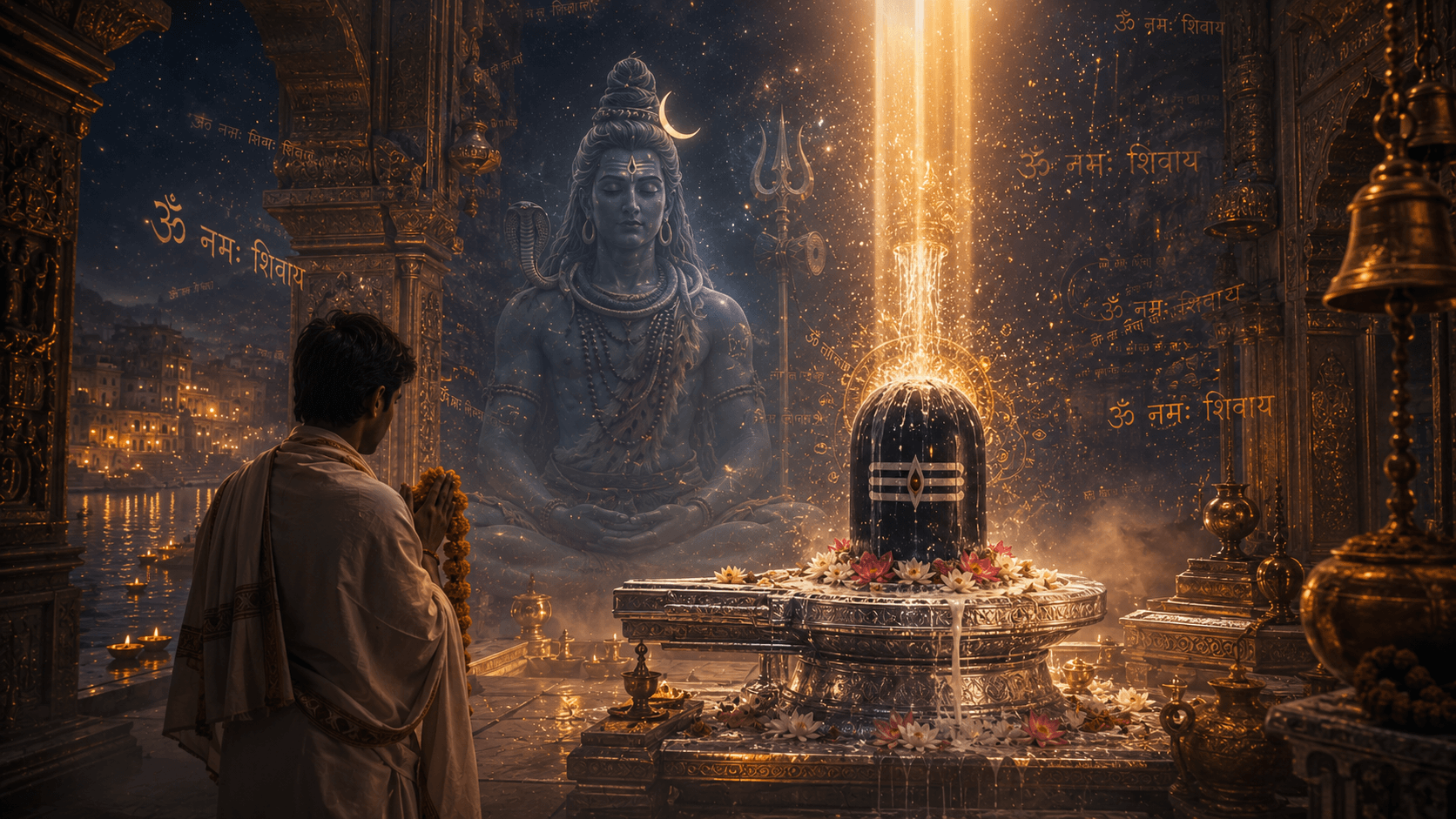
Can You Touch the Shivling in Kashi Vishwanath? Rules Explained
Planning a Kashi Vishwanath visit? Here’s what devotees should know about touching the Shivling, darshan etiquette, temple rules, and respectful conduct.
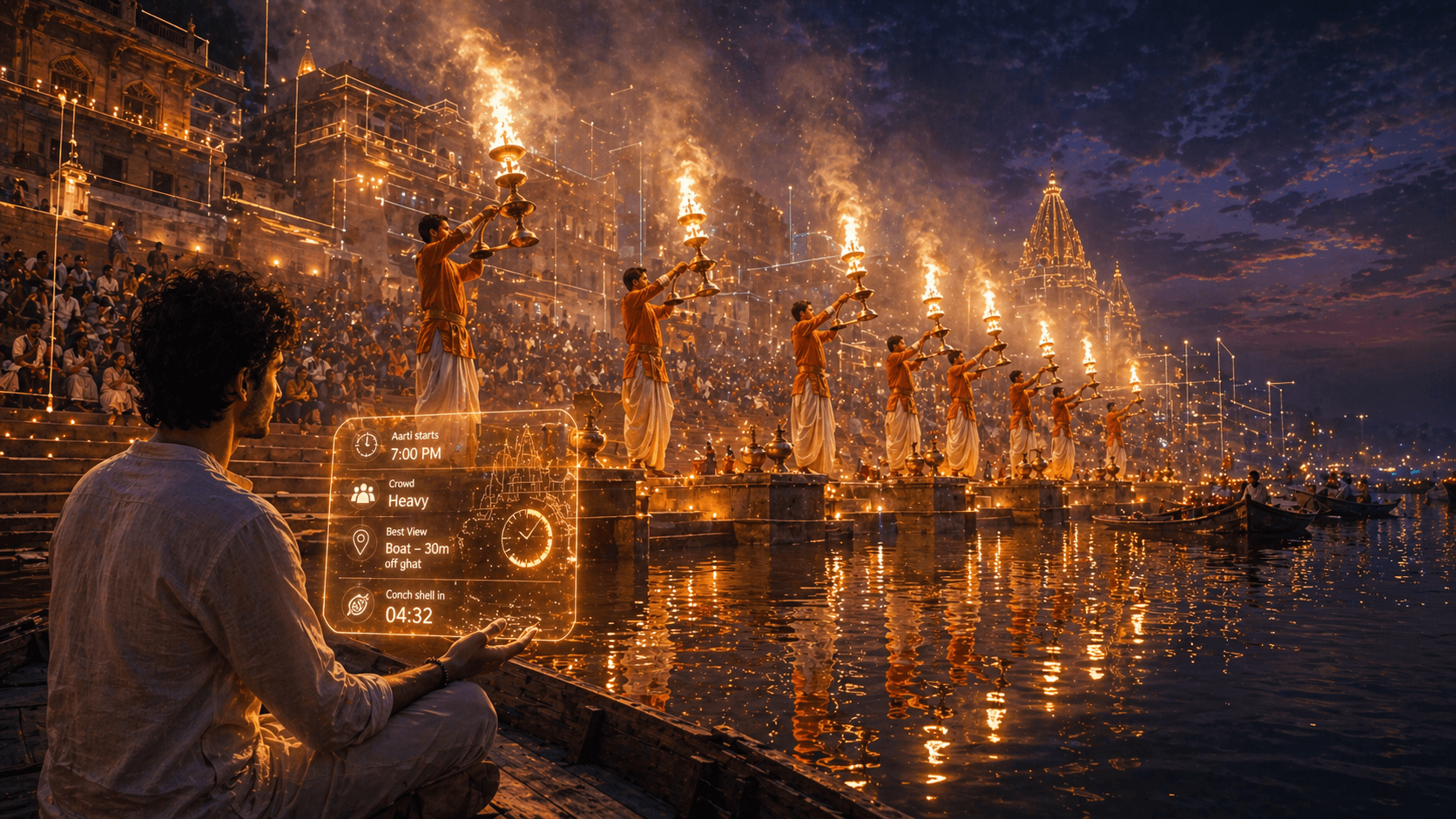
Ganga Aarti Varanasi Timing, Best Spot & What to Expect
A real traveler guide to ganga aarti varanasi timing - exact evening hours, best ghat to watch from, what to expect, and honest tips for first-timers.