
Hidden Gems Travel: Places Not on Google Maps
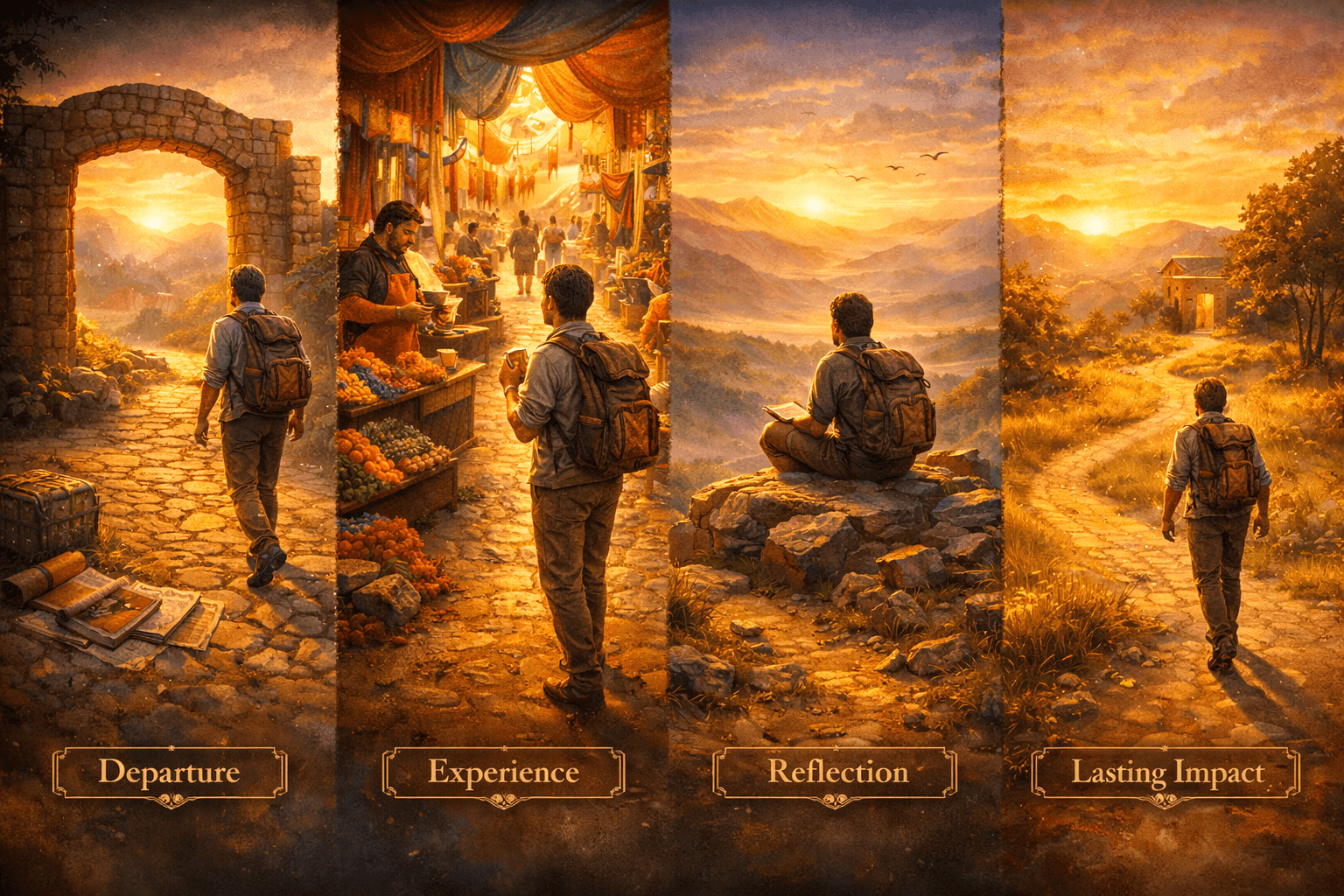
The best places don't announce themselves. They wait for you to wander close enough to notice.

You followed the blue dot on Google Maps to that famous viewpoint everyone recommended. You arrived, and so had two hundred other people. Selfie sticks blocked the horizon. A loudspeaker played music nobody asked for. You took a photo, posted it, and left feeling like you'd seen the place but hadn't really been there. The view was exactly as advertised — and somehow that was the problem.
Then, on the drive back, the driver took a wrong turn. Or maybe it was a shortcut — he wasn't sure. The road narrowed, the GPS lost signal, and the car climbed a ridge you hadn't planned to see. He pulled over where the road bent. And there it was: a view of the valley so wide and quiet that your breath caught. No railings. No signs. No other cars. Just mountains folding into each other under a sky that looked like it had been painted five minutes ago. You stood there for ten minutes and said nothing. And that — not the famous viewpoint — became the memory you kept.
That's what a hidden gem feels like. Not a place you searched for, but a place that found you when you stopped following the map. And the truth is: these places are everywhere. They're just not where the algorithms tell you to look.
What Are Hidden Gems, Really?
A hidden gem isn't just an unknown place. There are millions of unknown places — most of them are unremarkable. A hidden gem in travel is a place that feels personal. It feels quiet. It feels like it exists just for you in that moment, even though it's been there for centuries.
Hidden gems are discovered, not searched. They come from taking the road that wasn't on the itinerary. From asking a chai stall owner, "Where do you go when you want peace?" From walking past the last hotel on the street and continuing just a little further. From slowing down enough that the quiet places have time to reveal themselves.
Hidden gems aren't just locations. They're experiences. A village temple where a priest offers you prasad and tells you a story about the 400-year-old banyan outside. A lake so still that the mountains reflected in it look more real than the actual mountains. A neighborhood in an old city where every door is a different color and someone is always playing the radio. These aren't on any list. They're on the route you almost didn't take.
Hidden Gem Travelogues: Places That Stayed With Us
1. The Village That Google Forgot — Somewhere Above Tirthan Valley
The guesthouse owner in Jibhi said there was a village about an hour's walk uphill that "nobody goes to anymore." He didn't know its exact name — just pointed vaguely toward the ridge. The trail was steep, overgrown, and unmarked. After forty minutes, the trees opened into a cluster of slate-roofed houses sitting on a plateau so flat and green it looked sculpted. An old woman was drying apricots on her roof. She waved without surprise, as if visitors were normal — though they clearly weren't.
The silence was immense. Not empty silence — alive silence. Birds you couldn't see. Wind through walnut trees. The creak of a wooden gate somewhere. A child appeared with a kitten and stared. You could see five mountain ranges from the edge of the plateau, layered in shades of blue that got lighter the further they went. There was no phone signal. No shop. No signboard. Just a place where people lived quietly and the mountains watched over them. That village never appeared on any search result. But it appears in every memory of that trip.
2. The Stepwell Nobody Visits — Outside Bundi, Rajasthan
Bundi itself is already an offbeat travel destination — quieter than Jaipur, more intimate than Udaipur. But the real discovery was a stepwell about three kilometers outside town, down a dirt road that didn't seem to lead anywhere useful. A local painter mentioned it casually: "There's a baori near the fields. Very old. Very beautiful. Nobody goes."
He was right on all counts. The stepwell was deep, geometric, and breathtaking — its stone steps descending in perfect symmetry into green water. Pigeons nested in the carved arches. The only sound was wings and water dripping somewhere far below. No ticket counter. No guard. No other visitor. Just you and an 800-year-old structure that belonged to a time when water was sacred enough to build a palace around it. You sat on the top step for half an hour and thought about how many people had come to this water over eight centuries — and how quiet it was now that everyone had forgotten it.
3. The Hidden Lake — Somewhere in the Western Ghats, Karnataka
It wasn't on the hiking route. A forest guide mentioned it as an afterthought: "If you go left at the fallen tree, there's a lake. Maybe twenty minutes." The path was barely visible — fern-covered, muddy, and threaded with roots. The canopy closed overhead until the light turned green and the air went cool and damp.
And then: a lake. Small, perfectly round, still as glass. The trees around it reflected so precisely that you couldn't tell where the water ended and the forest began. A kingfisher sat on a branch and didn't move when you approached. The silence was the kind that makes you lower your voice instinctively, even though there's no one to disturb. You stayed for an hour. You didn't take a single photo for the first twenty minutes — and that's how you knew it was real. This was one of those secret travel destinations that no search engine will ever surface, because nobody has named it.
Have you ever discovered a place by accident that stayed with you longer than any planned destination? That's the signature of a hidden gem — it finds you, not the other way around.
4. The Temple at the End of the Road — Tamil Nadu
The road ended at a wall of granite and a set of steps carved into the hillside. A small board, hand-painted in Tamil, pointed upward. Two hundred steps later: a temple so old the stones had rounded at the edges, sitting on a rock shelf overlooking paddy fields that stretched to the horizon. An elderly priest was lighting a lamp. He didn't speak much English, but he gestured for you to sit.
The lamp flickered in the wind. The priest chanted softly. Below, a farmer was walking along a bund with a white egret following him like a pet. The whole scene was so gentle, so unhurried, so completely outside of time, that your eyes watered — not from sadness, but from the sudden, overwhelming awareness that beauty like this exists everywhere, all the time, and most of us are too busy following itineraries to notice. This wasn't a hidden tourist place. It was a hidden world.
5. The Neighborhood Nobody Recommends — Old Ahmedabad
Everyone said to see the Sabarmati Ashram and the Adalaj Stepwell. Fair enough. But the real Ahmedabad was in the pols — the old walled neighborhoods where carved wooden houses lean toward each other across narrow lanes, and every third door opens into a courtyard you didn't expect. A shopkeeper selling brass utensils insisted you try his mother's chai. His mother insisted you stay for lunch.
The lanes smelled of incense and frying onions. A kite-maker was stretching paper on bamboo frames in an alley so narrow your shoulders nearly touched both walls. Children played cricket with a tennis ball on a rooftop, and someone's grandmother watched from a jharokha window like she'd been watching from that exact spot for decades. This wasn't an unknown place to visit — people lived here. But for you, it was a discovery. Because you weren't following a route. You were following the sound of a radio playing old Hindi film songs through a cracked window, and it led you somewhere no map ever could.
6. The Viewpoint Without a Name — Meghalaya
Between Shillong and Cherrapunji, there's a stretch of road where the hills drop away suddenly and the valleys below are so deep that clouds float below you. Everyone drives past this stretch chasing the next waterfall. But the driver pulled over at a bend where a gap in the pine trees opened like a window. "Sometimes I stop here," he said. "Just to look."
The view was staggering. Layers of green falling into white mist. A river visible only as a thin silver thread at the bottom of an impossibly deep gorge. No barrier. No parking lot. No tourist. Just a bend in the road where someone had placed a flat stone — maybe as a seat, maybe as a marker that said: this is worth stopping for. You sat on that stone and watched the clouds move through the valley for twenty minutes. It was the most photographed trip of your life, but that spot — the one without a name — is the only image you can summon from memory without looking at your phone.
7. The Beach Behind the Fishing Village — South Goa
The popular beach was loud and warm and fine. But a fisherman mending nets near the shore pointed past the headland: "Other side. Quiet." The path went through his village — pastel houses, drying fish on racks, boats with names painted in Konkani. Past the last house, the path turned to sand, and the sand opened into a cove so sheltered that the waves barely whispered.
No shacks. No umbrellas. No music. Just a crescent of warm sand, rocks draped in green moss at both ends, and water so clear you could see fish moving over the bottom. A single coconut palm leaned out over the water at an angle that looked impossible. You swam, dried in the sun, read a few pages, and realized this was the version of Goa you'd been looking for — the one that exists before the brochures find it.
What hidden gem might exist near you right now — a quiet lane, a forgotten park, a rooftop with a view nobody talks about? Hidden gems don't require plane tickets. They require attention.
How Hidden Gems Are Actually Found
Notice a pattern in every story above? None of these places were found through a search engine. They were found through four things that have nothing to do with technology:
Curiosity. The willingness to ask "what's down that road?" or "what's past the last house?" or "what happens if I keep walking?" Curiosity is the single most reliable way to find places that no algorithm has indexed. It costs nothing and it never disappoints — even when the road leads nowhere, the walking itself becomes the story.
Slowing down. Hidden gems don't reveal themselves to people in a hurry. They reveal themselves to people who linger. Who sit at a chai stall long enough to hear a local's recommendation. Who walk instead of drive. Who stay an extra day in a small town because it feels right, even though the itinerary says otherwise.
Talking to locals. Not "where should tourists go?" but "where do you go?" That single shift in question changes everything. Locals know the unnamed waterfall, the temple behind the hill, the viewpoint where they take their families on Sundays. They just don't think of these places as destinations — they think of them as home. And that's exactly why they're special.
Exploring without strict plans. The most common feature of every hidden gem discovery is an empty slot in the schedule. A morning with nothing planned. An afternoon with no destination. That gap is where the unexpected walks in. If every hour is booked, there's no room for the unplanned magic that turns a trip into a story.
Why Hidden Gems Create Better Travel Memories
Popular tourist spots are designed for efficiency — signs, queues, designated photo spots, time limits. They serve a purpose. But they often feel like visiting a place through glass: you see it, you photograph it, you leave. Hidden gems work differently. They have no infrastructure telling you what to feel. You arrive on your own terms, you experience the place without filters, and the memory that forms is entirely yours.
There's also something about discovery itself that deepens a memory. The effort of finding a place — the wrong turn, the uncertain path, the moment of arrival — becomes part of the experience. You don't just remember the lake; you remember pushing through the ferns to reach it. You don't just remember the view; you remember the driver pulling over and saying "sometimes I stop here, just to look." The story of how you found it becomes inseparable from the place itself.
Hidden gems don't replace popular destinations. They add a dimension that itineraries can't provide — the dimension of personal discovery. And that's the dimension that turns a trip into a travelogue worth writing.
Sharing Hidden Gems Without Ruining Them
There's a tension in travel today: you discover a beautiful, quiet place — and you want to share it. But you also know that sharing it widely could change the very thing that made it special. This is where thoughtful travel storytelling matters. Writing a travelogue about a hidden gem isn't the same as dropping a pin on a map. A travelogue shares the experience, not just the coordinates. It invites people to seek their own version of that discovery, not to crowd yours.
Platforms like Pinaak are built around this idea — helping travelers preserve and share their hidden gem travelogues in a way that values the story over the location tag. Where the point isn't to create a new tourist rush, but to inspire others to slow down, explore with curiosity, and let their own hidden gems find them. Because the goal was never to make a list of secret travel destinations. The goal was to remind people that the best travel happens when you stop following lists entirely.
Frequently Asked Questions
What are hidden gems in travel?
Hidden gems are places that feel personal, quiet, and meaningful — not just unknown. They're discovered through curiosity, wrong turns, conversations with locals, or simply slowing down. A hidden gem could be an unnamed viewpoint, a forgotten stepwell, a quiet village, or a beach behind a fishing settlement. What makes it a gem is the emotional connection it creates — the feeling that you found something the itinerary couldn't have planned.
How do you find hidden tourist places?
Talk to locals — ask where they go, not where tourists go. Take unplanned detours. Leave gaps in your itinerary. Walk instead of drive. Stay longer in smaller towns. The best hidden tourist places are found through presence and curiosity, not through search engines or travel influencer recommendations.
What are some offbeat travel destinations in India?
India has countless offbeat travel destinations: quiet Himalayan villages above Tirthan Valley, forgotten stepwells outside Bundi in Rajasthan, hidden forest lakes in the Western Ghats, unnamed viewpoints between Shillong and Cherrapunji, ancient hill temples in Tamil Nadu, old pol neighborhoods in Ahmedabad, and sheltered coves behind fishing villages in South Goa. The best offbeat destinations are the ones you discover through your own journey.
Why are hidden gems better than popular tourist spots?
Hidden gems aren't necessarily "better" — they're different. Popular spots are well-managed and accessible, but they can feel impersonal. Hidden gems offer quiet, unfiltered experiences where you engage with a place on your own terms. The act of discovering them also deepens the memory — the story of how you found the place becomes part of the experience itself.
How do you write about hidden gems you discover?
Focus on the story, not the logistics. Describe how you found the place, what you experienced through your senses, any interactions with people, and how the place made you feel. Write like you're telling a close friend, not writing a guidebook. The goal is to share the experience — not just the location — so others are inspired to discover their own hidden gems through curiosity and presence.
The Best Places Are the Ones That Find You
Every traveler has a hidden gem story. The village nobody told them about. The viewpoint that wasn't on the route. The lake at the end of a trail that barely existed. The neighborhood that became the highlight of a city they almost skipped. These places weren't on any list. They weren't on Google Maps. They were on the other side of a wrong turn, a local's suggestion, or a moment where curiosity won over convenience.
The most meaningful places in travel are not always the ones everyone agrees are worth seeing. They're the ones that you discovered because you were paying attention. Because you slowed down. Because you asked the right question, or took the wrong road, or simply kept walking when the map said stop.
You don't need to travel far to find a hidden gem. You need to travel with your eyes open and your schedule loose. Leave room for the unplanned. Trust the detour. Talk to the people who live where you're visiting. And when you find a place that makes you stop, sit down, and forget to check your phone — you've found it.
The next hidden gem is already out there, waiting. Not for someone famous. Not for someone with a perfect itinerary. Just for someone curious enough to wander close enough to notice. That someone might be you.
The best places don't need a pin on the map. They need someone curious enough to wander close enough to notice.
Ready to write your travelogue?
Pinaak turns your travel moments into travelogues worth sharing. No writing skills needed — just your journey.

Keep Reading
Travelogue Structure & Format: How to Write One
Learn the pattern, structure, and format of a travelogue. Practical tips on how to start, organize, and write a meaningful travel story worth sharing.

20 Best Travelogue Examples: Classic to Modern Stories
Explore 20 powerful travelogue examples — from Ibn Battuta and Mark Twain to modern digital stories. Discover what makes a great travelogue worth reading.