
Travelogue Structure & Format: How to Write One
Your travel memories already have a shape. Structure just helps you see it.

You've come back from a trip that mattered. Maybe it was a week in the mountains where something shifted inside you. Maybe it was a solo train journey through a part of India you'd never seen. Maybe it was just a weekend drive that turned into something unexpectedly beautiful. Whatever it was, you want to write about it. You need to write about it — because you can already feel the details starting to blur, and you don't want to lose what that journey gave you.
So you open a blank page. And you stare at it. Because the experience doesn't arrive as a neat, organized story. It arrives as fragments — the color of the sky that one evening, the taste of tea at a roadside stall, the conversation with a stranger that you keep replaying, the silence at a temple that made you stop and just breathe. All of it real. All of it meaningful. But none of it in order.
This is the moment where most people give up. Not because they can't write — but because they don't know how to structure a travelogue. They think structure means rules, formulas, restrictions. But here's what structure actually is: it's the thing that turns scattered, beautiful memories into a story someone else can experience. Including your future self. Structure doesn't cage your travelogue. It gives it a spine.
What Is a Travelogue, Really?
Let's keep this simple. A travelogue is a personal account of a journey. Not a guidebook. Not a review. Not a list of places and prices. It's your story of what you experienced, observed, felt, and understood while you were somewhere that wasn't home.
A travelogue blends two worlds: the outer world — places, people, food, landscapes, cultures — and the inner world — your thoughts, your emotions, your realizations. When these two worlds come together in writing, the result is something that no travel guide or Instagram reel can replicate. That's a travelogue. And the structure of a travelogue is simply the way you arrange these elements so that a reader can walk through your journey alongside you — feeling what you felt, seeing what you saw, understanding what it meant.
The Natural Pattern of a Travelogue
Here's something that might surprise you: every meaningful trip you've ever taken already follows a natural pattern. You don't need to invent one. You need to recognize the one that's already there.
The travelogue pattern mirrors the emotional arc of travel itself — and it moves through four natural stages:
1. The Beginning: Departure, Motivation, or Arrival
Every journey starts somewhere — and so does every travelogue. Maybe it begins with why you decided to go. Maybe it begins the moment you stepped off the bus and the air smelled different. Maybe it begins with a feeling: restlessness, excitement, escape, curiosity. The beginning sets the journey in motion. It tells the reader: here is where something started to happen.
2. The Middle: Experiences, Discoveries, and Challenges
This is the heart of your travelogue — the places you went, the people you met, the food you tasted, the things that surprised you or made you uncomfortable or took your breath away. It's the winding road through a valley at sunrise. The market where nobody spoke your language but everyone smiled. The moment you got lost and found something better than what you were looking for. The middle isn't a list of activities. It's a collection of moments that felt alive.
3. The Reflection: Emotional Realization and Meaning
This is what separates a travelogue from a diary entry. At some point during the journey — or after — something clicked. You realized why that conversation with the old man at the tea stall moved you. You understood why the silence at 14,000 feet felt like an answer to a question you hadn't asked. You saw something about yourself that you couldn't have seen at home. The reflection is where the outward journey becomes an inward one. Don't skip it. This is where your travelogue becomes yours.
4. The Conclusion: Lasting Impact and Perspective
How did the journey change you? What did you carry home that wasn't in your bag? A travelogue doesn't need a dramatic ending — it needs an honest one. Maybe you returned with a quieter mind. Maybe you returned with a question you're still answering. Maybe you returned and looked at your own city differently. The conclusion isn't a summary. It's the perspective that survives the trip.
Think about your most memorable trip. Can you feel these four stages in it — the beginning, the experience, the realization, the lasting impact? That pattern was already there. Writing a travelogue is just giving it words.
The Ideal Travelogue Structure: A Practical Guide
Now let's turn that natural pattern into something you can actually use. Here's a simple travelogue structure that works for beginners and experienced writers alike:
Introduction Paragraph
Set the scene. Drop the reader into the journey. Describe where you are, what you're feeling, what pulled you to this place. You don't need to explain everything — just open a door and invite the reader to step through it. A good introduction makes people want to keep reading. It creates a sense of being there.
Body Paragraphs: Experiences and Observations
This is where you tell the story of what happened. Walk the reader through your journey — the sights, sounds, textures, conversations, and discoveries. Each paragraph should capture a specific moment or observation. Don't try to cover everything. Choose the moments that mattered most and describe them with enough detail that the reader can picture them. A morning walk through a village market is worth more than a paragraph listing five cities you visited.
Reflection Paragraph
Pause and go inward. What did the journey make you think about? What did you realize? How did a specific moment change your perspective? The reflection paragraph is where the travelogue deepens — where it stops being just a story about a place and becomes a story about you in that place. Even one or two sentences of honest reflection can transform an entire travelogue.
Conclusion Paragraph
Bring it home. Not with a summary of your itinerary, but with the feeling that lingers. What stayed with you? What do you understand now that you didn't before? The conclusion should leave the reader with something to sit with — a thought, an image, a quiet truth. The best travelogue endings don't wrap things up neatly. They open something up.
Best Travelogue Formats: Which One Fits Your Journey?
Not every travelogue needs to be told the same way. The best travelogue format depends on the kind of journey you had — and the kind of story you want to tell.
Chronological Format
Tell the story in the order it happened — day by day, moment by moment. This is the most natural and widely used format because it mirrors how we actually experience travel. It works especially well for road trips, multi-day treks, and journeys with a clear beginning and end. If you're writing your first travelogue, this is the safest and most intuitive choice.
Moment-Focused Format
Instead of following a timeline, organize your travelogue around 3–5 specific moments that defined the trip. The sunset conversation. The unexpected detour. The meal that changed everything. This format works beautifully when the journey wasn't about logistics but about a handful of moments that stayed with you. It feels less like a narrative and more like a collection of snapshots — and that can be very powerful.
Reflection-Focused Format
Start with what the journey meant to you — the realization, the change, the understanding — and then weave in the experiences that led to that meaning. This format works best for deeply personal trips: pilgrimages, solo journeys, trips taken during a major life transition. It puts the inner journey first and uses the outer journey as evidence. It's harder to write, but when done well, it's the most emotionally resonant of all three formats.
How Travelogue Paragraphs Actually Work
A good travelogue paragraph isn't just information. It's an experience in miniature. Each paragraph should weave together at least two or three of these elements:
Sensory details — what you saw, heard, smelled, tasted, or touched. The mist on your face at a waterfall. The sound of temple bells at dawn. The smell of woodsmoke and cardamom at a mountain chai stall. These details are what make a travelogue feel real rather than reported.
Specific moments — not "we visited a market" but "a woman at the corner stall handed me a slice of guava with chilli powder and laughed when my eyes watered." The more specific the moment, the more universal it feels. That's the paradox of good travel writing.
Personal thoughts — what you were thinking as it happened. Not analysis. Just honest, in-the-moment thought. "I wondered whether I'd remember this in ten years" is more powerful than any description of a landscape.
Emotional reflections — what you felt, and why it mattered. Joy, loneliness, wonder, discomfort, peace. When you name the emotion, the reader feels it too. A paragraph that combines a sensory detail, a specific moment, and an emotional reflection is a paragraph that no one skips over.
What moment from your travels would you start with? Not the most Instagram-worthy one — the one that your body still remembers. The one that, when you close your eyes, takes you right back.
How to Start a Travelogue (Without Staring at a Blank Page)
The beginning is where most people freeze. So let's make it simple. You don't need a clever opening line. You need an honest one. Here are three approaches that work every time:
Start with a Meaningful Moment
Pick one specific scene from your trip — not the most dramatic one, but the most vivid one in your memory — and open with it. "The bus stopped at a village I couldn't find on any map, and a boy ran up to the window selling pomegranates." You're already in the journey. The reader is already there. Everything else can unfold from this one moment.
Start with the Arrival
What did it feel like to arrive? The first breath of different air. The first unfamiliar sound. The first moment of disorientation or delight. Arrivals are natural starting points because they carry built-in emotion: anticipation, nervousness, relief, awe. "I stepped off the train at 4 a.m. and the only light came from the chai stall across the platform." That's a beginning that makes people lean in.
Start with Your Emotional State
Sometimes the best way to start a travelogue is not with a place but with a feeling. "I left because I was tired of knowing exactly what every day would look like." "I went to the mountains because the city had stopped making sense." When you open with emotional honesty, you immediately create connection. The reader thinks: I've felt that too. And from that moment, they're with you.
Common Mistakes That Flatten a Travelogue
Now that you know how to structure a travelogue, let's talk about what to avoid — the mistakes that turn a living, breathing travel story into something dry and forgettable.
Writing like an itinerary. "Day 1: Arrived at hotel. Visited temple. Had dinner." That's a schedule, not a travelogue. If your writing reads like a list of activities, go back and ask: what did I feel during these moments? What surprised me? What do I remember most vividly?
Focusing only on facts. Names of places, distances, prices, ratings — these are useful for guidebooks, not travelogues. A travelogue lives in the details that only you could notice. The way the light fell through the window of that old guesthouse. The sound of rain on a tin roof in a village where you knew no one. Facts inform. Details transport.
Ignoring emotions and reflections. If you describe what you saw but never share what it made you think or feel, you're writing a report, not a travelogue. The inner journey is what gives a travelogue its soul. Don't be afraid to be personal.
Overthinking structure. Structure is a tool, not a cage. If you spend more time worrying about format than writing honestly, you've got it backwards. Write the memories first. Let the feelings out. Then organize them. The structure serves the story — never the other way around.
Travelogues in the Digital Age
The travelogue pattern hasn't changed much in two thousand years — but the way we create and share them has. Today, travelogues live on blogs, social platforms, digital journals, and dedicated travel communities. A travelogue written on your phone during a bus ride through Kerala is just as valid as one written in a leather journal on a trans-Siberian train. What matters is the attention, the honesty, and the structure that holds it together.
Platforms like Pinaak are designed around this idea — helping everyday travelers create, structure, and preserve their travelogues in a space that values real stories over polished content. Whether you write 200 words or 2,000, the travelogue format is the same: your journey, your observations, your reflections, shared in a way that lets others walk alongside you. The medium changes. The impulse never does.
Frequently Asked Questions
What is the best format for a travelogue?
The most common and natural format is chronological — telling the story in the order it happened. It works well for most journeys. If your trip was defined by a few powerful moments, try a moment-focused format. If the trip changed you deeply, a reflection-focused format puts the meaning first and weaves in the experiences. For your first travelogue, chronological is the safest and most intuitive choice.
How many paragraphs should a travelogue have?
There's no fixed number. A short travelogue might have 8–12 paragraphs; a longer one could have 20 or more. What matters is that each paragraph earns its place — capturing a specific moment, sensory detail, or reflection. A practical starting structure: one opening paragraph, several body paragraphs for experiences, one reflection paragraph, and one closing paragraph. Let the journey decide the length, not a formula.
How do you structure a travelogue?
A travelogue follows four natural parts: introduction (set the scene and invite the reader in), body (share experiences, observations, and interactions in vivid detail), reflection (explore what the journey meant and what you realized), and conclusion (describe the lasting impact and the perspective you carry forward). This structure mirrors the emotional arc of travel: anticipation, experience, realization, meaning.
How do you start a travelogue?
Start with something specific and human — a vivid moment, an arrival scene, or an emotional state. Avoid opening with logistics or generic descriptions. "The fog was so thick at the mountain pass that I couldn't see the road, only the sound of prayer flags snapping in the wind" is a beginning that pulls people in. Begin with what you remember most clearly, and the rest will follow.
What pattern does a travelogue follow?
A travelogue follows an emotional pattern: beginning (departure or arrival), middle (experiences and discoveries), reflection (realization and meaning), and conclusion (lasting impact). This isn't a rigid formula — it's the natural shape of how we experience and remember journeys. Every meaningful trip already has this pattern inside it. Writing a travelogue is simply giving that pattern words.
Structure Doesn't Restrict Your Travelogue. It Gives It a Home.
Here's the truth about travelogue structure: it doesn't limit what you can say. It gives shape to what you've already experienced so that it can be understood, remembered, and shared. Without structure, your memories stay as beautiful, scattered fragments — vivid to you, invisible to everyone else. With structure, those fragments become a story that someone else can walk through and feel.
You don't need to be a professional writer. You don't need perfect grammar or a literary vocabulary. You need a journey, honest reflection, and a simple structure to hold it together: a beginning that invites, a middle that transports, a reflection that deepens, and an ending that stays.
Every trip you've taken has a travelogue inside it. The pattern is already there — in the excitement of departure, the richness of experience, the quiet moment where meaning arrived, and the perspective you carried home. All you have to do is write it down.
Start with one memory. Give it structure. Share it honestly. That's all a travelogue has ever been — and it's more than enough.
That's what platforms like Pinaak are for — a place where your structure finds readers, and your journey finds its audience.
Ready to write your travelogue?
Pinaak turns your travel moments into travelogues worth sharing. No writing skills needed — just your journey.

Keep Reading
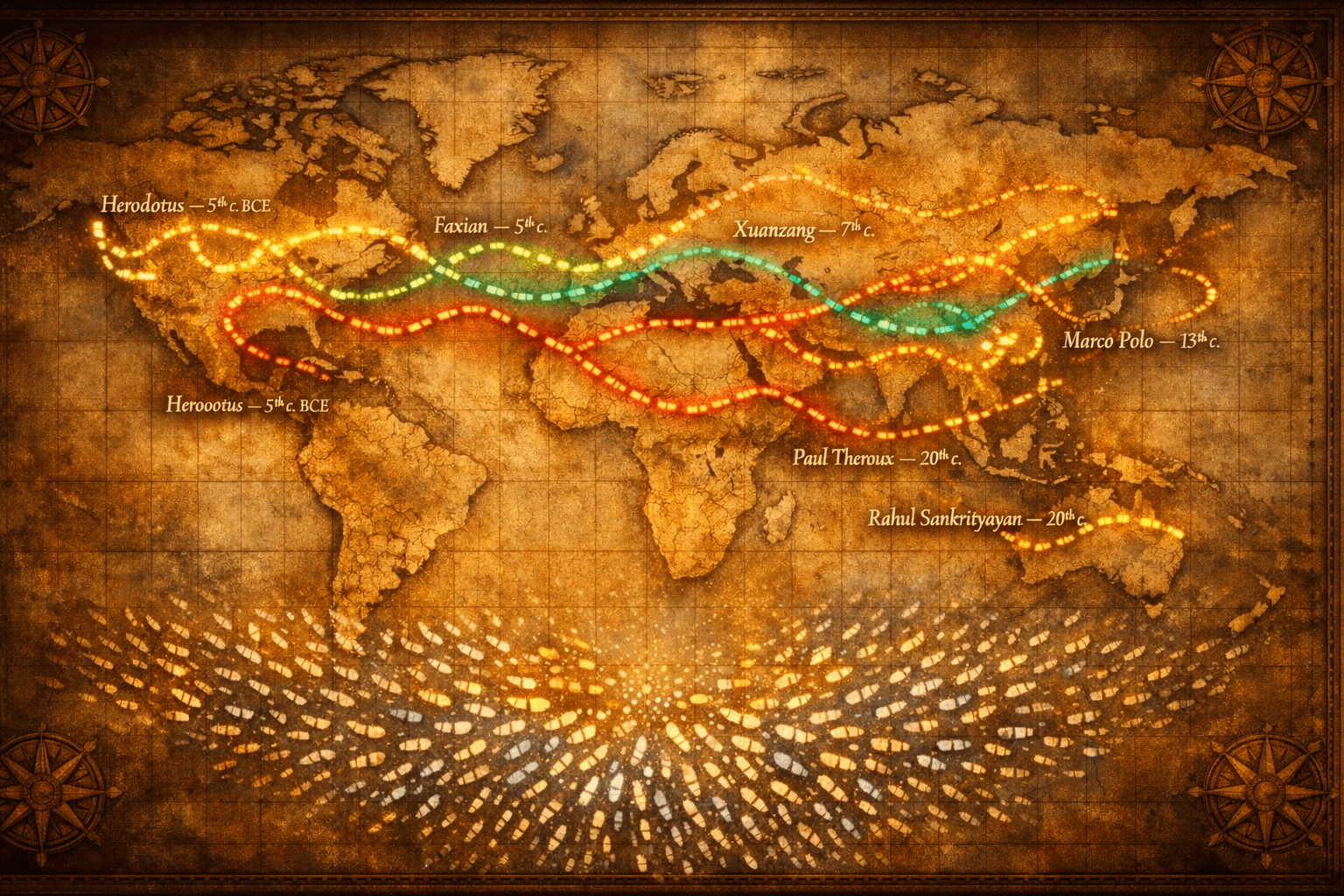
Greatest Travelogue Writers: Herodotus to Today
Explore travelogue writing history — from Herodotus and Ibn Battuta to modern digital storytellers. Discover the greatest writers and join their tradition.
What Best Defines a Travelogue? Meaning & More
Understand what truly defines a travelogue — its meaning, essential elements, natural pattern, and why your journey already qualifies as one worth sharing.