
Family Travel Travelogues: Making Memories Last
Why family travelogues matter and how to preserve your most meaningful travel memories — from childhood road trips to generational pilgrimages. Start writing.

The kids are fighting over who gets the window seat. Your mother is unwrapping aluminium foil parcels of parathas she packed at four in the morning. Your father is pretending to sleep but is actually watching the landscape change through one half-open eye. The train rocks gently. Someone spills chai. Nobody is upset about it.
This isn't a scene from a movie. It's Tuesday. It's your family on a train. And twenty years from now, when your children are grown and your parents' voices live mostly in memory, this is the moment you'll wish you had written down. Not the name of the hotel. Not the ticket price. This — the parathas, the chai stain, your father's quiet smile.
Family travel is like that. The big moments — the Taj Mahal, the first view of the mountains, the beach — those stay on their own. But the small ones? The ones that happen between destinations? Those need to be caught before they disappear. And a family travelogue is how you catch them.
What Exactly Is a Family Travelogue?
A family travelogue isn't a guidebook. It's not a review of hotels or a list of "top things to do." It's something much simpler and much more valuable — it's a personal account of a journey you shared with the people you love.
It captures the laughter when the car broke down on a mountain road and everyone had to push. It preserves your daughter's face the first time she saw snow. It holds your grandfather's voice as he told you about visiting the same temple fifty years ago. It records the argument about directions and the silence that came after, when everyone watched the sunset without speaking.
Family travel stories aren't about where you went. They're about who you were when you went there — and who you became by the time you came home.
Why Family Travelogues Matter More Than You Think
They Preserve Childhood in Its Own Words
Children see the world differently. A five-year-old doesn't notice the architecture of a fort — she notices the lizard on the wall, the echo of her voice in the stairwell, the way the stone feels warm under her hands. Travel with kids memories are extraordinary precisely because children notice what adults have learned to ignore. A family travelogue that includes a child's observations becomes a document of wonder — a record of how your family experienced the world when everyone was still small enough to be amazed by it.
They Capture Generations Together
Some of the most precious family travel stories happen between generations. A grandmother telling her granddaughter about the village she grew up in — while standing in that very village. A father showing his son the school he attended as a boy. A family pilgrimage to a temple that three generations have visited, each carrying different prayers. These moments exist at the intersection of past and present. They happen once. And if nobody writes them down, they become whispers that fade with time.
What family trip do you still talk about today? Not for the destination — but for what happened between you?
They Show Growth You Can't See in Photos
Photos freeze a moment. A family trip journal captures the movement between moments. The first mountain trip with your kids, where your son was terrified of the altitude but refused to admit it. The summer vacation where your teenager finally opened up during a long car ride and told you something they'd been carrying for months. The weekend road trip where your parents seemed older than you remembered — and you held your mother's hand while crossing a stream, reversing a lifetime of roles. Growth doesn't pose for cameras. But it shows up in stories.
They Strengthen What Holds a Family Together
Travel strips away routines. No one is at their desk. No one is on their usual schedule. The family is just — together. And in that togetherness, something shifts. You discover that your quiet father becomes talkative near the sea. That your sister, who never cooks at home, takes over the kitchen at the holiday cottage. That your children are funnier, braver, and more curious than you give them credit for in daily life. A family travelogue captures this version of your family — the travelling version, the unscripted version, the real one.
They Become Family Heirlooms
Twenty years from now, your children won't remember the hotel's star rating. But they might read a travelogue about the night you all slept under the stars because the tent was too small. They might read about their grandfather's joke that nobody laughed at but everyone remembers. They might read about the moment they, as toddlers, tasted salt water for the first time and cried — and how you laughed and held them and told them the sea was just saying hello. Travel memories with family, written down, become something no money can buy: a shared history that outlives the people who made it.
What to Capture in a Family Travelogue
The instinct is to document the big things — the monument, the sunrise, the view. But the soul of a family travelogue lives in the small things. Here's what to pay attention to.
The Conversations Nobody Expected
Something about travel loosens tongues. Your mother tells you a story about her childhood you've never heard before. Your teenage son, who hasn't spoken more than five words all week, suddenly asks a question about the universe while staring at the night sky. Your daughter turns to her grandmother and asks, "Were you scared when you got married?" These conversations happen on journeys because the usual walls aren't there. Write them down. Word for word, if you can.
The Mishaps That Become Legends
The wrong turn that led to the best meal of the trip. The flat tyre on a hill road that turned into a two-hour picnic. The hotel booking that didn't exist, so you all slept in the car and your father called it "camping." Every family has these stories. They're terrible in the moment and priceless in the retelling. A family travelogue that includes the chaos is always more honest — and more loved — than one that only shows the highlights.
The Quiet Gestures Nobody Photographs
Your father carrying your sleeping child from the car to the bed. Your mother making sure everyone has eaten before she touches her own plate. Your brother quietly negotiating with the taxi driver so your parents don't have to. These gestures are the real architecture of family travel. They don't make it to Instagram. But they should make it to your travelogue.
The Moments of Shared Silence
Not every meaningful moment involves words. Sometimes it's the whole family sitting on a hillside, watching the valley fill with mist, and nobody reaching for a phone. Sometimes it's everyone falling asleep in the car at the same time, trusting the driver and each other and the road. Write about the silences. They say as much as the conversations.
What memory would you want your children to read twenty years from now? The one that shows them how much they were loved — even on the days that felt ordinary?
How to Start Writing Your Family Travelogue
You don't need to be a writer. You don't need perfect grammar or poetic language. You just need to care enough about the memory to give it words. Here's how to begin.
Write Small Reflections Each Evening
After the kids are asleep, take five minutes. Just five. Write down what happened today — not the itinerary, but the moments. What made someone laugh? What surprised you? What did your child say that you don't want to forget? Three or four sentences are enough. Over the course of a trip, these small entries become something extraordinary.
Capture Different Perspectives
Ask each family member their favourite moment of the day. You'll be amazed at how differently everyone experienced the same trip. Your husband's highlight might be the food. Your daughter's might be the stray dog she played with. Your mother's might be the temple. A family travelogue that holds multiple perspectives is richer than any single voice could be.
Let Children Contribute
Give your child a small notebook. Or ask them three questions each night and write their answers in their own words. "What was funny today?" "What was scary?" "What do you want to remember?" Children's answers are often the most honest and the most beautiful parts of any family trip journal. A seven-year-old's description of a waterfall will be more alive than any travel writer's.
Revisit Together After the Trip
A week after returning home, sit together and read through what you wrote. Add details you forgot. Let your children fill in gaps. Laugh about the mishaps again. This act of revisiting is itself a bonding moment — and it cements the memories in ways that photos alone never can.
The Modern Paradox: A Thousand Photos, Zero Stories
We've never documented more and remembered less. A typical family holiday produces hundreds of photos — maybe a thousand. But ask anyone to tell you the story of that holiday six months later, and the details have already blurred. Which day was the waterfall? What did the guide say that made everyone laugh? What was the name of the restaurant where your daughter tried fish for the first time?
Photos capture surfaces. Family travel stories capture meaning. And in an age where every moment is photographed but few are reflected upon, the families who write down their journeys will be the ones who actually remember them.
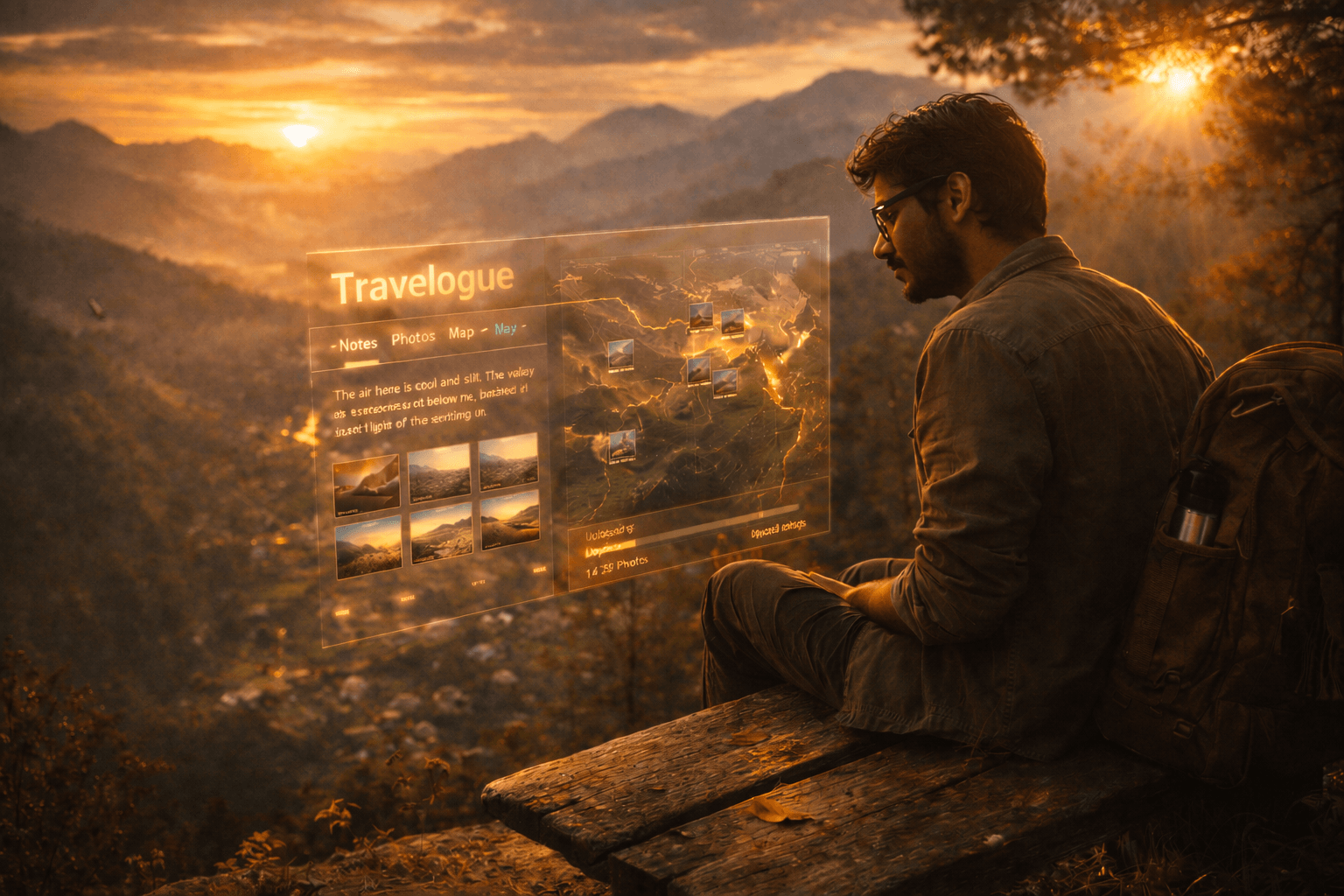
This is exactly why platforms like Pinaak exist — to help families turn their photos and travel moments into lasting travelogues that preserve not just what happened, but why it mattered. Not a photo dump. Not a social media post. A real, personal, family travelogue that your children can read years from now and feel what you felt.
Frequently Asked Questions
What is a family travelogue?
A family travelogue is a personal account of a journey shared with family — capturing not just the places visited but the emotions, conversations, funny moments, quiet observations, and shared experiences that made the trip meaningful. It preserves the human side of travel that photos alone can't hold.
How do I write a family travel journal?
Start simple. Write short reflections at the end of each day — what happened, what surprised you, what made everyone laugh or go quiet. Include different family members' perspectives, especially children's observations. Don't worry about perfect writing; focus on emotional honesty and sensory details. Platforms like Pinaak make it easy to turn these reflections into lasting travelogues.
Why are family travel memories important to preserve?
Family travel memories capture relationships at specific moments in time — children at certain ages, grandparents sharing stories, siblings discovering things together. These memories fade faster than we expect. A family travelogue preserves not just what you saw but how you felt, what you learned, and how the journey strengthened your bonds.
What should I include in a family travelogue?
Include candid conversations, funny travel mishaps, small gestures of care between family members, sensory details, children's reactions and questions, quiet moments of connection, lessons learned together, and shared realizations. The best family travelogues capture both the chaos and the tenderness of traveling with the people you love.
How can I involve my children in writing a family travelogue?
Ask your children simple questions each evening: What was your favourite part of today? What surprised you? What was the funniest thing? Write down their answers in their own words. Let younger children draw pictures. Give older children a small notebook or let them record voice notes. Their perspectives make the travelogue richer and create something they'll treasure as adults.
The Trip Ends. The Story Doesn't Have To.
Every family trip has a last day. The bags are packed. The car is loaded. Someone says, "I wish we could stay one more day." And then the journey home begins, and slowly, inevitably, the trip starts to settle into the past. The details soften. The conversations blur. The feelings — the real, raw, beautiful feelings of being together in a place that wasn't home — start to fade.
Unless you write them down.
A family travelogue doesn't have to be long. It doesn't have to be literary. It just has to be honest. Honest about the laughter and the arguments. Honest about the beauty and the boredom. Honest about the love that holds a family together through flat tyres and missed trains and one more hour in the car.
Family trips eventually end. But the stories we preserve become part of our shared history — passed down, read aloud, laughed over, cried over, lived again. They become proof that we were here. That we were together. That it mattered.
So start writing. Not tomorrow. Not on the next trip. Now. Pick a family journey — any one — and write down what you remember. Before the details disappear. Before the voices fade. While the memory is still warm enough to hold.
The trip ends. The story doesn't have to.
Ready to preserve your family travel memories?
Pinaak helps families turn photos and moments into lasting travelogues — not a photo dump, but a real story your children can read years from now.

Keep Reading

7 Key Elements Every Travelogue Needs
Discover the 7 essential elements of a great travelogue — from sensory details and personal perspective to emotional honesty. A practical guide for travelers.
How to Plan a Travelogue: A Step-by-Step Guide
Learn how to plan a travelogue — from setting intention to organizing memories. A practical guide to turning your journey into a story worth keeping.