
How AI is Changing Travel Storytelling in 2026
How AI is transforming travel storytelling — turning photos into narratives, helping travellers reflect and organize memories, and share meaningful journeys.

Your phone holds a thousand travel photos. But how many of them are actually stories?
You're sitting on your couch on a Sunday evening, scrolling through your camera roll. There it is — that trip to Rishikesh from last March. Two hundred and seventeen photos. A blurry sunset. Three nearly identical shots of a temple. A selfie on a suspension bridge. A plate of momos you forgot you'd eaten. And somewhere in between, buried under duplicates and accidental screenshots, there's a moment you remember vividly — the sound of the Ganges at five in the morning, the cold air on your face, the feeling that something inside you had quietly shifted.
But that moment? It's nowhere in those two hundred and seventeen photos. Because the camera captured what you saw. It didn't capture what you felt.
This is the gap that travellers have been trying to close for centuries. We've used handwritten diaries. We've written letters home. We've blogged, vlogged, posted Instagram carousels with poetic captions. And every generation has found its own way to say: "I went somewhere, and it changed me, and I want to remember how."
Now, in 2026, something new is entering that conversation. Not as a replacement for the traveller's voice, but as a quiet companion to it. Artificial intelligence is beginning to change the way we capture, organise, reflect on, and share our travel stories. And the shift is more human than you might expect.
How We Got Here: A Brief History of Travel Stories
Travel storytelling is one of the oldest forms of human expression. Herodotus wandered the ancient world and wrote down what he saw. Ibn Battuta spent thirty years on the road and dictated his journeys into what became one of history's great travelogues. For most of human history, preserving a travel experience meant sitting down with pen and paper and finding the words yourself.
Then cameras arrived, and suddenly you could show people what you'd seen. Then the internet arrived, and travel blogs gave everyone a platform. Then social media arrived, and travel storytelling became instant — a photo, a caption, a location tag, done. Each shift made sharing easier. But each shift also made something else harder: reflection. The faster we could share, the less time we spent sitting with what we'd experienced.
And now we're at the next shift. AI travel storytelling isn't about making sharing faster — it's about making reflection easier. It's about closing that gap between the two hundred photos on your phone and the one story you actually want to tell.
Turning Photos Into Stories
Here's something most travellers have experienced: you come home from a trip, look at your photos, and think, "I should really organise these into something." And then you don't. Because organising three hundred photos into a coherent narrative is genuinely hard work. You'd need to select the best ones, figure out the sequence, remember what happened when, and then write something meaningful to go with each image.
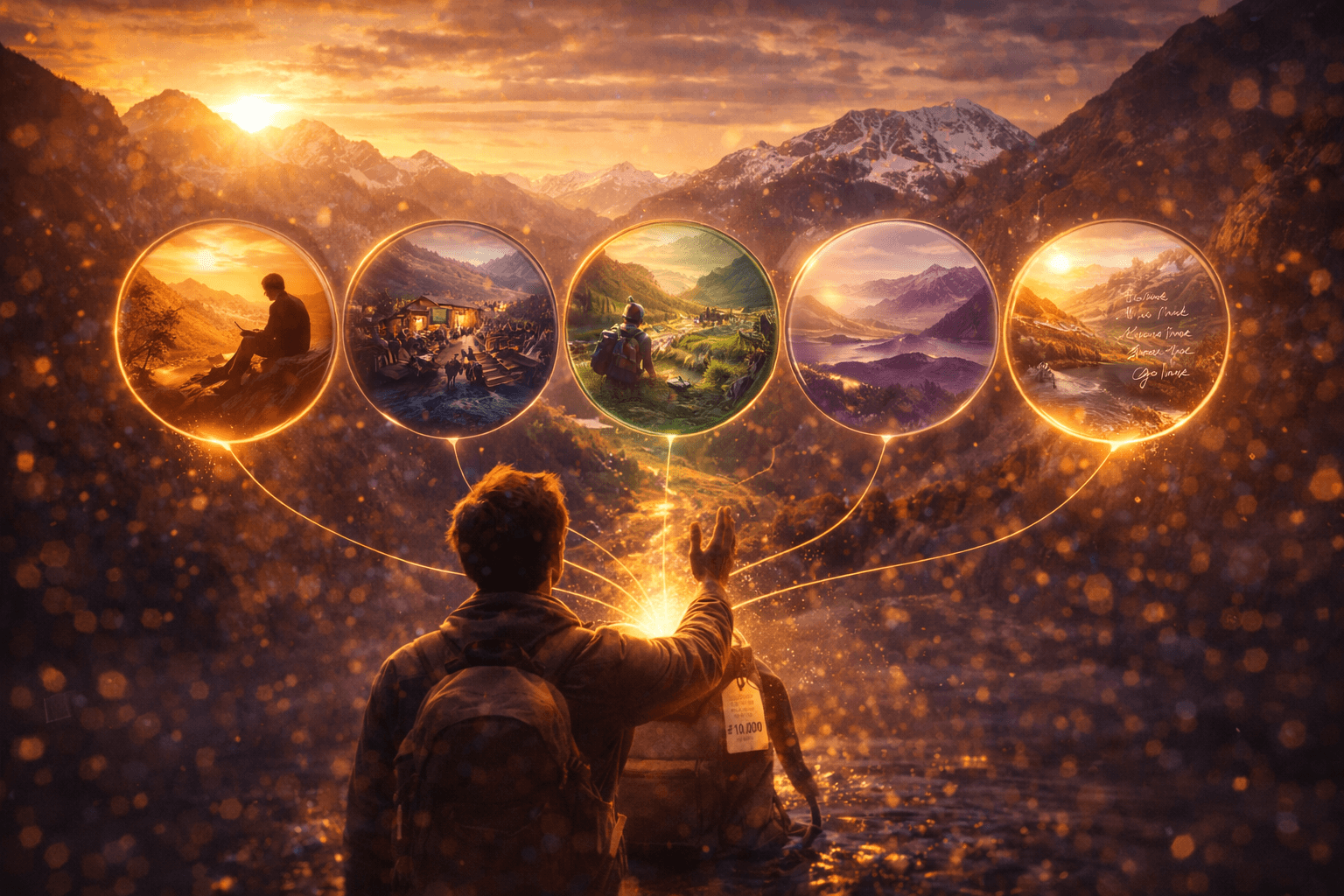
This is one of the most practical ways AI is changing travel storytelling. Imagine uploading your photos from a week in Himachal and having an AI recognise the locations, sort them chronologically, identify the key moments — a mountain pass, a market, a lakeside camp — and suggest a narrative structure. Not write the story for you. Suggest the shape of it. "It looks like your journey moved from Shimla to Manali over four days. Here are the chapters it naturally falls into."
That's not replacing storytelling. That's removing the blank-page problem. That's giving you a starting point instead of a paralysing empty screen. The story is still yours. The AI just helped you see its outline.
Helping Travellers Reflect on Their Journeys
This one is subtler, and arguably more important. Most of us are better at describing what we did on a trip than how it made us feel. "We went to the fort. We had lunch at this place. We drove back." The logistics are easy. The meaning is hard.
AI travel journals are beginning to change this by asking the right questions at the right time. Not generic prompts like "how was your day?" but specific, context-aware ones. "You spent two hours at Pangong Lake. What surprised you about the silence there?" Or: "This was the third temple you visited this week. Has your relationship with these spaces changed since the first one?"
These prompts don't write the reflection for you. They open a door you might not have opened yourself. And that's the difference between a photo dump and a travelogue — the moment you stop describing what happened and start understanding what it meant.
What story from your travels still exists only in your memory — never written down, never shared, slowly fading? What would it take for you to finally give it words?
Organising Travel Memories Automatically
Your phone doesn't know the difference between a meaningful travel photo and a screenshot of your boarding pass. They sit side by side in the same camera roll, equally weighted, equally forgotten. Over time, even the best trip photos get buried under months of everyday images — food deliveries, work screenshots, random memes your friend sent at midnight.
AI-powered platforms are starting to solve this by automatically grouping travel content by journey. Using location data, timestamps, and image recognition, they can identify that you were in Jaipur for three days last November and pull together every photo, note, and check-in from that trip into a single, organised collection. No manual sorting. No scrolling through six months of camera roll to find that one sunset shot.
It sounds simple, but the impact is real. When your memories are organised, you revisit them. When they're scattered, you don't. AI travel stories begin with organisation — not as a filing task, but as an act of preservation.
Lowering the Barrier to Storytelling
Here's a truth that doesn't get said enough: most people don't think of themselves as writers. They go on incredible journeys — through mountains, across deserts, into cities they've never seen — and when someone asks them about it, they say, "It was amazing," and leave it there. Not because they don't have stories. Because they don't think they have the skill to tell them.
AI travel writing tools are quietly dismantling this barrier. If you can describe what you saw in three sentences, AI can help you shape those sentences into a narrative. If you can speak into your phone about the market in Jodhpur — the colours, the noise, the old man selling puppets — AI can help you turn that voice note into a written passage that sounds like you, only more structured.
This isn't about AI writing for you. It's about AI writing with you. Helping you express something that was already inside you but hadn't found its way out yet. The future of travel storytelling isn't a world where machines tell human stories. It's a world where humans who never thought they could tell stories finally do.
Discovering Stories From Other Travellers
AI isn't just changing how we create travel stories — it's changing how we find them. Right now, if you search for "Hampi" online, you get the same ten blog posts, the same recommended itineraries, the same Google-optimised guides. What you don't easily find is the quiet, personal story from someone who spent a week in Hampi during monsoon and had the ruins entirely to themselves.
AI-powered discovery changes this by surfacing travel narratives based on mood, season, experience type, and emotional resonance rather than just search keywords. Looking for reflective solo travel stories from winter? Curious about first-time mountain trekking experiences? Interested in how other parents navigate travel with toddlers? AI can match you with stories that feel relevant to where you are in your own journey.
Platforms like Pinaak are building exactly this kind of experience — combining travelogues with AI-assisted storytelling so that the stories travellers create become discoverable, meaningful narratives for others. Not algorithms pushing viral content, but intelligent curation surfacing authentic human experiences.
What if your photos could automatically become a travel story — not a perfect, polished one, but an honest one? A story that remembers the details you've already started to forget?
The Balance: AI Assistance and Human Authenticity
Let's address the question that's probably been sitting in the back of your mind: if AI helps you write your travel story, is it still your story?
Yes. Completely. And here's why.
AI doesn't travel. It doesn't feel cold air on a mountain pass. It doesn't taste chai from a roadside stall in Varanasi. It doesn't experience the strange loneliness of being in a beautiful place with no one to share it with. Everything that makes a travel story worth reading — the perspective, the emotion, the personal meaning — comes from you. AI can help you structure it, prompt you to dig deeper, organise the pieces. But the raw material is entirely human.
Think of it this way. A carpenter uses power tools. Nobody says the table wasn't made by the carpenter. The tool didn't design the table or choose the wood or decide what the kitchen needed. The tool just made the work more efficient. AI travel storytelling works the same way. The craft is still yours. The tool just helps you build it.
The key is balance. Use AI to overcome the blank page. Use it to remember details you'd otherwise lose. Use it to find structure in your scattered memories. But always write the meaning yourself. Always keep the moments that matter in your own voice. That's where authenticity lives — not in perfect grammar, but in honest perspective.
What Comes Next: The Future of Travel Storytelling
We're still early. AI travel storytelling in 2026 is roughly where digital photography was in 2005 — useful, promising, and nowhere near its full potential. But the direction is clear, and it's worth imagining where this goes.
Smarter AI travel journals will learn your storytelling style over time. After your third or fourth travelogue, the AI won't just suggest generic prompts — it'll know that you tend to notice food more than architecture, that you prefer writing about people over landscapes, that your best reflections come on the last day of a trip. It'll adapt to you, making each travelogue feel more naturally yours.
AI-curated travel memories will surface forgotten moments at meaningful times. Imagine your phone gently reminding you, a year later, that you were in Ladakh on this exact date — and here's the travelogue you wrote about it. Not just a photo notification, but a whole story, waiting for you to re-enter.
And immersive storytelling formats will combine photos, written reflections, location data, ambient sounds, and even local weather into travelogues that don't just describe a journey — they recreate the feeling of being there. Not virtual reality, but emotional reality. A story that puts you back in the moment with everything except the cold.
Frequently Asked Questions
How is AI changing travel storytelling?
AI is changing travel storytelling by helping travellers turn photos into structured narratives, organise scattered memories into meaningful journeys, reflect on emotional experiences through guided prompts, and lower the barrier to storytelling for people who don't consider themselves writers. AI-assisted platforms can group photos by location and time, suggest narrative structures, and help surface meaningful travel stories from other travellers.
What are AI travel journals?
AI travel journals are digital platforms that use artificial intelligence to help travellers capture, organise, and narrate their journeys. Unlike traditional journals, AI travel journals can automatically sort photos and experiences, suggest writing prompts based on your trip, help structure your memories into travelogues, and even assist with expressing emotions and reflections you might struggle to put into words on your own.
Can AI write travel stories for you?
AI can assist with travel writing by providing structure, prompts, and organisation, but the most meaningful travel stories still come from personal experience, emotion, and reflection. The best approach is AI-assisted storytelling where technology helps you articulate and preserve your memories while the perspective, meaning, and authenticity remain entirely yours.
What is the future of travel storytelling?
The future of travel storytelling includes smarter AI travel journals that learn your storytelling style, AI-curated travel memories that surface forgotten moments at meaningful times, immersive storytelling formats combining photos, reflections, and location data, and community-driven platforms where AI helps connect travellers through shared experiences and destinations.
How can I preserve my travel memories better?
To preserve travel memories more meaningfully, go beyond uploading photos to social media. Create structured travelogues that combine images with written reflections. Use AI-assisted platforms like Pinaak to organise your journeys, add context and emotion to your photos, and build travel narratives that capture not just what you saw but how it made you feel.
The Story Was Always Yours. Now It's Easier to Tell.
Technology changes how stories are told. It always has. The printing press didn't replace travellers — it gave their stories a wider audience. Cameras didn't replace observation — they added a visual layer to it. The internet didn't replace personal narrative — it gave everyone a platform.
AI is the next chapter in that same story. Not a replacement for the traveller's voice, but an amplifier for it. A tool that helps you remember what you'd otherwise forget. A companion that asks the questions you didn't think to ask yourself. A structure that turns your scattered photos and half-remembered feelings into something lasting.
The heart of travel storytelling hasn't changed. It's still human curiosity. Still the desire to go somewhere, see something, feel something, and come back different. Still the ancient impulse to sit down after a journey and say: "Let me tell you what happened."
AI just makes it a little easier to say it well. And in a world where we take more photos than ever but tell fewer stories than we should, that might be exactly what we need.
The heart of travel storytelling hasn't changed. It's still the desire to go somewhere, feel something, and come back different.
Turn your photos into travel stories with Pinaak
Use AI-assisted storytelling to organise your journeys, reflect on what mattered, and share meaningful travelogues — not just captions.

Keep Reading

Your First 30 Days on Pinaak: A Creator's Guide
Follow a travel creator's first 30 days on Pinaak — from scattered photos to structured travelogues, from casual traveler to intentional storyteller.
Narrative Travelogues: Types & How to Write One
Learn what narrative travelogues are, explore the different types, and discover how to turn your journeys into powerful travel stories worth reading.