
Travelogues in Literature: A History of Travel Writing

Long before anyone had a passport, a boarding pass, or a phone with a camera, people crossed mountains and oceans and deserts — and when they came back, they told stories. Around fires. On scrolls. In leather-bound journals carried through monsoons. The urge to travel and the urge to tell are almost the same thing. We go somewhere new. We see something that changes us. And then we need — not want, need — to share it with someone who wasn't there.
That urge is thousands of years old. It produced some of the greatest literature the world has ever known. And it's the same urge that makes you write a caption under a sunset photo on Instagram, hoping that someone, somewhere, will feel even a fraction of what you felt.
This is the story of how travelogues in literature evolved — from ancient Greek historians walking across empires to Buddhist monks crossing the Himalayas, from Ibn Battuta's thirty-year odyssey to the Instagram story you posted last weekend. The formats have changed. The human need behind them hasn't moved an inch.
What Is a Travelogue, Really?
A travelogue is a personal account of a journey. Not a map. Not a guidebook. Not a list of hotel ratings. It's the story of what happened to a person when they left the familiar and entered the unknown — what they saw, what they felt, who they met, what surprised them, and how the journey changed the way they understood the world.
Travelogues are one of the oldest forms of narrative literature. Before novels existed, before newspapers, before blogs — people were already writing travelogues. Because the journey story is, in many ways, the original story. Leave home. See something extraordinary. Come back changed. Tell the tale.
Every era has its own version of this. And every version reveals as much about the era as it does about the journey.
The First Travellers Who Wrote It Down
Herodotus: The Curious Greek
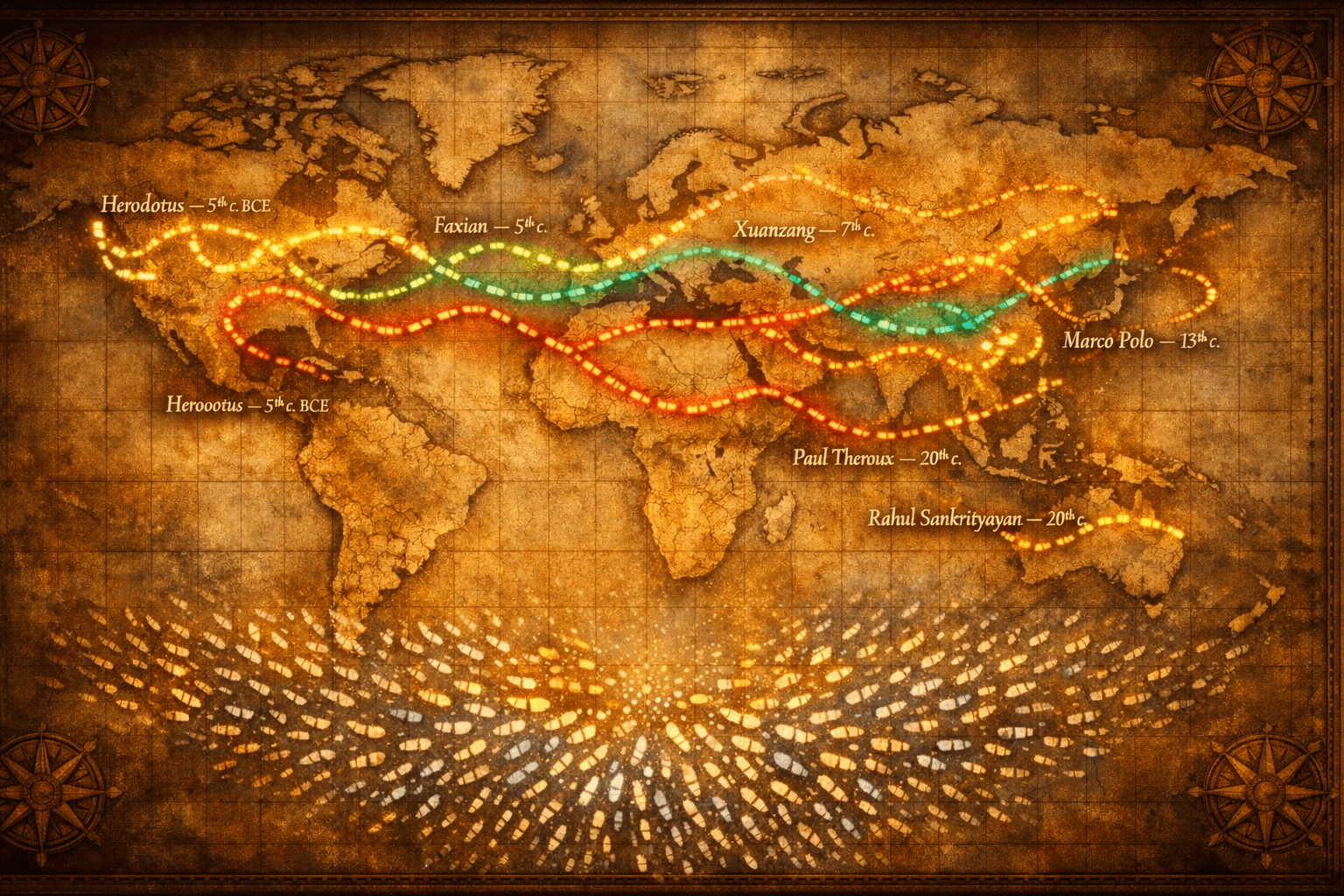
Around 440 BCE, a Greek historian named Herodotus wrote what many consider the first travelogue in Western literature. His work, The Histories, wasn't just about wars and politics — it was about the places he visited. Egypt. Persia. Scythia. He described the pyramids, the Nile floods, the customs of distant peoples. He got some things wrong. He got some things spectacularly wrong. But he did something no one before him had done so thoroughly — he recorded what he witnessed as a traveller, not just as a historian. He looked at the world with curiosity rather than conquest. And that made his writing the earliest surviving literary travelogue we know of.
Faxian and Xuanzang: The Pilgrim Monks
While the Western world had Herodotus, the East had its own extraordinary travel writers. Faxian, a Chinese Buddhist monk, walked from China to India around 400 CE to collect sacred texts. His journey took over a decade, crossing the Taklamakan Desert and the Himalayas — landscapes that would challenge a modern expedition. His travelogue, A Record of Buddhist Kingdoms, documented not just the monasteries he visited but the cultures, the landscapes, and the people he encountered along the way.
Two centuries later, Xuanzang made a similar journey — a seventeen-year pilgrimage from China to India and back. His travelogue, Great Tang Records on the Western Regions, became one of the most important historical documents of the ancient world. It described kingdoms that no longer exist, cities that have since turned to dust, and a route across Asia that connected civilisations. These monks didn't travel for adventure. They travelled for faith. But what they left behind was literature — rich, detailed, and deeply human.
Imagine writing about your journey with no camera, no GPS, no internet. Just your memory, a brush, some ink, and the knowledge that if you don't write it down, the world you saw will never be seen by anyone else.
Ibn Battuta and Marco Polo: When the World Got Bigger
Ibn Battuta: The Father of Travelogue
If one person can be called the father of travelogue, it's Ibn Battuta. Born in Tangier, Morocco, in 1304, he set out on a pilgrimage to Mecca at the age of twenty-one — and then kept going. For nearly thirty years. Across North Africa, the Middle East, Central Asia, India, Southeast Asia, China, and sub-Saharan Africa. An estimated 120,000 kilometres. On foot, on horseback, by camel, by boat.
His travelogue, the Rihla (meaning "The Journey"), is extraordinary not just for its scope but for its humanity. Ibn Battuta didn't just describe geography. He described hospitality — who fed him, who housed him, who treated him with kindness or suspicion. He documented weddings and funerals, markets and mosques, court politics and street life. He wrote about the Delhi Sultanate with the detail of someone who lived there. He wrote about the Maldives with the bewilderment of someone falling in love with a place he never expected to visit.
The Rihla is the history of travel writing condensed into one life. It's curious, brave, sometimes exaggerated, always alive. And it remains one of the most important literary travelogues ever written.
Marco Polo: The Merchant Storyteller
Around the same era, on the other side of the Mediterranean, a Venetian merchant named Marco Polo travelled the Silk Road to China and spent seventeen years in the court of Kublai Khan. His travelogue, The Travels of Marco Polo, introduced Europe to the wealth, culture, and sophistication of Asia. Whether every detail was accurate is still debated — some historians believe Polo embellished heavily, others argue he reported faithfully. But what's undeniable is the impact. His book made Europeans dream of the East. It inspired Columbus. It expanded the European imagination about what the world contained.
Together, Ibn Battuta and Marco Polo represent a turning point in the history of travel writing. Their travelogues weren't just personal stories — they were bridges between civilisations. They made the distant feel reachable, the unknown feel knowable.
Have you ever shared a journey hoping someone else would feel it too? That impulse — to bridge the distance between your experience and another person's understanding — is as old as writing itself.
The Modern Turn: When Travelogues Became Inner Journeys
For centuries, travelogues were primarily about the external — new lands, new peoples, new customs. But somewhere in the twentieth century, literary travelogues shifted. The journey outward became a journey inward. Writers started using travel not just to describe places but to understand themselves.
Paul Theroux: The Train Window Philosopher
Paul Theroux didn't fly to his destinations — he took trains. Long, slow, uncomfortable trains. His travelogues, including The Great Railway Bazaar and The Old Patagonian Express, are less about the places he reached and more about what happened along the way. The strangers in the compartment. The conversations that changed him. The landscapes that passed while he was thinking about something else entirely. Theroux turned the literary travelogue into a meditation — proof that the journey itself is the destination, even when the destination is disappointing.
Bruce Chatwin: The Restless Poet
Bruce Chatwin's In Patagonia is barely a travelogue in the traditional sense. It's a collection of stories, memories, encounters, and digressions — all held together by the thin thread of a journey through southern Argentina. Chatwin didn't write about places the way a geographer would. He wrote about them the way a poet would — finding myth in the mundane, mystery in the ordinary, and meaning in the act of walking itself. His work blurred the line between travelogue and literature so completely that it's hard to know where one ends and the other begins.
These writers — and many others like them — changed what a travelogue could be. It was no longer just a record of where you went. It became a record of who you were while you were going there.
Travelogues in the Digital Age: Blogs, Phones, and Instagram
And then the internet happened. And suddenly, everyone could be a travel writer.
The early 2000s brought travel blogs — long-form personal accounts of backpacking trips, gap years, and round-the-world journeys. Platforms like WordPress and Blogger gave anyone with an internet connection the ability to publish their travelogue. Some were brilliant. Many were ordinary. But all of them were part of the same tradition that started with Herodotus — a person went somewhere, saw something, and felt compelled to share it.
Then came smartphones. And Instagram. And the travelogue compressed into a single image with a caption. A photo of a mountain pass with three sentences about how the altitude made you cry. A shot of a street market with a paragraph about the grandmother who gave you free samosas. A sunset with a line about missing someone.
Are these travelogues? In the truest sense — yes. They're short. They lack the depth of a Theroux or the scope of an Ibn Battuta. But they carry the same seed: a personal experience of a place, shared with the hope that someone else will feel it too.
Today, platforms like Pinaak are bridging this gap — giving modern travellers the tools to create travelogues that go beyond a single post. Photo travelogues. Reflective journals. Story-driven accounts of journeys that deserve more than a caption. The literary tradition of the travelogue isn't dying in the digital age. It's evolving. And the people writing the next chapter aren't famous authors — they're everyday travellers with phones in their pockets and stories worth telling.
What Has Changed — and What Never Will
The format has changed beyond recognition. Herodotus carved his observations onto papyrus. Faxian wrote with a brush on silk. Ibn Battuta dictated to a scribe. Theroux typed on a portable typewriter in a train compartment. You tap on a phone screen while waiting for your coffee.
But the core hasn't moved. Every travelogue — from the oldest scroll to the newest Instagram story — is built on the same foundation: I went somewhere. I saw something that mattered. I want you to know about it. That's it. That's the entire history of travel writing in three sentences.
And that means you — yes, you — are part of this tradition. Every time you describe a journey with honesty, every time you capture what a place made you feel rather than just what it looked like, every time you write a few sentences about a sunset or a conversation or a meal that changed your day, you're doing what Ibn Battuta did. What Xuanzang did. What Theroux did. The scale is different. The impulse is identical.
What story from your travels would you want preserved for centuries? The one that someone in the year 2300 might read and think, "That person really saw the world"?
Frequently Asked Questions
Who is the father of travelogue?
Ibn Battuta is widely regarded as the father of travelogue. Born in Morocco in 1304, he spent nearly thirty years traveling across Africa, the Middle East, Central Asia, South Asia, Southeast Asia, and China — covering an estimated 120,000 kilometres. His account, the Rihla, is one of the most comprehensive and influential travelogues in literary history. In the Western tradition, Herodotus is sometimes credited as the father of travel writing for his detailed accounts in The Histories.
Who wrote the first travelogue?
The earliest known travelogue is often attributed to Herodotus, whose Histories (around 440 BCE) included extensive travel observations from Egypt, Persia, and the Mediterranean. Earlier travel accounts exist from ancient Egypt and Mesopotamia. In the Eastern tradition, Faxian wrote a detailed travelogue of his journey to India around 400 CE. The concept of travel writing has existed across cultures for thousands of years.
What is the oldest travelogue in literature?
The oldest surviving travelogue is generally considered to be The Histories by Herodotus, written around 440 BCE. Some scholars point to even older Egyptian texts such as the Story of Sinuhe (around 1875 BCE) as early forms of travel narrative. In Chinese and Indian traditions, Faxian's Record of Buddhist Kingdoms (circa 400 CE) is among the oldest surviving dedicated travelogues.
Are Instagram posts considered travelogues?
Yes, Instagram posts can be considered modern travelogues — especially when they include personal reflections, cultural observations, emotional responses, and storytelling beyond surface-level photos. A thoughtful caption that describes how a place made you feel is doing what travelogue writers have done for centuries, just in a shorter, more visual format. Platforms like Pinaak take this further by helping travelers create more complete digital travelogues.
What makes a literary travelogue different from a travel blog?
A literary travelogue emphasises narrative craft, emotional depth, cultural reflection, and personal transformation — treating the journey as both a physical and inner experience. A travel blog tends to focus more on practical information, recommendations, and tips. However, the line between them is blurring. The key difference is intent: literary travelogues prioritise meaning and storytelling over utility.
You Are Part of This Story
The history of travelogues in literature isn't a finished chapter in a textbook. It's a living, ongoing story — and you're in it. Every traveller who writes down what they felt, who captures a conversation they don't want to forget, who describes a place with enough honesty that a stranger can feel it — they're adding a page to a tradition that spans millennia.
From Ibn Battuta's handwritten journeys across continents to the Instagram story you posted from a hilltop last month, travelogues have always been about one thing: sharing perspective across time and distance. Saying, "I was here. This is what it was like. I hope you can feel it too."
The format will keep changing. Scrolls became books. Books became blogs. Blogs became stories and reels and digital journals. Tomorrow it might be something we haven't imagined yet. But the travelogue itself — the simple, brave act of turning a journey into a story — will never stop. Because as long as people travel, they'll need to tell someone about it.
So the next time you sit somewhere beautiful and feel the urge to write — don't dismiss it. That urge is ancient. It's the same one Herodotus felt on the banks of the Nile, that Ibn Battuta felt in the markets of Delhi, that Theroux felt on a slow train through India. Follow it. Write your journey down. Because your travelogue — however short, however imperfect — is the next page in the longest story ever written.
Ready to write your own travelogue?
Pinaak helps you turn journeys — from nearby walks to cross-continent odysseys — into travelogues that actually preserve what you felt.

Keep Reading
Greatest Travelogue Writers: Herodotus to Today
Explore travelogue writing history — from Herodotus and Ibn Battuta to modern digital storytellers. Discover the greatest writers and join their tradition.

20 Best Travelogue Examples: Classic to Modern Stories
Explore 20 powerful travelogue examples — from Ibn Battuta and Mark Twain to modern digital stories. Discover what makes a great travelogue worth reading.