
Is 2 Days Enough in Varanasi? A 2-Day Itinerary
Is 2 days enough in Varanasi? Yes — here's a tested 2-day itinerary covering sunrise boat rides, Kashi Vishwanath, Sarnath, Ganga Aarti & hidden gems.
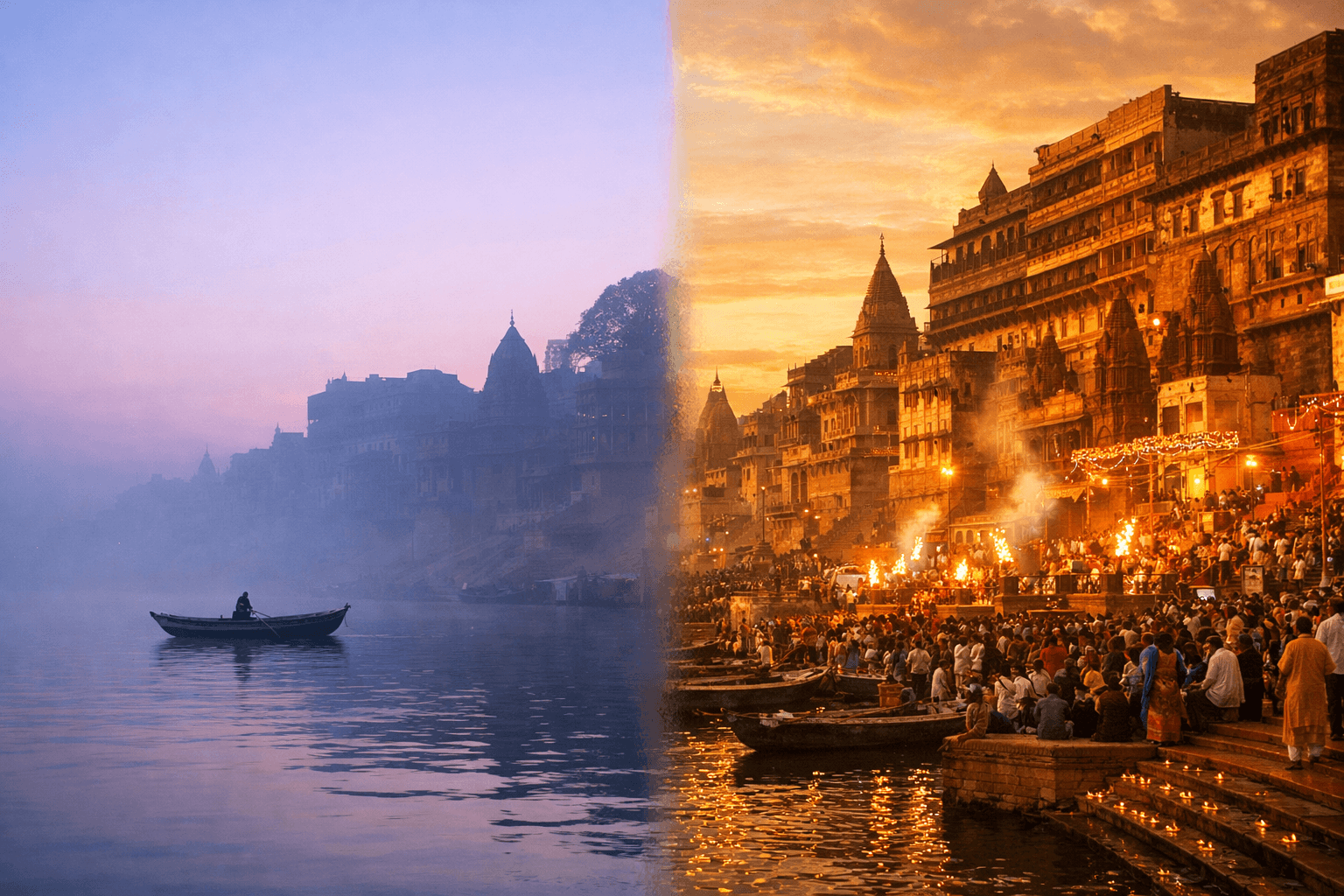
You've got a weekend. Maybe a Friday-to-Sunday window. Maybe two days squeezed between a work trip and a flight home. And somewhere in the back of your mind, there's this question that won't go away: is 2 days enough in Varanasi?
You've seen the photos. The orange sky over the ghats. The flames rising during aarti. The impossibly narrow lanes that somehow hold an entire universe. And you're wondering — can you actually experience all of that in just 48 hours? Or will it feel like a rushed highlight reel?
I had the exact same question before my first trip. I'd heard people say Varanasi needs at least a week. That you need to "slow down" and "let the city come to you." And sure, that sounds lovely. But most of us don't have a week. We have a weekend. And the real question isn't whether a week would be better — it's whether two days can still be meaningful.
After spending multiple trips in Varanasi — including a varanasi weekend trip that ended up being one of my most memorable — I can tell you with confidence: yes. Two days is enough. More than enough, if you plan it right.
Here's exactly how.
Is 2 Days Enough in Varanasi?
Let's be honest about it. In two days, you won't visit every ghat. You won't sit in a classical music concert at Tulsi Ghat. You probably won't explore Ramnagar Fort or spend an afternoon learning about Banarasi weaving techniques from a fourth-generation artisan.
But here's what you will do.
You'll watch the sun rise over the Ganges from a wooden boat while the city slowly wakes up around you. You'll walk through lanes so old that the stones under your feet have been polished smooth by centuries of footsteps. You'll stand at Dashashwamedh Ghat as seven priests perform the Ganga Aarti in perfect synchronization, fire reflecting off the river and a thousand phones held up like modern-day offerings.
You'll eat kachori so crispy it shatters in your mouth. You'll drink chai that costs ₹10 and tastes like it should cost ten times more. You'll visit the place where Buddha gave his first sermon. And you'll sit on a rooftop as the sun drops behind the skyline and think: "I get it now. I get why people keep coming back."
Two days in Varanasi doesn't give you everything. But it gives you the feeling. And in a city like this, the feeling is the point.
How to Plan Your Varanasi Weekend Trip
A little planning goes a long way here. Varanasi isn't a city that follows neat tourist logic — it runs on its own rhythm. Here's how to work with it instead of against it.
- Arrive early — ideally the night before Day 1. If your train or flight lands by 10 PM, you'll have time to settle in and wake up fresh for the 5:30 AM sunrise boat ride. Arriving on the morning of Day 1 means you lose half a day to travel fatigue.
- Stay near the ghats. Book a hotel or guesthouse between Assi Ghat and Dashashwamedh Ghat. This keeps you within walking distance of almost everything. Godowlia is another solid option — slightly more commercial, but well-connected. Avoid staying near the railway station; it's far from the action.
- Get around on foot + auto. The old city is pedestrian-only in most parts. For Sarnath or the railway station, use auto-rickshaws. Ola and Uber work but can be unreliable near the ghats. Negotiate auto fares upfront.
- Book a sunrise boat ride in advance. Ask your hotel to arrange one, or negotiate at the ghat the evening before. Morning rates are better than on-the-spot bargaining at 5:30 AM when you're half asleep.
- Pack light and wear simple clothes. You'll be walking a lot, stepping in and out of temples, and navigating uneven lanes. Slip-on shoes, breathable fabrics, and modest clothing for temple visits.
Day 1 — Sunrise Ghats, Old City Walk & Ganga Aarti
This is the day that'll make you understand what Varanasi is really about. It starts before the city wakes up and ends with fire on the river.
Sunrise Boat Ride on the Ganges (5:30 AM – 7:00 AM)
Set your alarm for 5:00 AM. I know — it hurts. But this is the single most important thing you'll do in your entire 2 day varanasi itinerary.
Walk to Assi Ghat or Dashashwamedh Ghat in the pre-dawn dark. The ghats are already stirring — a few sadhus meditating by the water, someone practicing yoga on the steps, the faint sound of bells from a nearby temple. Board a boat and push off into the river.
For the next 90 minutes, you'll drift northward along the ghat line. The sky shifts from deep blue to pink to gold. Morning bathers step into the water for their rituals. Smoke rises from the cremation ghats at Manikarnika — a reminder that life and death exist side by side here, without drama or separation. The boatman rows in silence. The city unfolds like it has every morning for thousands of years.
Shared boats cost ₹100–150 per person. Private ones run ₹300–500. Either way, it's the most valuable ₹150 you'll ever spend.
Walk Through the Ghats (7:00 AM – 8:30 AM)
Once you're back on land, don't leave the ghats yet. This is the best time to walk along them. The steps are still relatively empty. The morning light is warm and golden. You'll pass wrestlers training in an akhara, kids flying kites, women drying sarees on the stone steps.
Walk from Assi Ghat toward Dashashwamedh. Take your time. Stop where something catches your eye. There's no right route here — just walk and watch. The ghats are Varanasi's living room. Everyone comes here for different reasons, and you'll see all of them in a single morning.
Grab breakfast along the way. A plate of kachori-sabzi and a cutting chai from any ghat-side stall will cost you ₹30–40 and set you up for the morning.
Explore Kashi Vishwanath Temple Area (9:00 AM – 10:30 AM)
Head to the Kashi Vishwanath Temple by 9:00 AM. The new corridor has made access much easier, but the queue still builds after 10 AM — so earlier is better.
Leave your phone, wallet, and bags at the hotel or use the lockers near the entrance (₹10–20). Only carry your ID. The security process takes 10–15 minutes, and darshan itself depends on the crowd — expect 20–45 minutes.
After the temple, spend some time in the corridor itself. The new complex connects directly to the ghats and has been beautifully restored. It's worth a slow walk through.
Street Food Break (11:00 AM – 12:30 PM)
You've earned this. The lanes around Vishwanath Gali and Dashashwamedh are packed with food stalls, and this is where Varanasi shows off its culinary identity.
- Tamatar chaat — tangy tomato-based chaat you won't find anywhere else in India. Dashashwamedh Ghat area has the best.
- Blue Lassi Shop — legendary tiny shop. Saffron or mango lassi in a clay cup. The line moves fast.
- Kachori Gali — an entire lane dedicated to kachoris. The stuffed ones with spicy potato filling are addictive.
- Banarasi paan — get the sweet meetha paan. Even if you don't usually eat paan, this one's different.
- Malaiyo — if you're visiting November to February, don't miss this. Frothy saffron milk foam in a clay bowl. It's seasonal and disappears after winter.
Budget ₹150–250 for a proper food crawl. Eat slow. Eat everything. This is as much a Varanasi experience as the temples.
Evening Ganga Aarti at Dashashwamedh Ghat (6:00 PM – 7:45 PM)
After lunch, take a break. Go back to your hotel. Rest your feet. Read a book. Varanasi's afternoon heat — even in winter — can drain you. You'll want energy for the evening.
Reach Dashashwamedh Ghat by 5:45 PM. The Ganga Aarti starts around 6:45 PM, but the ghat fills up fast. Find a spot on the steps directly facing the priests. Sit down. Wait. Watch the ghat transform as the crowd thickens and the energy builds.
When the aarti begins, it's overwhelming in the best possible way. Seven priests move in perfect unison — each holding multi-tiered brass lamps, swinging them in slow arcs as conch shells echo off the water. Incense smoke curls upward. The crowd is silent, then chanting, then silent again. The flames reflect on the Ganges like the river itself is participating.
Stay until the end. Don't leave early. The last five minutes — when the priests kneel and the crowd releases small leaf boats with candles onto the river — is the most powerful part.
Dinner after: walk into the old city lanes and pick any restaurant that looks busy. Varanasi Cafe, Pizzeria Vaatika, and Dosa Cafe are reliable. Or go simple — another round of street food by the ghats.
Day 2 — Temples, Culture & Hidden Corners
Day 1 gave you the iconic Varanasi. Day 2 gives you the quieter, deeper layers. This is the day you stop being a tourist and start feeling like someone who actually knows the city a little.
Morning at Assi Ghat (6:00 AM – 8:00 AM)
Skip the boat today. Instead, head to Assi Ghat on foot and just sit. This is the southernmost major ghat and it has a different vibe from Dashashwamedh — less touristy, more local. You'll see morning yoga sessions, students from BHU reading on the steps, and the daily Subah-e-Banaras cultural program (happens early morning on select days).
Walk along the ghat. Watch the rituals. Have chai from one of the stalls right on the steps. There's a large Shiva lingam under a peepal tree at Assi Ghat — it's one of the city's most sacred spots and often overlooked by visitors who rush straight to Dashashwamedh.
Breakfast again at the cafes near Assi — Brown Bread Bakery is solid if you want a continental option. Or stick with the local kachori-sabzi-chai combo.
Visit Sarnath (9:00 AM – 12:00 PM)
After breakfast, take an auto to Sarnath. It's about 10 km northeast — roughly 30 minutes. Negotiate the fare upfront (₹150–200 one way) or ask your hotel to arrange a round trip.
Sarnath is where Buddha delivered his first sermon after attaining enlightenment. It's a stark contrast to the intensity of Varanasi — green, calm, and almost serene. The Dhamek Stupa is the centerpiece: a massive cylindrical stone structure sitting quietly in the middle of a manicured lawn. It's the kind of place where you instinctively lower your voice.
Don't skip the Archaeological Museum (₹25 entry). It houses the original Ashoka Pillar capital — the four-lion emblem that became India's national symbol. Seeing it in person hits different than seeing it on a coin.
Allow 1.5–2 hours for Sarnath. The museum closes at 5 PM but mornings are less crowded. There's also a Tibetan monastery nearby if you have an extra 20 minutes.
Banarasi Silk & Local Markets (1:00 PM – 3:30 PM)
Back in the city after lunch, spend the afternoon exploring Varanasi's markets. The old city lanes double as shopping streets, and here's what's worth your time:
- Banarasi silk sarees — this is what Varanasi is world-famous for. Shops in Vishwanath Gali and the lanes around Peeli Kothi have authentic handlooms. Prices start at ₹1,500 and go up to several lakhs. If you're buying, ask to see the weave pattern on the reverse side — real Banarasi silk has a clean, mirror-image reverse.
- Wooden toys and crafts — Varanasi's traditional wooden toys are hand-painted and surprisingly affordable. Great as souvenirs.
- Rudraksha and religious items — available throughout the old city. Quality varies, so buy from established shops near the temple corridor.
- Gulabi Minakari (pink enamel jewelry) — a unique Varanasi craft. Look for it in the lanes around Thatheri Bazaar.
Don't rush the shopping. Bargaining is expected but keep it friendly. And remember — the lanes themselves are the real experience. The shopping is just the excuse to be in them.
Rooftop Sunset Over the Ganges (5:00 PM – 7:00 PM)
For your last evening, skip the main ghat crowd. Instead, find a rooftop cafe or guesthouse terrace overlooking the river. Several places near Meer Ghat and Munshi Ghat offer uninterrupted views of the Ganges.
Order a cup of chai or a cold lassi. Sit. Watch the sun turn the river gold, then orange, then deep red. Below you, the ghats will start to light up for the evening aarti — this time you're watching it from above, at a distance, as the sound of bells and chanting drifts up like background music to the sunset.
This is the moment where your varanasi in 2 days trip stops being a checklist and becomes a memory. You're not watching the city. You're part of it.
Finish with dinner in the old city. Try something you haven't had yet — maybe a thali from a local dhaba, or chaat from a different vendor than yesterday. Then walk back along the ghats one last time in the dark. The night ghats have their own magic — quieter, cooler, lit by the glow of oil lamps and distant fires.
Pro Tips for Visiting Varanasi in 2 Days
Pro tips
- Arrive the night before Day 1. This gives you a full two days starting with the sunrise. Arriving on Day 1 morning wastes half the day.
- Book your sunrise boat ride the evening before. Walk down to the ghat, find a boatman, agree on a price. Morning negotiations are always more expensive.
- Wear simple, modest clothes. Especially for temple visits. No shorts, no sleeveless tops. Slip-on footwear is essential — you'll be removing shoes constantly.
- Carry ₹500–1000 in small change. Many ghat-side vendors, auto drivers, and small temples don't accept UPI. ₹10 and ₹20 notes are your best friends.
- Don't schedule every hour. Leave gaps. Varanasi rewards wandering. Some of the best moments happen when you're walking with no destination.
- Drink water constantly. The ghats reflect heat, even in cooler months. Carry a reusable bottle.
- Talk to locals. The chai stall owner, the boatman, the saree shopkeeper — everyone has a Varanasi story. These conversations become your best memories.
Common Mistakes Travelers Make in Varanasi
I've made some of these myself. Hopefully you won't have to.
- Trying to see everything. Varanasi has 84 ghats. You don't need to visit all of them. Trying to creates a rushed, stressful trip. Focus on the Assi-to-Manikarnika stretch and you'll see the best of the city.
- Sleeping through sunrise. This is the single biggest regret I hear from travelers. The morning ghats are a completely different experience from the afternoon ones. Set two alarms if you have to.
- Ignoring the smaller ghats. Everyone goes to Dashashwamedh and Manikarnika. But ghats like Meer Ghat, Munshi Ghat, and Tulsi Ghat are quieter, more photogenic, and give you a more intimate experience of the river.
- Visiting only temples. Varanasi's magic isn't inside any single building. It's in the lanes, the food, the river, the light, and the people. If you spend all your time in queues, you'll miss the city itself.
- Not eating the street food. I understand the hesitation. But Varanasi's street food is legendary for a reason. Stick to busy stalls (high turnover means fresher food) and you'll be fine.
- Taking photos at the cremation ghats. Manikarnika and Harishchandra are active cremation sites. Photography is strictly not allowed and deeply disrespectful. Watch from a respectful distance — preferably from a boat.
Is a 2-Day Varanasi Itinerary Worth It?
I've been asked this by friends, by strangers on the internet, by people planning their first India trip. And my answer is always the same.
Varanasi isn't a city you "complete." There's no finishing line. No moment where you've seen it all and can check it off a list. People who've lived here for decades still discover new corners.
But two days? Two days is enough to understand why this city has been pulling people in for over 3,000 years. It's enough to feel the weight of the Ganges at dawn, the chaos of the old city at noon, and the surrender of the aarti at night. It's enough to change the way you think about India, about spirituality, about what it means for a place to be truly, unapologetically alive.
A varanasi weekend trip isn't a compromise. It's a gift. Take it.
Frequently Asked Questions
Is 2 days enough in Varanasi?
Yes. Two days covers the sunrise boat ride, Kashi Vishwanath, old city exploration, Ganga Aarti, Sarnath, local markets, and rooftop sunsets. You'll miss some deeper experiences, but 48 hours gives you a meaningful and complete introduction to the city.
What should I not miss in Varanasi?
The three non-negotiables: sunrise boat ride on the Ganges, evening Ganga Aarti at Dashashwamedh Ghat, and walking through the narrow old city lanes. After that, the street food trail and Sarnath are strong additions.
Is Varanasi safe for tourists?
Varanasi is generally safe, including for solo travelers and women. The ghat areas and old city are busy and well-populated. Use standard precautions — secure your valuables, avoid isolated spots at night, and be aware of common scams like inflated boat prices.
What is the best time to visit Varanasi?
October to March. The weather is comfortable for walking and early morning boat rides. November to February also brings malaiyo, a seasonal specialty. Avoid May–June when temperatures cross 45°C.
How many days do you really need in Varanasi?
Two days is the sweet spot for first-timers. Three days is ideal if you want a slower pace. One day works but feels tight. A week lets you go deeper into the culture, music, and weaving traditions.
Where should I stay in Varanasi for a 2-day trip?
Stay between Assi Ghat and Dashashwamedh Ghat. This puts you walking distance from boat rides, aarti, temples, and street food. Godowlia and Lanka are alternatives with better road access.
Can I visit Sarnath and Varanasi in 2 days?
Absolutely. Sarnath is only 30 minutes from central Varanasi by auto. The Dhamek Stupa and museum take 1.5–2 hours, fitting easily into the morning of Day 2.
Final Thoughts
There's a moment — usually on the second evening — where Varanasi stops being a place you're visiting and starts being a place you've experienced. It's hard to pin down when exactly it happens. Maybe it's the second sunset. Maybe it's hearing the aarti bells for the last time. Maybe it's walking through a lane you've already walked through and noticing something you missed the first time.
So, is 2 days enough in Varanasi? It's enough to feel something real. Enough to come home with stories that people actually want to hear. Enough to know that you'll be back — not because you missed anything, but because Varanasi has a way of pulling you in once it knows your name.
If this 2-day Varanasi itinerary helped you plan your trip, there's more where this came from. On Pinaak - Travelogue Platform, every travel story comes from someone who's actually been there — itineraries, travelogues, and honest moments from real travelers. When you're back, share your own Varanasi story so the ghats and lanes don't fade into a camera roll you never open.
Two days in Kashi is not a compromise — it's a full loop through the river, the lanes, and the aarti flame.
Turn your Varanasi trip into a travelogue
Pinaak helps you capture real trips — photos, notes, and moments — as stories you can share. No writing degree required.

Keep Reading

20 Best Travelogue Examples: Classic to Modern Stories
Explore 20 powerful travelogue examples — from Ibn Battuta and Mark Twain to modern digital stories. Discover what makes a great travelogue worth reading.

How to Write a Travelogue: A Beginner's Guide
Learn how to write a travelogue with this beginner-friendly step-by-step guide. Includes travelogue format, structure, writing tips, real examples, and FAQs.