
10 Best Indian Travelogues Every Traveler Must Read
Discover the journeys that don't just show you India — they change how you feel about it.
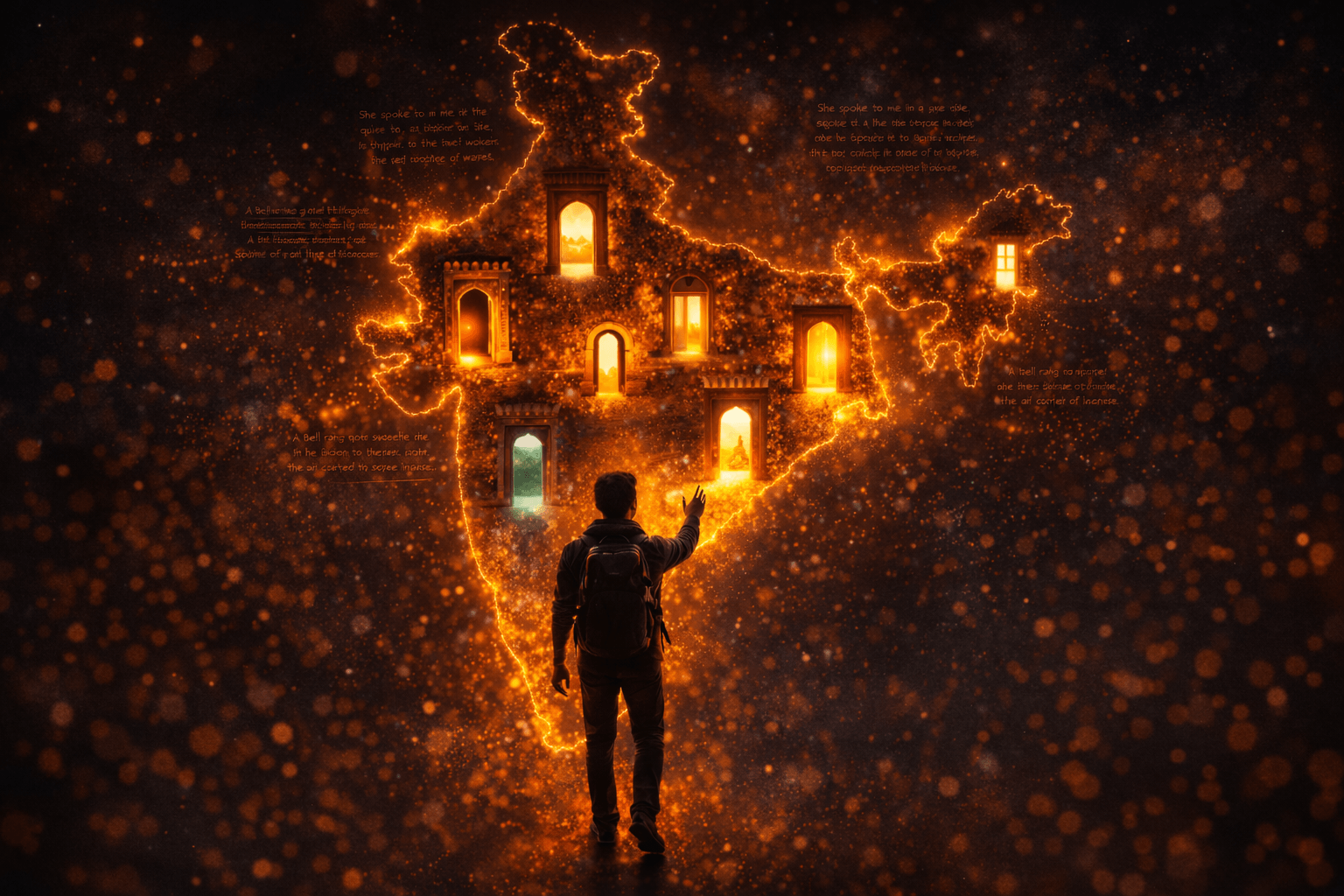
Some books you read. Others take you somewhere. They don't just describe a mountain pass or a crowded railway platform — they put you there. You feel the altitude in your lungs. You smell the chai before it appears on the page. You hear the temple bell at dawn and suddenly you're no longer sitting in your room. You're standing in a place you've never been, feeling something you didn't expect.
That's what the best Indian travelogues do. They don't give you itineraries. They give you India — in all its chaos and calm, its contradictions and kindness, its dust and its divinity. They take a subcontinent that's impossible to summarise and somehow make you feel like you understand a small, true piece of it.
Whether you've travelled across India a dozen times or have never set foot on its soil, these ten travelogue books about India will change how you see the country — and perhaps how you see travel itself.
What Makes Indian Travel Writing Unlike Anything Else
India doesn't let you write about it casually. The landscape shifts every few hundred kilometres — from Himalayan glaciers to Kerala backwaters, from Rajasthan's deserts to Assam's tea gardens. The languages change. The food changes. The gods change. And yet something holds it all together — a thread that every Indian travelogue tries to trace but none can fully unravel.
The best Indian travelogue books don't just describe destinations. They explore the emotional layers underneath. They ask: what does it mean to stand in a temple that's been prayed in for a thousand years? What happens to a person when they ride a train across an entire subcontinent? How does a city like Mumbai hold twenty million individual stories without collapsing?
Indian travel writing, at its finest, isn't about geography. It's about transformation — the kind that happens to you when you stop planning and start paying attention.
The 10 Best Indian Travelogues You Should Read
1. The Great Railway Bazaar — Paul Theroux
Journey: London to Asia and back, with extensive Indian rail sections
Paul Theroux boarded a train in London and didn't stop until he'd crossed Asia. The Indian sections of this travelogue are extraordinary — not because of the destinations, but because of the people he meets in cramped compartments. Tea sellers, fortune tellers, retired colonels, young students heading to universities they've never seen. Theroux writes about India's railways the way a musician writes about rhythm — it's not about where the train goes, but what happens inside it while it moves. If you've ever sat on an Indian train and watched the landscape change while a stranger shared their life story with you, this book will feel like a mirror.
2. City of Djinns — William Dalrymple
Journey: One year living in Delhi
William Dalrymple moved to Delhi and spent a year peeling back its layers — Mughal ruins beneath modern flyovers, Partition memories beneath cheerful markets, ancient djinn legends beneath the concrete of a rapidly modernising capital. This isn't a tourist's account of Delhi. It's a love letter written by someone who understood that every street in this city carries centuries on its shoulders. Dalrymple is one of the most famous Indian travel writers (by adoption, at least), and this book shows why. He makes you feel that Delhi isn't a city — it's an archaeological dig of emotions, and every layer reveals something you weren't expecting.
3. Maximum City: Bombay Lost and Found — Suketu Mehta
Journey: Returning to Mumbai after decades abroad
Suketu Mehta came back to the city he'd left as a teenager and found it had become something monstrous and magnificent. This travelogue is Mumbai at full volume — the underworld, the film industry, the bar dancers, the diamond traders, the people who sleep on footpaths and wake up with ambition that would exhaust a Fortune 500 CEO. It's not a comfortable read. It's an overwhelming one. And that's the point. Mumbai doesn't do comfort. It does survival, ambition, and a strange, relentless love. This is the Indian travelogue that shows you a city's soul with the lights on and the curtains open.
Have you ever returned to a place from your childhood and found it completely transformed — yet somehow still holding the same feeling?
4. Slowly Down the Ganges — Eric Newby
Journey: Tracing the Ganges from Hardwar to the Bay of Bengal
Eric Newby and his wife set out to follow the Ganges from the foothills to the sea. The journey is absurd, uncomfortable, funny, and profoundly moving — sometimes all on the same page. Newby writes about India with the bewildered affection of someone who doesn't fully understand it but loves it anyway. The river in this travelogue is more than a geographical feature. It's a living character — patient, ancient, and carrying the prayers and pollution of an entire civilisation on its back. You finish this book understanding not just the Ganges but the idea that some journeys are defined by the path itself, not the destination.
5. Nine Lives — William Dalrymple
Journey: Spiritual India — nine portraits across the subcontinent
Nine people. Nine forms of devotion. A Jain nun who fasted for months. A Theyyam dancer in Kerala who becomes a god on stage. A Tibetan monk in exile. A devadasi singer. Dalrymple lets each person tell their own story, and the result is one of the most powerful explorations of Indian spirituality ever written. This isn't about temples or rituals. It's about what faith costs — the sacrifices, the ecstasy, the loneliness, and the transcendence. If you've ever wondered what it means when India is called "spiritual," this book replaces the cliché with nine deeply human truths.
6. Chai, Chai — Bishwanath Ghosh
Journey: Small-town India through railway junctions
While most Indian travelogue books focus on famous cities or remote wildernesses, Bishwanath Ghosh went to the places in between — the railway junction towns that exist because a train stops there. Towns like Mughal Sarai, Itarsi, Jhansi. Places travellers pass through but never visit. Ghosh visited them. He ate at their platform stalls, walked their dusty streets, talked to their stationmasters and shopkeepers. The result is a travelogue that celebrates the ordinary — and in doing so, reveals the extraordinary pulse of small-town India that most of us never see.
7. An Area of Darkness — V.S. Naipaul
Journey: A year traveling across India — first encounter with ancestral homeland
This is not a kind book. V.S. Naipaul, born in Trinidad to a family of Indian origin, came to India expecting to find belonging and instead found frustration, confusion, and a country that didn't match the version he'd inherited through stories. The travelogue is uncomfortable reading — Naipaul's gaze is sharp, sometimes harsh, often unfair. But there's an honesty here that's rare in Indian travel writing. He writes about the gap between expectation and reality, between the India of imagination and the India of experience. You don't have to agree with Naipaul to learn from him. Sometimes the most valuable travelogues are the ones that challenge you.
Which part of India would you want to experience through someone else's eyes? The mountains? The coast? The small towns nobody writes about?
8. Following Fish — Samanth Subramanian
Journey: India's coastline — through its fishing communities
Samanth Subramanian followed fish. Literally. He traced the fishing communities along India's vast coastline — from Mangalore's fish markets to Kerala's toddy shops to Bengal's hilsa obsession. Each chapter is a different coast, a different fish, a different culture built around the sea. The genius of this travelogue is its lens: by following a single thread (fish, in this case), Subramanian reveals the astonishing diversity of coastal India. You learn about caste, religion, economics, and ecology — all through the story of what people catch, cook, and eat. It's one of the freshest Indian travelogue books of the last two decades.
9. The Elephant, the Tiger, and the Cellphone — Shashi Tharoor
Journey: Modern India — culture, politics, identity, and change
Shashi Tharoor writes about India not as a traveller passing through but as someone deeply embedded in its contradictions. This collection of essays is a travelogue of ideas — journeys through India's relationship with democracy, Bollywood, cricket, caste, language, and modernity. It's the book you read when you want to understand not where India is, but what India is. Tharoor writes with wit and warmth, and he doesn't shy away from the messy, glorious complications of being Indian in the twenty-first century. It's travel writing for the mind.
10. Land of the Seven Rivers — Sanjeev Sanyal
Journey: India's geography as living history — from the Saraswati to the modern coastline
Sanjeev Sanyal traces India's history not through kings and empires but through its geography — its rivers, coastlines, trade routes, and shifting landscapes. The result is a travelogue through time. You follow ancient merchants down the Deccan plateau, stand on the shores where Roman ships once anchored, and watch the Saraswati river disappear into legend. What makes this book remarkable is how it connects landscape to memory. Every mountain pass, every river confluence, every coastal town in India carries a story that's older than any monument. Sanyal reveals those stories with the enthusiasm of someone who genuinely loves the land beneath his feet.
Why Indian Travelogues Still Matter
In an age of Instagram reels and thirty-second travel clips, you might wonder whether long-form Indian travel writing still has a place. It does. More than ever. Because a reel shows you a sunset. A travelogue makes you feel why that sunset mattered to the person watching it.
The best Indian travelogues aren't records of where someone went. They're records of how someone changed. They capture the moment a traveller realised that India wasn't what they expected — and that the surprise was the gift. They preserve conversations with strangers on trains, the taste of dal at a roadside dhaba at two in the morning, the silence of a Himalayan pass that makes you forget you have a name.
These are things no algorithm can recommend. No map can show. No five-star review can capture. They live only in stories — and travelogues are where those stories breathe.
The Next Chapter: Your Own Indian Travelogue
Here's the beautiful thing about Indian travel writing: it's not finished. The ten books on this list opened doors. But the country is vast enough, complex enough, and alive enough that there are thousands of travelogues still waiting to be written. Maybe by you.
Today, travelogues don't have to live only in published books. Modern travellers are creating their own Indian travelogues in digital formats — turning their photos, reflections, and experiences into stories that preserve the emotional texture of their journeys. Platforms like Pinaak are built around this idea: that every journey through India, no matter how short or how local, deserves to be remembered not as a photo dump but as a meaningful travelogue.
You don't need to ride a train across the subcontinent or follow a river to the sea. You just need to travel with your eyes open and write down what you feel. That's how every travelogue on this list began — not with a publishing deal, but with a journey and the honest desire to remember it properly.
What would your Indian travelogue be about? The hills you visited as a child? The city you moved to for work? The road trip you took with friends that changed everything?
Frequently Asked Questions
What are the best Indian travelogues to read?
Some of the best Indian travelogues include "The Great Railway Bazaar" by Paul Theroux, "City of Djinns" by William Dalrymple, "Maximum City" by Suketu Mehta, "Slowly Down the Ganges" by Eric Newby, "Nine Lives" by William Dalrymple, "Chai, Chai" by Bishwanath Ghosh, and "Following Fish" by Samanth Subramanian. These books cover everything from Himalayan journeys to coastal explorations to spiritual pilgrimages across India.
Who are the most famous Indian travel writers?
Famous Indian travel writers and writers about India include William Dalrymple, Suketu Mehta, Bishwanath Ghosh, Samanth Subramanian, Sanjeev Sanyal, Shashi Tharoor, and Ruskin Bond. International writers like Paul Theroux, Eric Newby, and V.S. Naipaul have also written iconic travelogues that shaped how the world understands Indian culture, landscapes, and people.
What makes Indian travelogues different from other travel writing?
Indian travelogues stand apart because India itself is extraordinarily diverse — in landscape, language, culture, and spirituality. The best Indian travelogue books don't just describe places; they explore the emotional and philosophical layers of traveling through India, capturing sensory richness, cultural complexity, spiritual depth, and personal transformation.
Can I write my own Indian travelogue?
Absolutely. You don't need to be a professional writer to create a meaningful Indian travelogue. Focus on personal observations, emotional responses, sensory details, and honest reflections from your journeys. Modern platforms like Pinaak make it easy to turn your travel photos and memories into lasting digital travelogues.
Are there good travelogue books about specific regions of India?
Yes. "City of Djinns" focuses on Delhi, "Maximum City" on Mumbai, "Chai, Chai" on Indian railway junction towns, "Following Fish" on India's coastal communities, "Slowly Down the Ganges" traces the river from source to sea, and "Nine Lives" explores spiritual communities across the subcontinent. Each offers deep, immersive coverage of specific Indian regions and cultures.
Reading India, One Journey at a Time
India is a country that resists being understood quickly. It reveals itself slowly — through conversations, through meals shared with strangers, through the sudden silence of a mountain morning or the overwhelming roar of a city at rush hour. You can visit India and see its surface. Or you can read about it and feel its depth.
The ten travelogues on this list do something that guidebooks and travel blogs rarely achieve. They let you experience India beyond geography — through its people, its contradictions, its spiritual intensity, and its stubborn, beautiful refusal to be simple. They help you understand not just where India is, but what it means to travel through it with honesty and attention.
So read them. Start with whichever title called to you. Let it take you somewhere. And when you're done — when the last page has settled — consider this: the next great Indian travelogue doesn't have to come from a famous writer. It could come from you. From your next journey. From the observations you make, the people you meet, and the moments you choose to remember.
Because every Indian travelogue ever written began the same way — not with a plan to write a book, but with a journey that refused to be forgotten.
Ready to start writing your own Travelogue?
Pinaak is where travelers share real stories, connect with a community of explorers, and turn their journeys into something lasting. Your next trip deserves more than a photo album — give it a voice.

Keep Reading
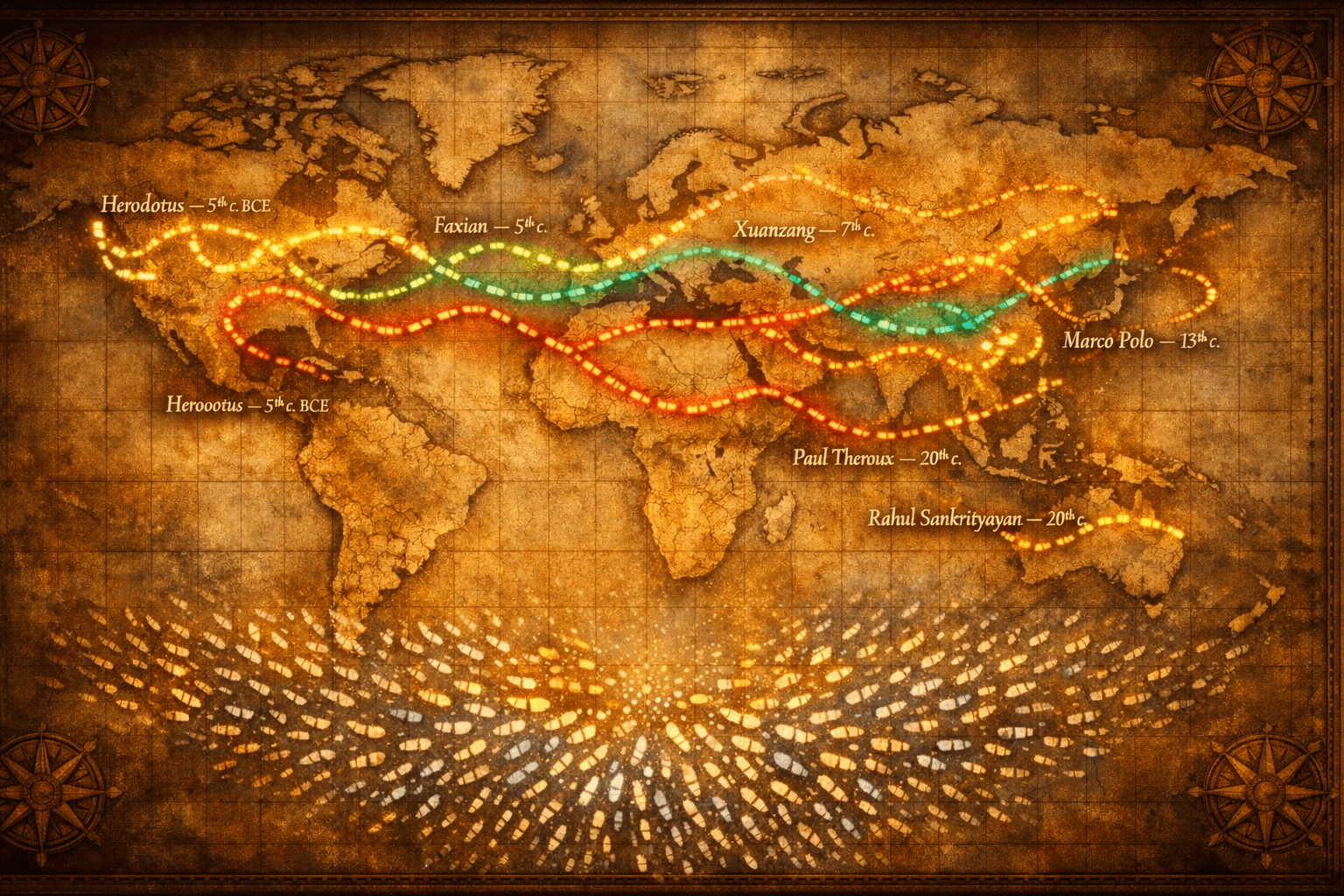
Greatest Travelogue Writers: Herodotus to Today
Explore travelogue writing history — from Herodotus and Ibn Battuta to modern digital storytellers. Discover the greatest writers and join their tradition.
How to Write a Travelogue: A Beginner's Guide
Learn how to write a travelogue with this beginner-friendly step-by-step guide. Includes travelogue format, structure, writing tips, real examples, and FAQs.